
Hashing and digital signatures are two of the most important concepts in modern cybersecurity. They help protect data, verify authenticity, and make sure digital files, messages, and documents have not been altered.
If you want to understand how passwords are protected, how secure documents are signed, or how systems prove that data is genuine, then learning hashing and digital signatures is the right place to start. These two tools are used every day in websites, apps, banking systems, software updates, and secure communication
by:maryam
Introduction
Hashing and digital signatures are fundamental to digital trust. They solve two of the biggest problems in cybersecurity: how to detect tampering and how to prove that information really came from the right source.
As more of our lives move online, these concepts matter more than ever. Whether you are checking a downloaded file, protecting a password, or verifying a signed contract, hashing and digital signatures help keep the digital world trustworthy
Table of Contents
- What Hashing Means
- What Is a Cryptographic Hash Function?
- Why Hashing Matters
- Common Hashing Algorithms
- What Digital Signatures Mean
- How Digital Signatures Work
- Hashing and Digital Signatures Together
- Real-World Uses
- Password Hashing
- SHA-256 and Modern Security
- Hashing vs Encryption
- Mistakes Beginners Should Avoid
- People Also Ask
- Frequently Asked Questions
- Key Takeaways
- Conclusion
What Hashing Means
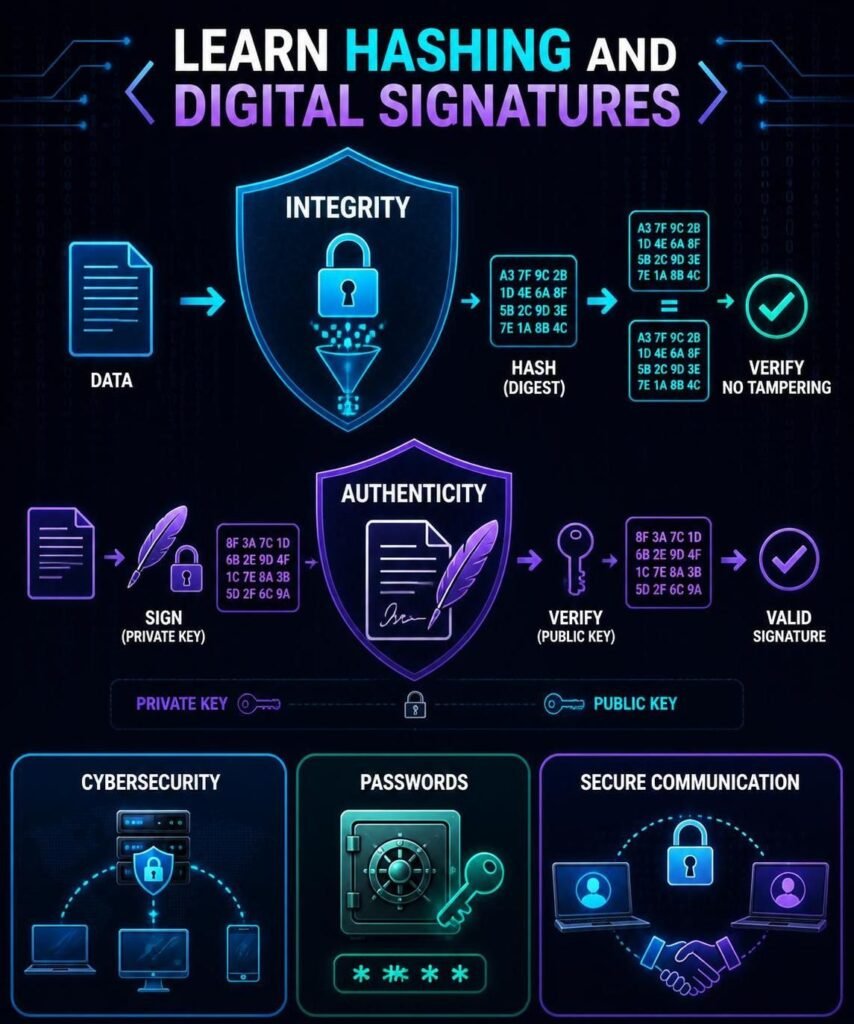
Hashing is the process of taking data of any size and turning it into a fixed-length value called a hash. This hash acts like a digital fingerprint for the original data
The most important thing to understand is that hashing is one-way. That means you can create a hash from data, but you should not be able to reverse the hash and recover the original data
This makes hashing extremely useful for checking whether data has changed. If even one letter, number, or symbol changes in the original file, the hash will also change
What Is a Cryptographic Hash Function?
A cryptographic hash function is a special kind of hashing algorithm designed for security. It takes input data and produces a unique output that is:
- Fixed in length.
- Hard to predict.
- Very difficult to reverse.
- Sensitive to even small changes.
For example, if you change just one character in a document, the hash value will look completely different. That is why hashing is so useful for data integrity and file verification.
A good cryptographic hash function should be:
- Deterministic, meaning the same input always produces the same hash.
- Fast to compute.
- One-way.
- Resistant to collisions.
- Secure against tampering.
Why Hashing Matters
Hashing matters because it helps confirm that data has not been altered. This is important in many different situations.
For example:
- A software download can be checked with a hash to confirm it was not tampered with.
- A password can be stored as a hash instead of plain text
- A message can be hashed before being digitally signed.
- A file can be verified after transfer.
Without hashing, it would be much harder to trust digital data. Hashing is one of the simplest but most powerful tools in cybersecurity
Common Hashing Algorithms
There are several hashing algorithms used in security, but not all of them are equally safe today.
SHA-256
SHA-256 is one of the most widely used cryptographic hash functions. It is part of the SHA-2 family and is commonly used in cybersecurity, blockchain, and software verification
SHA-3
SHA-3 is a newer hash standard designed to provide a different internal structure than SHA-2. It is used less often in everyday systems, but it is an important modern option
MD5
MD5 was once popular, but it is no longer secure for most modern security purposes because it is vulnerable to collisions
SHA-1
SHA-1 is also considered outdated and should not be used for security-critical tasks.
If you are working with modern cybersecurity systems, SHA-256 is one of the most common terms you will see
What Digital Signatures Mean
A digital signature is a cryptographic method used to prove that a message, document, or file came from a specific person or system and has not been changed
A digital signature is not the same thing as a handwritten signature. It is much stronger because it can verify both:
- Authenticity: who sent it
- Integrity: whether the content changed.
Digital signatures are used in contracts, software updates, secure email, financial systems, and identity verification
How Digital Signatures Work
Digital signatures use public key cryptography, which means they rely on a pair of keys:
- A private key, which is kept secret.
- A public key, which can be shared with others
Here is the basic process:
- The sender creates a hash of the document or message.
- That hash is encrypted with the sender’s private key
- The encrypted hash becomes the digital signature
- The recipient uses the sender’s public key to verify the signature.
- The recipient also creates a fresh hash of the received document
- If the two hashes match, the signature is valid.
This process proves that the document has not been altered and that it came from the correct sender
Hashing and Digital Signatures Together
Hashing and digital signatures work together closely
A digital signature usually does not sign the entire document directly. Instead, it signs the hash of the document. This is much faster and more efficient than signing large amounts of data
This combination gives you three important security benefits:
- Integrity: the document has not been changed.
- Authenticity: the sender is verified
- Non-repudiation: the sender cannot easily deny signing it
That is why hashing and digital signatures are a core part of modern trust systems.
Real-World Uses
You encounter hashing and digital signatures more often than you may realize.
Common real-world uses include:
- Checking whether a downloaded file was modified.
- Protecting passwords in a database.
- Signing software updates.
- Verifying emails and documents.
- Securing online transactions.
- Supporting blockchain systems.
- Protecting cloud-based services.
These tools are used across business, government, finance, and consumer technology.
Password Hashing
Password hashing is one of the most important applications of hashing in cybersecurity.
Instead of storing a password as plain text, systems store a hash of the password. When a user logs in, the system hashes the entered password and compares it with the stored hash.
To make password hashing more secure, systems often use a salt. A salt is random data added before hashing. This helps prevent attackers from using precomputed tables and makes identical passwords produce different stored values.
Good password security usually includes:
- Password hashing.
- Salting.
- Slow hashing algorithms.
- Multi-factor authentication.
This is why hashing is so important in protecting user accounts.
SHA-256 and Modern Security
SHA-256 is one of the best-known hashing algorithms in current use. It is widely trusted because it produces a strong fixed-length hash and is used in many security systems.
You may see SHA-256 in:
- File verification.
- Certificate systems.
- Blockchain networks.
- Data integrity checks.
- Security tools.
When people search for SHA-256 hashing, they are usually looking for a safe, modern cryptographic hash function that can be used in real-world security environments.
Hashing vs Encryption
People often confuse hashing and encryption, but they are not the same.
Hashing
- One-way process.
- Used for integrity and verification.
- Cannot be reversed into the original data.
Encryption
- Two-way process
- Used for confidentiality.
- Can be decrypted with the right key
A simple way to think about it:
- Hashing tells you whether data changed.
- Encryption hides data from unauthorized people
Both are useful, but they solve different problems.
Mistakes Beginners Should Avoid
When learning about hashing and digital signatures, beginners often make a few common mistakes
Using Weak Algorithms
MD5 and SHA-1 should not be used for security-critical systems.
Confusing Hashing with Encryption
Hashing is not meant to hide data. It is meant to verify data
Ignoring Salting
Without salting, password hashes are easier to attack
Mismanaging Private Keys
If the private key used for a digital signature is stolen, trust is broken.
Assuming Hashes Prove Identity
A hash alone does not prove who crated the data. That is why digital signatures are needed
Avoiding these mistakes helps you understand the difference between basic data checking and real digital trust.
Comparison Table
| Feature | Hashing | Digital Signatures |
|---|---|---|
| Main Purpose | Data integrity | Authenticity and integrity |
| Can It Be Reversed? | No | No |
| Uses Keys? | No | Yes, public and private keys |
| Verifies Sender? | No | Yes |
| Detects Tampering? | Yes | Yes |
| Common Use | Passwords, file checks | Contracts, software, secure messages |
This table shows why hashing and digital signatures are related but not identical. They solve different parts of the security problem

People Also Ask
What is hashing in cybersecurity?
Hashing in cybersecurity is the process of converting data into a fixed-size value to verify integrity, protect passwords, and detect tampering
What is a digital signature?
A digital signature is a cryptographic proof that a message or document came from a specific sender and was not changed
Is hashing the same as encryption?
No. Hashing is one-way and used for verification. Encryption is reversible and used for confidentiality
Why are digital signatures important?
They help prove who sent something and whether it was altered
Which hashing algorithm is most used today?
SHA-256 is one of the most widely used secure hashing algorithms
Can a hash be decrypted?
No. A cryptographic hash is designed to be one-way
Frequently Asked Questions
What is the difference between hashing and digital signatures?
Hashing creates a fixed-length fingerprint of data, while digital signatures use hashing plus public key cryptography to prove authenticity and integrity
Why is hashing important?
Hashing is important because it helps detect data changes, protect passwords, and verify file integrity
How do digital signatures protect documents?
They allow recipients to verify that the document has not changed and came from the correct sender
Can digital signatures be forged?
Strong digital signatures are extremely difficult to forge if the private key is protected properly
What is a hash value?
A hash value is the fixed-length result produced by a hashing algorithm
What is salting in password hashing?
Salting means adding random data before hashing a password to make attacks harder
Is SHA-256 secure?
SHA-256 is considered secure for many modern uses and is widely trusted in cybersecurity.
Why not use MD5?
MD5 is too weak for modern security because collisions can be created more easily
Do digital signatures use hashing?
Yes. They usually sign the hash of the data, not the full data itself
Where are hashing and digital signatures used?
They are used in software updates, password protection, secure messaging, file verification, email security, and financial systems
Key Takeaways
- Hashing turns data into a fixed-length value called a hash.
- A cryptographic hash function helps verify integrity and detect tampering
- Digital signatures use hashing and public key cryptography together
- Hashing does not prove identity, but digital signatures can.
- Passwords should be stored with hashing and salting, not plain text
- SHA-256 is one of the most common modern hashing algorithms
- Hashing and digital signatures are essential for digital trust and cybersecurity
Conclusion
Hashing and digital signatures are core building blocks of modern cybersecurity Hashing helps verify that data has not changed, while digital signatures help prove who created or approved that data.
Together, they make digital systems more trustworthy, from password storage and file verification to secure documents and online transactions. If you want to understand how digital trust works, learning hashing and digital signatures is one of the best places to start