
Symmetric encryption is one of the most important concepts in modern cybersecurity. It is the method used to protect data in everything from online banking and secure messaging to cloud storage and password protection.
If you want to understand how symmetric encryption works, this guide explains what it is, how it protects data, where it is used, and why it remains essential in the digital age
Table of Contents
- What Is Symmetric Encryption?
- How Symmetric Encryption Works
- Types of Symmetric Encryption
- Common Symmetric Encryption Algorithms
- Symmetric vs. Asymmetric Encryption
- Real-World Uses of Symmetric Encryption
- Advantages of Symmetric Encryption
- Disadvantages of Symmetric Encryption
- How to Use Symmetric Encryption Safely
- Common Mistakes to Avoid
- People Also Ask
- Frequently Asked Questions
- Key Takeaways
- Conclusion
What Is Symmetric Encryption?
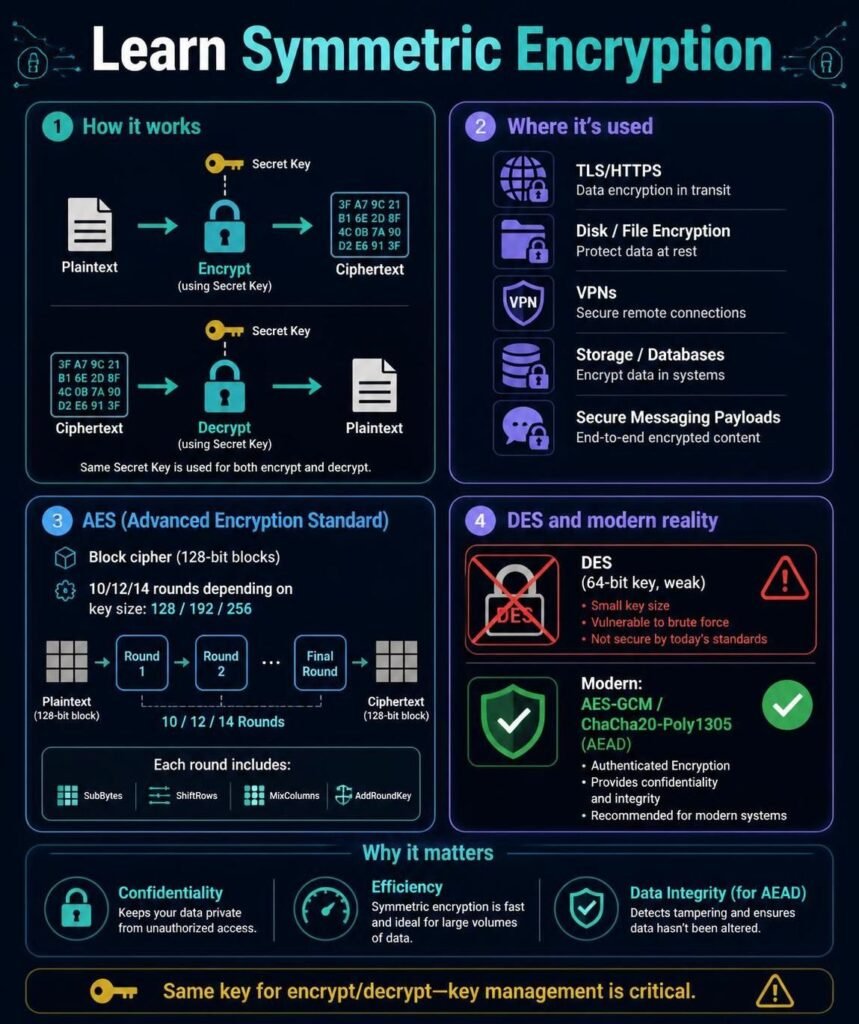
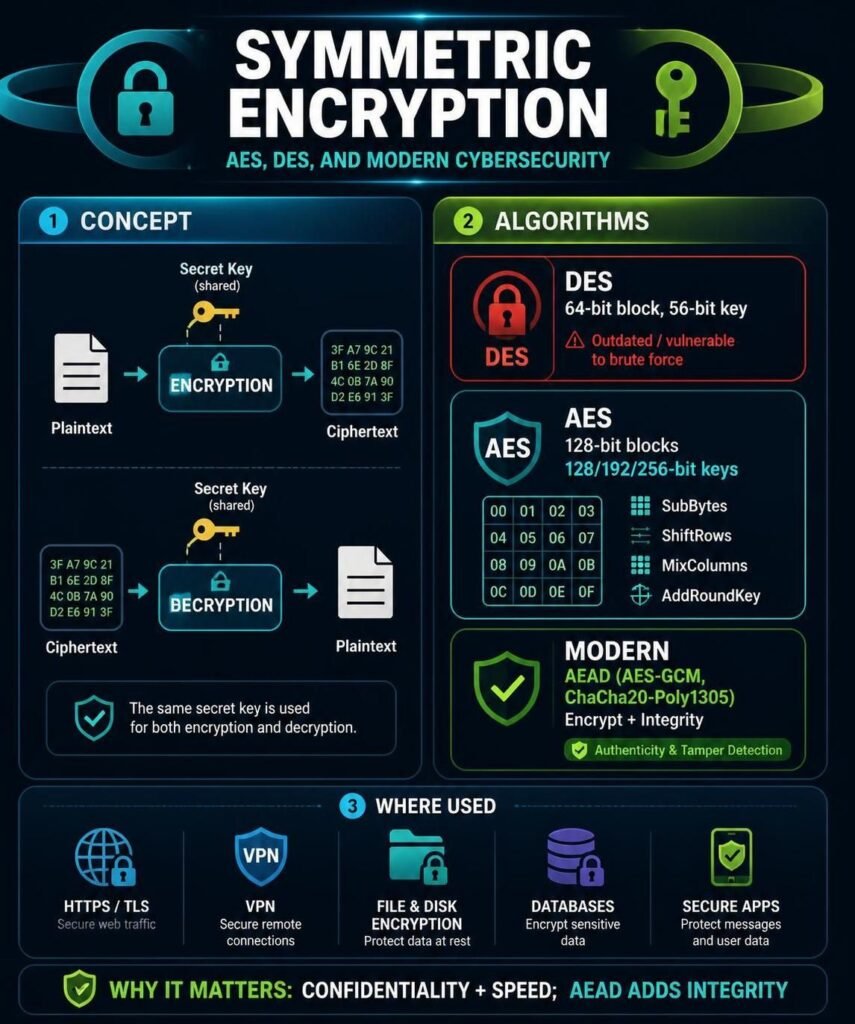
Symmetric encryption is a type of encryption that uses a single key to both encrypt and decrypt data. This means the same secret key is used by the sender to lock the data and by the receiver to unlock it
In simple terms, symmetric encryption is like a locked box. Both the sender and receiver have the same key. The sender puts the message in the box and locks it. The receiver uses the same key to open the box and read the message
Symmetric encryption is also known as secret-key encryption or private-key encryption. It is one of the oldest and most widely used forms of cryptography
How Symmetric Encryption Works
Symmetric encryption works in three main steps:
1. Encryption
The sender takes the original data (called plaintext) and uses a symmetric key to transform it into unreadable data (called ciphertext
2. Transmission
The ciphertext is sent over a network (like the internet) to the receiver. Even if someone intercepts the data, they cannot read it without the key
3. Decryption
The receiver uses the same symmetric key to transform the ciphertext back into plaintext.
This process ensures that only people with the correct key can read the data
Types of Symmetric Encryption
There are two main types of symmetric encryption
1. Block Ciphers
Block ciphers encrypt data in fixed-size blocks (like 64-bit or 128-bit chunks). Each block is encrypted separately.
Examples:
- AES (Advanced Encryption Standard)
- DES (Data Encryption Standard)
- 3DES (Triple DES)
- Blowfish
Use cases:
- File encryption
- Database encryption
- Disk encryption
2. Stream Ciphers
Stream ciphers encrypt data one bit or byte at a time. They are faster and better for real-time communication
Examples:
- RC4
- Salsa20
- ChaCha20
Use cases:
- Streaming video (like Zoom or Discord)
- Secure messaging
- Real-time data transfer
Common Symmetric Encryption Algorithms
Here are the most common symmetric encryption algorithms used today:
1. AES (Advanced Encryption Standard)
- Key size: 128, 192, or 256 bits
- Security: Very strong
- Use: Government, military, banks, and businesses
- Status: Most widely used symmetric algorithm in the world
2. DES (Data Encryption Standard)
- Key size: 56 bits
- Security: Weak (broken in 1999)
- Use: Legacy systems
- Status: Deprecated, should not be used
3. 3DES (Triple DES)
- Key size: 168 bits
- Security: Moderate
- Use: Payment systems, legacy applications
- Status: Being phased out
4. Blowfish
- Key size: Up to 448 bits
- Security: Strong
- Use: File encryption, password hashing
- Status: Still used, but less common than AES
5. ChaCha20
- Key size: 256 bits
- Security: Very strong
- Use: Mobile devices secure messaging
- Status: Growing in popularity
Symmetric vs. Asymmetric Encryption
Symmetric encryption is not the only type of encryption. There is also asymmetric encryption (public-key encryption Here is how they compare:
| Feature | Symmetric Encryption | Asymmetric Encryption |
|---|---|---|
| Number of Keys | One key (shared) | Two keys (public and private) |
| Speed | Fast | Slow |
| Security | Strong (if key is protected) | Strong (mathematically secure) |
| Key Distribution | Difficult (need to share key securely) | Easy (public key can be shared) |
| Use Cases | Data encryption, file storage | Key exchange, digital signatures |
| Algorithms | AES, DES, 3DES, Blowfish | RSA, ECC, Diffie-Hellman |
Key difference:
- Symmetric encryption uses one key for both encryption and decryption.
- Asymmetric encryption uses two keys: one for encryption and one for decryption.
Real-World Uses of Symmetric Encryption
Symmetric encryption is used in almost every part of modern technology:
1. Online Banking
Banks use symmetric encryption to protect:
- Customer data in databases.
- Transactions between servers.
- Mobile banking apps.
2. Secure Messaging
Apps like WhatsApp, Signal, and Telegram use symmetric encryption to:
- Encrypt messages after a secure key exchange.
- Protect voice and video calls.
3. Cloud Storage
Services like Google Drive, Dropbox, and OneDrive use symmetric encryption to:
- Encrypt files stored on servers.
- Protect data during upload and download
4. Wi-Fi Security
Wi-Fi networks use symmetric encryption (like WPA2 or WPA3) to:
- Protect data transmitted over the network.
- Prevent unauthorized access.
5. Full Disk Encryption
Operating systems like Windows (BitLocker) and macOS FileVault use symmetric encryption to:
- Encrypt entire hard drives.
- Protect data if the device is stolen.
6. VPNs
Virtual Private Networks (VPNs use symmetric encryption to:
- Encrypt all internet traffic.
- Protect privacy and anonymity.
7. Database Encryption
Companies use symmetric encryption to:
- Protect customer data in databases.
- Comply with regulations like GDPR and HIPAA.
Advantages of Symmetric Encryption
Symmetric encryption has several important advantages:
1. Fast and Efficient
Symmetric encryption is much faster than asymmetric encryption. This makes it ideal for encrypting large amounts of data.
2. Strong Security
When used with strong algorithms (like AES-256), symmetric encryption provides excellent security.
3. Low Computational Cost
Symmetric encryption requires less processing power, making it suitable for mobile devices and embedded systems.
4. Widely Supported
Almost all modern systems, software, and hardware support symmetric encryption.
5. Simple to Implement
Symmetric encryption is easier to implement than asymmetric encryption, especially for beginners.
Disadvantages of Symmetric Encryption
Despite its advantages, symmetric encryption has some limitations:
1. Key Distribution Problem
The biggest challenge is sharing the secret key securely. If the key is intercepted, the encryption is broken.
2. Key Management
Managing multiple keys for different users or systems can become complex.
3. No Built-In Authentication
Symmetric encryption does not prove who sent the message. It only protects the data.
4. Vulnerable to Key Theft
If the key is stolen or leaked, all encrypted data is at risk
How to Use Symmetric Encryption Safely
To use symmetric encryption safely, follow these best practices:
1. Use Strong Algorithms
- Use: AES-256, ChaCha20
- Avoid: DES, 3DES, RC4
2. Protect the Key
- Store keys in a secure location (like a hardware security module or key vault).
- Never share keys over unencrypted channels
3. Rotate Keys Regularly
- Change keys periodically to reduce the risk of compromise.
- Use automated key rotation tools
4. Use Hybrid Systems
- Combine symmetric encryption with asymmetric encryption for key exchange.
- This solves the key distribution problem
5. Follow Standards
- Use NIST-approved algorithms.
- Follow industry best practices (like PCI DSS, GDPR, HIPAA).
Common Mistakes to Avoid
When using symmetric encryption, avoid these common mistakes:
1. Using Weak Algorithms
- Mistake: Using DES or RC4.
- Solution: Use AES-256 or ChaCha20
2. Storing Keys in Plain Text
- Mistake: Saving keys in a text file or email
- Solution: Use a key management system or hardware security module.
3. Not Rotating Keys
- Mistake: Using the same key for years.
- Solution: Rotate keys every 90 days or less.l
4. Sharing Keys Over Insecure Channels
- Mistake: Sending keys via email or chat.
- Solution: Use secure key exchange protocols (like Diffie-Hellman).
5. Ignoring Updates
- Mistake: Using outdated software or libraries.
- Solution: Keep cryptographic libraries and software up to date
People Also Ask
What is symmetric encryption?
Symmetric encryption is a type of encryption that uses one key to both encrypt and decrypt data
How does symmetric encryption work?
It uses a single secret key to transform plaintext into ciphertext and back.
What is the most common symmetric encryption algorithm?
AES (Advanced Encryption Standard) is the most widely used symmetric algorithm
Is symmetric encryption secure?
Yes, if strong algorithms (like AES-256) and proper key management are used
What is the difference between symmetric and asymmetric encryption?
Symmetric encryption uses one key, while asymmetric encryption uses two keys (public and private)
Where is symmetric encryption used?
It is used in online banking, secure messaging, cloud storage, Wi-Fi security, and more.
What are the disadvantages of symmetric encryption?
The main disadvantage is the key distribution problem (sharing the key securely)
Can symmetric encryption be broken?
Yes, if weak algorithms are used or keys are stolen.
Frequently Asked Questions
What is symmetric encryption?
Symmetric encryption is a cryptographic method that uses a single key for both encryption and decryption
How does symmetric encryption differ from asymmetric encryption?
Symmetric encryption uses one shared key, while asymmetric encryption uses a public-private key pair.
What are the most common symmetric encryption algorithms?
AES, DES, 3DES, Blowfish, and ChaCha20 are the most common.
Is AES symmetric or asymmetric?
AES is a symmetric encryption algorithm.
Why is symmetric encryption faster than asymmetric encryption?
Because it uses simpler mathematical operations and one key instead of two.
What is the key distribution problem in symmetric encryption?
It is the challenge of securely sharing the secret key between parties.
Can symmetric encryption be used for digital signatures?
No, digital signatures require asymmetric encryption.
What is the best symmetric encryption algorithm?
AES-256 is considered the best and most secure symmetric algorithm.
How do I protect symmetric keys?
Use hardware security modules, key vaults, and secure key exchange protocols.
Should I use symmetric or asymmetric encryption?
Use symmetric encryption for data encryption and asymmetric encryption for key exchange and digital signatures.
Key Takeaways
- Symmetric encryption uses one key for both encryption and decryption.
- It is fast and efficient, making it ideal for large data.
- AES-256 is the most secure and widely used symmetric algorithm.
- It is used in online banking, messaging, cloud storage, and more.
- The key distribution problem is the main challenge.
- Use hybrid systems (symmetric + asymmetric) for best security.
- Avoid weak algorithms like DES and RC4.
- Protect keys with secure key management systems.
Conclusion
Symmetric encryption is a fundamental part of modern cybersecurity. It is fast, efficient, and secure when used correctly.
From protecting online transactions and securing messages to encrypting files and databases, symmetric encryption is used in almost every part of the digital world.
If you want to protect your data, understand how encryption works, and use strong algorithms like AES-256, you are already on the right path.
The future of symmetric encryption is bright, especially as new algorithms and standards continue to evolve. Start learning and using symmetric encryption today to keep your data safe.