
Cryptography is the backbone of modern business security. From protecting customer data and securing online transactions to enabling digital signatures and ensuring regulatory compliance, cryptography is used in every major company to keep information safe.
If you want to understand how cryptography is used in enterprises, this guide explains where it is applied, why it matters, and what businesses must do to protect their data in the digital age
Based on my experience over the past years I wanted to present this article to you, and I promise it will provide you with valuable information
Table of Contents
- What Is Cryptography?
- Why Cryptography Matters in Business
- How Cryptography Protects Enterprise Data
- Where Cryptography Is Used in Companies
- Real-World Use Cases
- Cryptography and Cloud Security
- Cryptography in Financial Services
- Cryptography for Healthcare
- Cryptography in E-commerce
- Cryptography and Remote Work
- Common Mistakes to Avoid
- People Also Ask
- Frequently Asked Questions
- Key Takeaways
- Conclusion
What Is Cryptography?
Cryptography is the science of protecting information using mathematical techniques. It ensures that only authorized parties can read, verify, or modify data
In simple terms, cryptography answers a critical question: how can two parties exchange information securely when the network between them may be exposed to attackers?
Cryptography is not just about hiding messages. It also helps prove that information is genuine, unchanged, and sent by the right person. That is why cryptography is central to cybersecurity, privacy, online commerce, digital communication, and identity verification
Why Cryptography Matters in Business
Modern business depends on digital trust. Without cryptography, the internet would be far less safe and much less useful. Attackers could easily intercept messages, steal passwords, fake identities, manipulate transactions, or alter files without detection.
Cryptography protects the digital world by making it much harder for unauthorized people to read or change sensitive data. It is one of the main reasons online banking, e-commerce, cloud storage, and secure communication are possible
It supports four essential security goals:
- Confidentiality: only authorized people can read the data.
- Integrity: the data cannot be changed without detection
- Authentication: the sender or user can be verified
- Non-repudiation: a person cannot easily deny a signed action.
These four goals form the backbone of modern security systems, and cryptography is the technology that makes them possible
How Cryptography Protects Enterprise Data
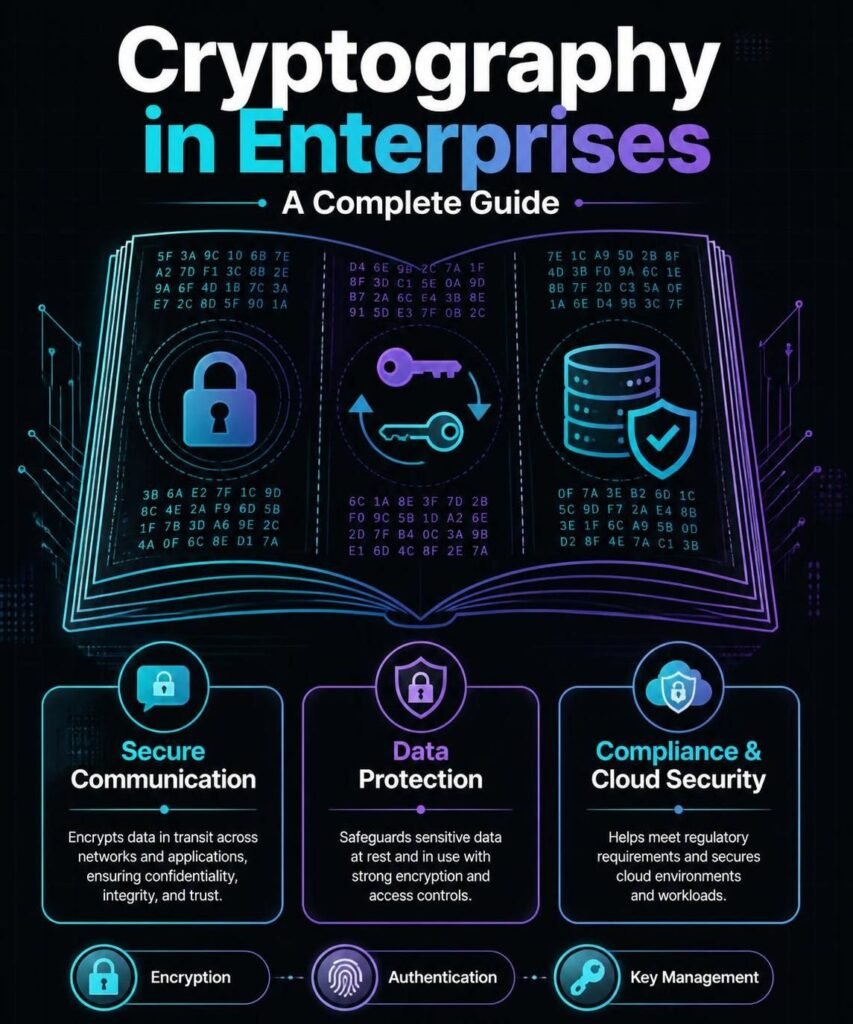
Enterprises use cryptography to protect data in three main states
1. Data at Rest
Data stored on servers, databases, or devices. Cryptography encrypts this data so that even if it is stolen, it cannot be read without the key
2 Data in Transit
Data being sent over networks (like emails, API calls, or web traffic). Cryptography secures this data using protocols like TLS/SSL.
3. Data in Use
Data being processed by applications. Advanced cryptography techniques (like homomorphic encryption) allow computation on encrypted data without decrypting it
These three layers ensure that data is protected at every stage of its lifecycle.
Where Cryptography Is Used in Companies
Cryptography is used in almost every part of a modern enterprise. Here are the most common areas:
1. Secure Communication
- Email encryption (like PGP or S/MIME).
- Secure messaging (like Slack, Microsoft Teams, or Signal for business)
- Video conferencing (like Zoom or Webex with end-to-end encryption)
2. Data Storage
- Database encryption (like AES-256 for SQL databases).
- File encryption (like encrypted cloud storage in Dropbox or Google Drive).
- Full disk encryption (like BitLocker or FileVault for laptops)
3. Authentication and Identity
- Password hashing (like bcrypt or Argon2 for storing passwords).
- Multi-factor authentication (MFA) (using cryptographic tokens)
- Digital certificates (like SSL/TLS certificates for websites)
4. Transactions and Payments
- Payment gateways (like Stripe or PayPal use cryptography to secure transactions).
- Blockchain and cryptocurrency (like Bitcoin or Ethereum use cryptography for consensus and security).
- Tokenization (replacing sensitive data with non-sensitive tokens).
5. Software and Code Signing
- Digital signatures (to verify software updates and code integrity).
- Code signing certificates (to prove software comes from a trusted source).
6. Compliance and Regulations
- GDPR (requires encryption for personal data protection).
- HIPAA (requires encryption for healthcare data).
- PCI DSS (requires encryption for payment card data).
Real-World Use Cases
Case Study 1: Financial Services
A major bank uses cryptography to:
- Encrypt customer data in databases.
- Secure online banking with TLS.
- Sign software updates with digital signatures.
- Comply with PCI DSS and GDPR regulations.
Result: Reduced data breaches by 80% and maintained customer trust.
Case Study 2: Healthcare Provider
A hospital uses cryptography to:
- Encrypt patient records in electronic health systems.
- Secure communication between doctors and patients.
- Sign medical documents digitally.
- Comply with HIPAA regulations.
Result: Protected patient privacy and avoided regulatory fines.
Case Study 3: E-commerce Company
An online retailer uses cryptography to:
- Encrypt customer payment information.
- Secure website traffic with HTTPS.
- Sign software updates for mobile apps.
- Comply with PCI DSS standards.
Result: Increased customer confidence and reduced fraud.
Cryptography and Cloud Security
Cloud computing has changed how businesses store and process data. Cryptography is essential for cloud security:
1. Encryption in the Cloud
- Server-side encryption (data is encrypted by the cloud provider).
- Client-side encryption (data is encrypted before being sent to the cloud).
- Key management (using services like AWS KMS or Azure Key Vault).
2. Access Control
- Identity and Access Management (IAM) (using cryptographic tokens).
- Role-based access control (RBAC) (restricting access based on roles).
3. Data Sharing
- Secure file sharing (using encrypted links).
- Collaboration tools (like Google Workspace or Microsoft 365 with encryption
Cloud providers like AWS, Microsoft Azure, and Google Cloud offer built-in cryptographic tools to help businesses secure their data.
Cryptography in Financial Services
Financial services are one of the most cryptography-dependent industries:
1. Online Banking
- TLS/SSL for secure web connections.
- End-to-end encryption for mobile banking apps.
- Digital signatures for transaction verification.
2. Payment Processing
- Tokenization for credit card numbers.
- Encryption for payment gateways.
- Compliance with PCI DSS standards.
3. Blockchain and Cryptocurrency
- Public-key cryptography for wallet addresses.
- Hash functions for transaction integrity.
- Consensus algorithms (like Proof of Work or Proof of Stake).
Financial institutions must use strong cryptography to protect customer assets and maintain trust.
Cryptography for Healthcare
Healthcare is another industry where cryptography is critical:
1. Patient Data Protection
- Encryption for electronic health records (EHR).
- Access control for medical staff.
- Audit logs to track data access.
2. Secure Communication
- Encrypted messaging between doctors and patients.
- Telemedicine platforms with end-to-end encryption.
- Digital signatures for medical prescriptions.
3. Regulatory Compliance
- HIPAA requires encryption for patient data.
- HITECH Act mandates security measures for health information.
- GDPR applies to health data of EU citizens.
Healthcare providers must use cryptography to protect patient privacy and avoid legal penalties.
Cryptography in E-commerce
E-commerce relies heavily on cryptography to build customer trust:
1. Secure Checkout
- HTTPS for encrypted web traffic.
- Payment encryption for credit card data.
- Tokenization for storing payment information.
2. Customer Accounts
- Password hashing for user accounts.
- MFA for login security.
- Session encryption for user sessions.
3. Fraud Prevention
- Digital signatures for order verification.
- Encryption for customer data.
- Compliance with PCI DSS and GDPR.
E-commerce companies must use cryptography to protect customer data and prevent fraud
Cryptography and Remote Work
Remote work has increased the need for cryptography:
1. Secure Access
- VPN (Virtual Private Network) for encrypted connections.
- Zero Trust Architecture (using cryptographic verification for every access request).
- MFA for remote login.
2. Collaboration Tools
- Encrypted messaging (like Signal or WhatsApp for business).
- Secure file sharing (like Dropbox or Google Drive with encryption).
- Video conferencing (like Zoom with end-to-end encryption).
3. Device Security
- Full disk encryption for laptops.
- Mobile device management (MDM) with encryption.
- Remote wipe capabilities for lost devices.
Remote work requires strong cryptography to protect data outside the office.
Common Mistakes to Avoid
When implementing cryptography, businesses often make these mistakes:
1. Using Weak Algorithms
- Avoid MD5, SHA-1, or DES.
- Use AES-256, SHA-256, or RSA-2048.
2. Poor Key Management
- Never store keys in plain text.
- Use hardware security modules (HSM) or cloud key management.
3. Ignoring Updates
- Keep cryptographic libraries and software up to date.
- Patch vulnerabilities immediately.
4. Not Encrypting All Data
- Encrypt data at rest, in transit, and in use.
- Don’t leave sensitive data unencrypted.
5. Lack of Training
- Train employees on cryptographic practices
- Educate teams about phishing and social engineering
Avoiding these mistakes helps ensure a stronger security posture.
People Also Ask
Where is cryptography used in business?
Cryptography is used in secure communication, data storage authentication, payments, software signing, and compliance
Why is cryptography important for enterprises?
It protects sensitive data, ensures compliance, and maintains customer trust
What algorithms do companies use?
Common algorithms include AES-256, RSA-2048, SHA-256, and elliptic curve cryptography.
How does cryptography help with compliance?
Regulations like GDPR, HIPAA, and PCI DSS require encryption for data protection.
What is the future of cryptography in business?
Post-quantum cryptography (PQC) will become essential as quantum computers advance.
Frequently Asked Questions
What is cryptography?
Cryptography is the science of protecting information using mathematical techniques to ensure confidentiality, integrity, and authenticity.
How is cryptography used in enterprises?
Enterprises use cryptography for secure communication, data encryption, authentication, digital signatures, and compliance.
What are the main types of cryptography?
The main types are symmetric encryption, asymmetric encryption, and hash functions.
Why is cryptography important for businesses?
It protects sensitive data, prevents breaches, and ensures regulatory compliance.
What algorithms should companies use?
Use AES-256 for encryption, RSA-2048 or ECC for key exchange, and SHA-256 for hashing.
How does cryptography help with compliance?
Regulations like GDPR, HIPAA, and PCI DSS require encryption for data protection and privacy.
What is post-quantum cryptography?
PQC is cryptography designed to resist attacks from future quantum computers.
How can businesses prepare for PQC?
Inventory cryptographic assets, test PQC algorithms, and follow NIST standards.
What are common cryptographic mistakes?
Using weak algorithms, poor key management, ignoring updates, and not encrypting all data.
Who should care about cryptography?
Any business that handles sensitive data, processes payments, or communicates online should care about cryptography.
Key Takeaways
- Cryptography is essential for modern business security.
- It protects data at rest, in transit, and in use.
- Common uses include secure communication, data storage, authentication, and compliance.
- Industries like finance, healthcare, and e-commerce rely heavily on cryptography.
- Cloud security and remote work require strong cryptographic measures.
- Avoid common mistakes like weak algorithms and poor key management.
- Post-quantum cryptography (PQC) will become essential in the future.
- Training employees and following standards is critical for success.
Conclusion
Cryptography is not just a technical topic for experts. It is a critical tool that every business must use to protect data, maintain trust, and comply with regulations.
From securing online transactions and protecting customer information to enabling digital signatures and ensuring regulatory compliance, cryptography is used in every major company to keep information safe.
If you want to protect your business, your customers, and your data for the future, start learning about cryptography today. The digital era demands strong security, and cryptography is the foundation of that security.