
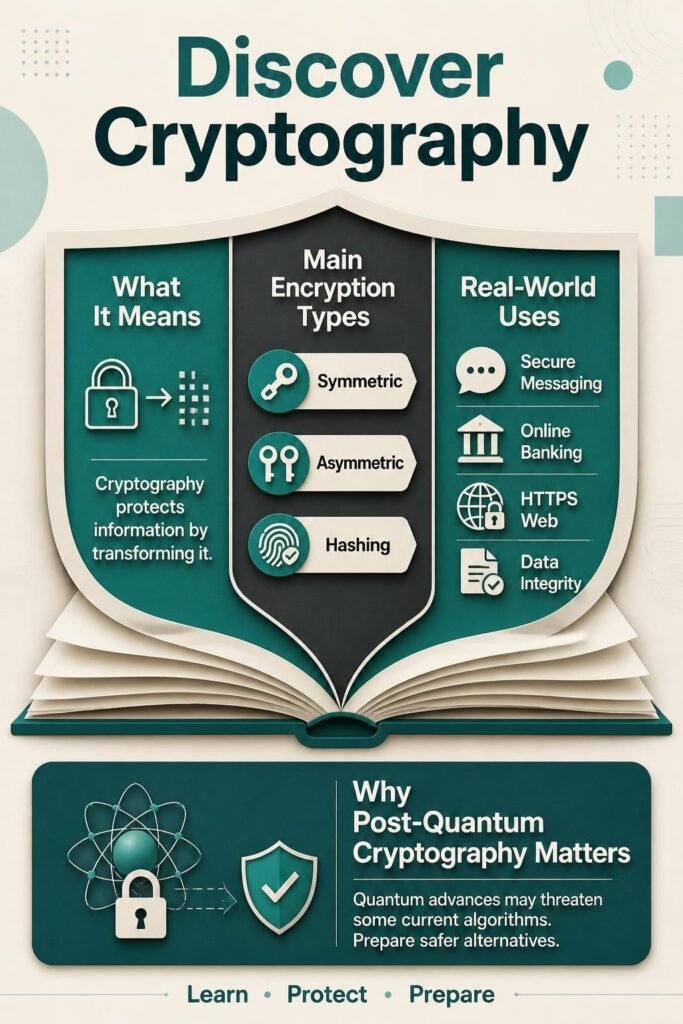
Cryptography is the science of protecting information so that only authorized people can read, verify, or use it. It is one of the most important foundations of the modern digital world, powering secure websites, encrypted messaging, online banking, software updates, password protection, digital signatures, and post-quantum security
At a time when data breaches, identity theft, and cyberattacks are growing more advanced, cryptography is no longer a niche technical subject. It is a critical part of everyday life. Whenever you log in to an account, send a private message, pay online, or open a secure website, cryptography is working behind the scenes to keep your data safe.
This article explains what cryptography is, how it works, why it matters, the main types of cryptography, how encryption protects data, how digital signatures and key exchange work, why password security depends on cryptography, and why governments are now preparing for post-quantum cryptography. It also explains why older cryptographic systems can be risky and what the future of cryptography looks like
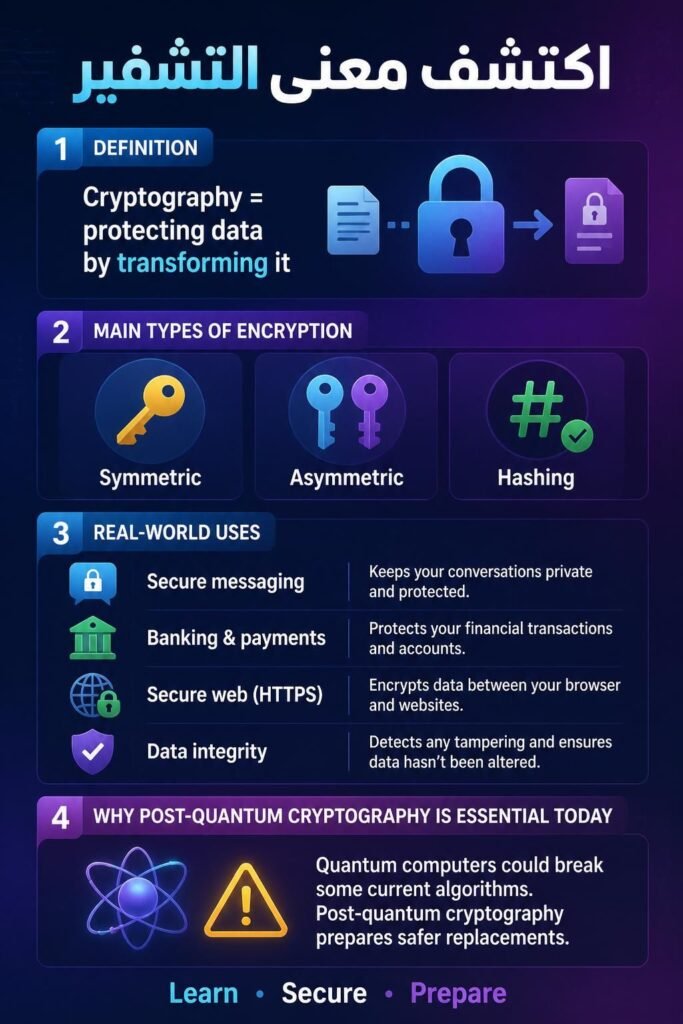
Table of Contents
- What Cryptography Means
- Why Cryptography Matters
- The Main Goals of Cryptography
- The Main Types of Cryptography
- How Encryption Works
- Cryptography in Everyday Life
- Digital Signatures
- Key Exchange and Secure Communication
- Cryptography and Password Security
- Post-Quantum Cryptography and Government Action
- Legacy Cryptography vs. Modern Cryptography
- Real-World Risks and Weaknesses
- Practical Steps for Beginners
- The Future of Cryptography
- FAQ
- Conclusion
What Cryptography Means
The word cryptography comes from Greek roots meaning “secret writing,” but modern cryptography is much broader than hiding messages. Today, cryptography is the science of using mathematical methods to protect information, verify identities, and maintain trust in digital systems
In simple terms, cryptography answers a difficult question: how can two people exchange information securely when the communication channel between them may be monitored or attacked? The answer involves algorithms, keys, protocols, and careful system design.
Cryptography does not only hide information. It also helps prove that information is genuine, unchanged, and sent by the right person. That is why cryptography is central to cybersecurity, privacy, online commerce, digital communication, and identity verification.
Why Cryptography Matters
Modern life depends on digital trust. Without cryptography, the internet would be far less safe and much less useful. Attackers could easily intercept messages, steal passwords, fake identities, manipulate transactions, or alter files without detection.
Cryptography protects the digital world by making it much harder for unauthorized people to read or change sensitive data. It is one of the main reasons online banking, e-commerce, cloud storage, and secure communication are possible.
It supports four essential security goals:
- Confidentiality: only authorized people can read the data.
- Integrity: the data cannot be changed without detection.
- Authentication: the sender or user can be verified.
- Non-repudiation: a person cannot easily deny a signed action.
These four goals form the backbone of modern security systems, and cryptography is the technology that makes them possible.
The Main Goals of Cryptography
Cryptography is designed to solve specific security problems. Understanding these goals makes it easier to understand why cryptography is used everywhere in digital systems.
Confidentiality
Confidentiality means protecting information from unauthorized access. If someone intercepts encrypted data, they should not be able to read it without the correct key.
Integrity
Integrity means making sure data has not been changed or tampered with. Cryptographic hashes and digital signatures are often used to detect modifications.
Authentication
Authentication proves that a message, user, or system is genuine. In cryptography, this usually involves keys, signatures, or certificates.
Non-repudiation
Non-repudiation prevents someone from denying that they performed a digital action, such as signing a document or sending a secure message
These goals are often used together. In a secure system, cryptography does not only hide data; it also protects trust.
The Main Types of Cryptography
Cryptography includes several major approaches, and each one solves a different kind of problem.
Symmetric Cryptography
Symmetric cryptography uses the same secret key for both encryption and decryption. This makes it fast and efficient, which is why it is widely used for protecting large amounts of data.
Typical uses include:
- File encryption.
- Full disk encryption.
- Secure communication after a session key has been agreed upon.
- High-speed data protection in internal systems.
The biggest weakness of symmetric cryptography is key sharing. If both sides need the same secret key, that key must be delivered safely in advance. If an attacker gets the key, the system is compromised.
Asymmetric Cryptography
Asymmetric cryptography uses two related keys:
- A public key, which can be shared openly.
- A private key, which must stay secret.
What one key encrypts, the other key decrypts. This makes asymmetric cryptography extremely useful for secure communication across open networks.
It is commonly used for:
- Digital signatures.
- Secure key exchange.
- Identity verification.
- Secure email.
- Certificate-based trust systems.
Asymmetric cryptography solves one of the biggest challenges in cybersecurity: how to establish trust when two people have never met or shared a secret before.
Hash Functions
A cryptographic hash function transforms data into a fixed-length output called a hash. Hashing is designed to be one-way, meaning the original data should not be recoverable from the hash alone.
Hashing is used for:
- Password storage.
- File verification.
- Data integrity checks.
- Blockchain systems.
- Digital fingerprinting of files and messages.
A small change in the input creates a completely different hash. This makes hash functions very useful for detecting tampering.
How Encryption Works
Encryption is the process of turning readable data, known as plain text, into unreadable data, known as cipher text. Decryption reverses the process and restores the original information.
A simplified encryption process works like this:
- The sender starts with plain text.
- A cryptographic algorithm uses a key.
- The data is transformed into cipher text.
- The receiver uses the correct key to decrypt it.
The security of encryption depends on several factors:
- The strength of the algorithm.
- The length and quality of the key.
- How the system is implemented.
- Whether the key is protected properly.
Even strong cryptography can fail if the implementation is weak or the key is stolen. That is why cryptography is as much about secure design as it is about mathematics.
Cryptography in Everyday Life
Most people use cryptography every day without realizing it. It is built into the services and apps that people rely on constantly.
Common examples include:
- Secure messaging apps.
- Online banking.
- E-commerce checkout pages.
- Password managers.
- Secure Wi-Fi connections.
- Software update verification.
- Cloud storage protection.
- Login systems for websites and apps.
When you visit a website using HTTPS, cryptography is protecting the connection between your browser and the site. When you send a private message in a secure app, cryptography helps keep that message private. When a bank verifies a transaction, cryptography helps protect the legitimacy of the operation.
Cryptography is not something separate from the internet. It is part of how the internet works.
Digital Signatures
A digital signature is one of the most important applications of cryptography. It proves that a message, file, or document came from a specific sender and has not been altered.
Digital signatures are widely used in:
- Contracts.
- Software distribution.
- Government records.
- Financial systems.
- Business communication.
- Secure email.
They provide two major benefits:
- Authenticity: the sender is verified.
- Integrity: the content has not been changed.
This is why digital signatures are essential in legal, business, and technical environments. They make digital actions easier to trust.
Key Exchange and Secure Communication
A key exchange allows two parties to agree on a secret key over an insecure network. This is one of the most important uses of cryptography because symmetric encryption is fast, but it needs a shared secret before it can work.
Modern secure systems often combine both major forms of cryptography:
- Asymmetric cryptography is used to safely exchange a key.
- Symmetric cryptography is then used for fast data encryption.
This hybrid model gives the best of both worlds: secure setup and efficient communication.
Without secure key exchange, many digital systems would be much harder to protect. It is a major reason why secure web browsing, encrypted messaging, and many cloud services work reliably
Cryptography and Password Security
Passwords are one of the weakest parts of many security systems, which is why cryptography plays such an important role in protecting them.
Good systems never store passwords as plain text. Instead, they use hashing, salting, and sometimes slow hashing algorithms designed to make attacks harder.
A salt is random data added before hashing. It helps prevent attackers from using precomputed tables and ensures that even identical passwords do not produce identical stored values.
Good password protection usually includes:
- Hashing.
- Salting.
- Slow hashing algorithms.
- Multi-factor authentication.
This is one of the most practical uses of cryptography in daily life. When password systems are designed properly, cryptography helps protect users even if a database is exposed.
Post-Quantum Cryptography and Government Action
Cryptography is constantly evolving because the threat landscape keeps changing. One of the most important modern developments is the rise of post-quantum cryptography.
In 2026, President Donald Trump signed an executive order accelerating the federal shift toward post-quantum cryptography. The order reflects a growing concern that future quantum computers may eventually be able to break some of the encryption methods that are widely used today. It directs government agencies to prepare for quantum-resistant standards and to migrate sensitive systems before future threats become practical.
This is a major signal that cryptography is not just a technical topic. It is also a policy, infrastructure, and national security issue
Post-quantum cryptography is designed to resist attacks from quantum computers. That matters because data encrypted today may need to remain secure for many years. In sectors like government, healthcare, finance, and defense, long-term confidentiality is critical.
Legacy Cryptography vs. Modern Cryptography
Older cryptographic methods were built for older computers, older threat models, and older network environments. Some of those methods are now too weak to be trusted because computing power has increased and attack techniques have become more advanced.
Modern cryptography is far more resilient because it is designed with current threats in mind. It uses stronger algorithms, larger keys, better protocol design, and more careful security standards.
However, modern cryptography is not automatically safe in every situation. It can still fail if:
- It is implemented badly.
- Keys are weak or stolen.
- Software is outdated.
- The system is misconfigured.
- Users ignore security best practices.
This is why organizations need to retire old algorithms quickly and keep systems updated. Using outdated cryptography can create serious vulnerabilities even when the rest of the system looks secure.
Real-World Risks and Weaknesses
Cryptography is powerful, but it is not magic. It is one part of a larger security ecosystem, and it can still be undermined by human mistakes or poor design.
Common risks include:
- Weak passwords.
- Stolen keys.
- Outdated software.
- Poor random number generation.
- Phishing attacks.
- Bad implementation of secure protocols
- Failure to update systems
One of the most important lessons in cybersecurity is that strong cryptography does not protect a weak system by itself. If attackers can trick users, steal credentials, or exploit software flaws, the benefits of cryptography can be reduced.
That is why cryptography must always be combined with secure coding, proper access control, regular updates, and user awareness.
Practical Steps for Beginners
If you are learning about cryptography, it helps to build understanding in layers.
Start with these steps:
- Learn the difference between encryption, hashing, and digital signatures.
- Understand symmetric and asymmetric cryptography.
- Study how keys are generated, shared, and protected.
- Learn why randomness is so important.
- Explore how cryptography is used in browsers, apps, and secure websites.
- Read about common mistakes and attacks.
This foundation will make advanced topics much easier to understand later
The Future of Cryptography
The future of cryptography will be shaped by new computing models, stronger privacy expectations, and more advanced attacks.
Some of the most important future areas include:
- Post-quantum cryptography.
- Privacy-preserving technologies.
- Secure digital identity.
- Better key management
- More resilient authentication systems.
The goal of cryptography will remain the same: protect information and make digital communication trustworthy. But the methods will continue to evolve as technology changes.
For businesses, governments, and everyday users, staying current with cryptographic standards is becoming more important every year.
FAQ
Is cryptography the same as encryption?
No. Encryption is only one part of cryptography. Cryptography also includes hashing, signatures, authentication, and key exchange.
Why is cryptography important?
It protects privacy, verifies identity, secures transactions, and helps digital systems remain trustworthy
Can cryptography be broken?
Yes, sometimes. Weak algorithms, poor implementation, stolen keys, and human error can all create vulnerabilities.
Do people use cryptography every day?
Yes. It is used in secure websites, private messaging, online payments, password storage, and many other digital services
Why is post-quantum cryptography important?
It is designed to protect data against future quantum computers that may be able to break some current encryption methods.
Conclusion
Cryptography is the science that makes secure digital life possible. It protects privacy, ensures integrity, proves authenticity, and helps people trust the systems they use every day.
From secure messaging and online banking to digital signatures and post-quantum protection, cryptography is one of the most important technologies in the modern world. It is not just about hiding information. It is about building trust, defending data, and keeping digital communication secure now and in the future