How to prepare your company for PQC migration is now a practical business question, not a future security theory. Companies that delay risk discovering too late that their current cryptography cannot protect long-lived data, regulated systems, or customer trust in a post-quantum world
Introduction
How to prepare your company for PQC migration starts with a simple truth: quantum-safe planning is now a business resilience issue, not just a security project. If your company relies on public-key cryptography for TLS, certificates, code signing, VPNs, authentication, or secure data exchange, the migration will touch more systems than most leaders expect. This matters now because cryptographic inventories, vendor dependencies, and migration timelines take time to map, and the organizations that start early will have far more room to move carefully. As the PQC Migration Roadmap and practical readiness checklists emphasize, the first step is understanding where cryptography exists before changing anything. In this article, you’ll get a realistic, practical roadmap for U.S. companies that want to prepare without panic and without wasting budget. pqcc
Table of Contents
- Introduction
- What PQC migration actually means
- Why companies should start now
- Build a cryptographic inventory
- Assess business and data risk
- Create a crypto-agility plan
- Work with vendors and partners
- Pilot, test, and phase the rollout
- Common mistakes to avoid
- Practical timeline for U.S. companies
- People Also Ask
- Frequently Asked Questions
- Key Takeaways
- Conclusion
What PQC migration means
PQC migration means moving from cryptographic systems that may be vulnerable to future quantum attacks toward post-quantum cryptography that is designed to withstand those threats. In practice, this is not a single switch you flip; it is a staged program that affects algorithms, certificates, libraries, protocols, hardware, vendors, and operational processes. Most companies will need a hybrid period where classical and post-quantum methods coexist, because not every system can be updated at the same time. That is why planning, inventory, and phased execution matter more than simply choosing new algorithms
The best way to think about PQC migration is as a modernization program for your security foundation. You are not just replacing RSA or ECC in isolation; you are making your environment crypto-agile so that future changes are less painful. That means your architecture should support replacement of algorithms without redesigning every application, a point highlighted in enterprise readiness guidance. This is especially important for companies with long product life cycles, regulated records, or customer data that must stay confidential for years
Why start now
The risk is not only “quantum computers someday.” The real issue is that sensitive data stolen today can be stored and decrypted later, which makes long-term confidentiality a current risk for many sectors. That includes healthcare, finance, legal, government contractors, SaaS vendors, and any company handling intellectual property or customer identity data. If your organization’s data must remain protected for five, ten, or even twenty years, then delayed migration becomes a strategic risk rather than a technical preference.
Starting early also lowers cost. A rushed migration usually means unplanned certificate changes, broken integrations, extra vendor fees, and emergency testing. A measured migration lets teams reuse normal refresh cycles, renewals, and platform upgrades instead of creating a separate crisis project. In U.S. companies, where compliance, customer trust, and cyber insurance reviews matter, early PQC planning can also reduce future procurement friction and audit risk.
Build inventory first
Before selecting tools or algorithms, build a cryptographic inventory. This is the most important part of How to prepare your company for PQC migration because you cannot protect what you have not mapped. Start with everything that touches public-key cryptography: websites, customer portals, APIs, internal apps, remote access tools, email security, signing systems, identity platforms, and cloud services. Then go deeper into certificates, KMS keys, hardware security modules, code-signing chains, SSH keys, and application libraries
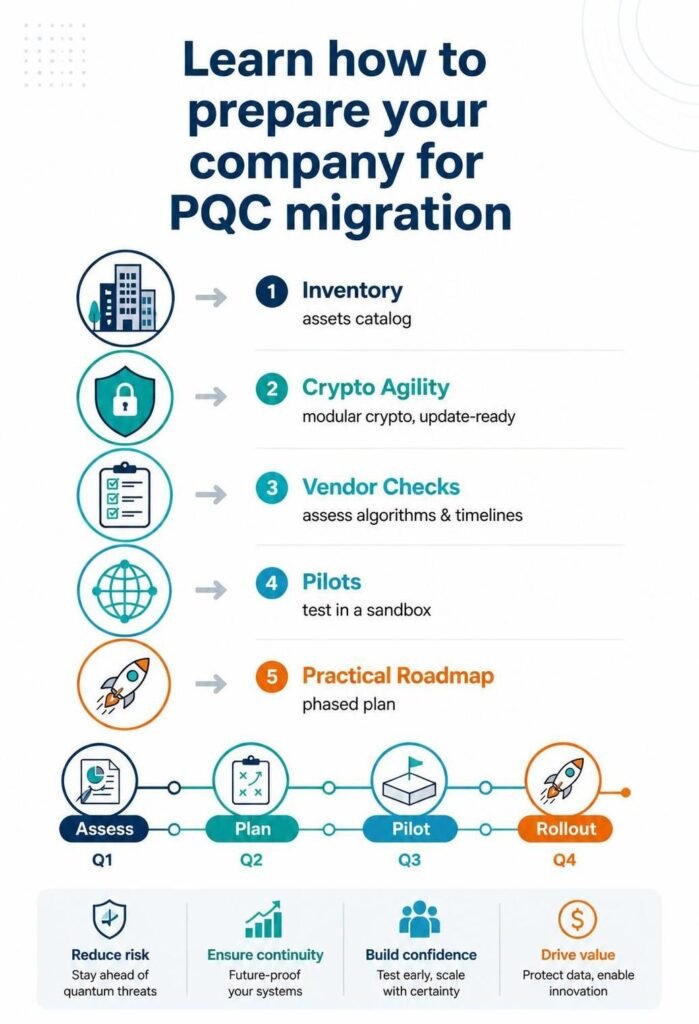
A practical inventory should capture at least these fields:
| Asset | Owner | Algorithm | Key size | Expiry | Business criticality | Vendor dependency |
|---|---|---|---|---|---|---|
| Public website TLS | IT/SecOps | RSA/ECC | 2048/256 | Date | High | Hosting provider |
| Internal PKI | Infrastructure | RSA/ECC | 2048/256 | Date | High | CA platform |
| Code signing | DevOps | RSA | 2048 | Date | Critical | Build pipeline |
| VPN | Network team | RSA/ECC | 2048/256 | Date | High | Security appliance |
The checklist approach recommended by readiness guides is useful because it breaks discovery into manageable steps: public-facing domains, TLS certificates, application-level cryptography, internal PKI, cloud keys, and vendor dependencies. Keep the inventory in a spreadsheet or CMDB, but assign an owner and a review cadence. If no one is responsible for updating it, it will become outdated before the migration even starts. cipherready
Assess business risk
Not every system needs the same migration priority. The next step in How to prepare your company for PQC migration is to classify systems by business impact and data longevity. Systems that protect long-lived confidential data should rise to the top: customer identity stores, payment workflows, legal archives, source code repositories, healthcare records, and regulated documents. Systems with shorter data lifetimes can usually move later, as long as they are not critical dependencies.
Use a simple risk matrix
| Risk level | Examples | Migration priority |
|---|---|---|
| Critical | Code signing, identity, regulated records, VPN, PKI | Immediate |
| High | Customer portals, APIs, internal auth | Early |
| Medium | Marketing sites, non-sensitive apps | Planned |
| Low | Temporary or public content systems | Later |
This classification helps you avoid wasting time on low-risk systems while critical assets remain exposed. Enterprise guidance repeatedly emphasizes prioritization and dependency mapping because PQC migration will be easier when you group related systems instead of migrating one certificate at a time in isolation. One good rule: if the data must stay private for a long time, treat it as high priority. encryptionconsulting
Create crypto agility
Crypto agility means your systems can change algorithms with minimal disruption. It is one of the most important themes in modern post-quantum planning because the standards and best practices will continue to evolve. If your code assumes one certificate format, one provider, or one algorithm forever, your migration will be expensive and fragile. If your architecture supports algorithm substitution, your team can adapt with far less effort
Where agility matters most
The biggest agility gaps usually appear in identity systems, TLS termination, application libraries, and hardware appliances. Legacy systems often hard-code algorithms into configuration files, certificates, or build scripts. Cloud systems may hide complexity but still depend on older cryptographic assumptions. That is why readiness plans recommend documenting all algorithm dependencies, not just the obvious certificate layer
To improve agility, standardize your crypto interfaces. Use centralized certificate management where possible, minimize custom crypto code, and prefer vendors that publish PQC roadmaps. Also maintain a clear deprecation policy so old algorithms can be removed in a controlled way. The goal is not to predict the future perfectly; the goal is to make future changes possible without rebuilding the business
Work with vendors
Vendor readiness is often where migration projects slow down. Many companies control only part of the stack, while the rest is provided by cloud services, SaaS platforms, security appliances, payment gateways, and managed infrastructure. That means How to prepare your company for PQC migration must include vendor assessment as a formal workstream, not a side conversation. Ask every critical vendor what their PQC roadmap looks like, what algorithms they support, and whether they can provide crypto bill of materials or migration guidan
A vendor questionnaire should ask:
- Which PQC algorithms are supported now or planned?
- What is the timeline for hybrid or post-quantum certificates?
- Can you support crypto-agile deployment?
- What dependencies will break during migration?
- How do you handle code signing and TLS transition?
The best vendors will give a roadmap, test guidance, and support commitments. The weakest will tell you to “wait and see.” That answer is a risk signal. If a vendor protects customer-facing security functions and has no migration plan, you may need mitigation options, alternative products, or a phased architecture change
Pilot before rollout
A full PQC migration should never begin with production-wide changes. Start with a controlled pilot in one environment, one application, or one business unit. This lets you test performance, interoperability, certificate lifecycles, monitoring alerts, and rollback procedures before broader deployment. Practical guides from enterprise security providers consistently recommend phased rollout instead of a big-bang cutover
Good pilot candidates include:
- Internal web applications
- Non-customer-facing APIs
- Test environments that mirror production
- Secondary certificates or lower-risk services
During the pilot, measure latency, CPU usage, handshake performance, support-ticket volume, and certificate renewal behavior. Also test with browsers, mobile devices, load balancers, proxies, and security tools. Many PQC failures happen not because the algorithm is wrong, but because one small dependency somewhere in the chain does not support the new configuration. A pilot exposes those issues while the stakes are still low
Plan by phase
The most practical PQC migrations use phases. That keeps the project manageable and aligns it with normal business cycles
| Phase | Focus | Output |
|---|---|---|
| Phase 1 | Discovery | Full crypto inventory |
| Phase 2 | Prioritization | Risk-ranked migration roadmap |
| Phase 3 | Pilot | Validated hybrid deployment |
| Phase 4 | Expansion | Critical systems migrated |
| Phase 5 | Standardization | Policies, procurement, and operations updated |
This staged model reflects the migration roadmaps and handbooks published by industry groups and security teams. The exact order may differ depending on your stack, but the principle stays the same: discover first, then prioritize, then test, then expand. Companies that skip these phases usually spend more time on remediation than migration
Budget and governance
PQC migration is not just an engineering task. It needs executive sponsorship, budget, and a named owner. Without governance, teams will treat it as “someone else’s project,” and progress will stall. A good program has a steering group that includes security, infrastructure, application owners, compliance, procurement, and leadership.
Budget should cover:
- Discovery tooling
- Certificate and PKI modernization
- Vendor replacement or upgrades
- Testing and QA
- Training and documentation
- Contingency for legacy systems
The most underestimated cost is internal time. Engineers, security teams, and vendor managers will all spend hours mapping dependencies and validating changes. That is normal. What matters is that the company treats PQC migration like any other strategic transformation: with priorities, milestones, and accountability.
Common mistakes
The most common mistake is starting with algorithms instead of inventory. If you do that, you may choose a good quantum-safe option but fail to deploy it anywhere useful. Another mistake is assuming vendors will solve the problem for you. They will help, but only if you understand your own dependencies first
Other mistakes include:
- Ignoring internal applications and focusing only on websites.
- Failing to test certificate renewals and monitoring systems.
- Waiting until regulations force emergency action.
- Treating PQC as a one-time project rather than a long-term operating model.
- Forgetting code signing, SSH, and identity systems.
One more subtle mistake is overpromising internally. Don’t tell stakeholders the migration is a simple upgrade. It is a multi-quarter program with real operational impact. Setting realistic expectations will protect trust and make the team more effective
A practical 90-day start
If your company is just beginning, here is a realistic first quarter plan.
Days 1–30: Discovery
- List all public-facing domains and critical internal systems.
- Inventory certificates, keys, and crypto libraries
- Identify data with long confidentiality requirements.
- Build your first risk register.
Days 31–60: Assessment
- Prioritize systems by business impact.
- Send vendor questionnaires.
- Identify quick wins and blockers
- Define your crypto-agility requirements.
Days 61–90: Pilot planning
- Select one low-risk pilot system
- Design a hybrid test plan.
- Set rollback procedures
- Present the migration roadmap to leadership
This approach is manageable for a mid-sized U.S. company and scalable for larger enterprises. It gives you enough structure to move forward without trying to solve everything at once
Realistic expectations
PQC migration is not glamorous, but it is necessary. You are unlikely to see immediate revenue from it, and that is fine. The value is in reducing future operational risk, protecting long-lived data, and preventing rushed emergency changes later. The companies that approach it strategically will save money, avoid outages, and make future crypto transitions easier
A strong PQC program also creates side benefits. It forces better asset visibility, better vendor discipline, and better ownership of cryptographic systems. In that sense, the migration is not just about the quantum threat; it is about fixing old security hygiene problems while you prepare for the future
Key Takeaways
- How to prepare your company for PQC migration begins with cryptographic discovery, not algorithm selection.
- Long-lived data and regulated systems should be migrated first.
- Crypto agility is essential because standards and vendor support will keep evolving
- Vendor readiness can make or break your migration timeline.
- Pilots, phased rollout, and rollback planning reduce risk.
- Governance and budget matter as much as technical work.
- The earlier you start, the less painful the migration will be
People Also Ask
What is PQC migration?
PQC migration is the process of moving from current public-key cryptography to post-quantum cryptography designed to resist future quantum attacks
Why is PQC migration important now?
It matters now because sensitive data can be captured today and decrypted later, so long-lived confidential data is already at risk.
Which systems should be migrated first?
Start with code signing, identity, TLS, VPNs, PKI, and any system protecting long-term confidential data.
How long does PQC migration take?
For most companies, it is a multi-quarter or multi-year effort depending on system complexity and vendor dependencies.
Do all vendors support PQC today?
No. Vendor support is uneven, which is why readiness questionnaires and roadmap checks are essential.
Is PQC migration only for large enterprises?
No. Small and mid-sized companies also need a plan, especially if they handle regulated or long-lived sensitive data.
What is crypto agility?
Crypto agility is the ability to replace cryptographic algorithms and components without redesigning your entire system.
Frequently Asked Questions
What does PQC stand for?
PQC stands for post-quantum cryptography, which refers to cryptographic methods designed to resist attacks from future quantum computers.
How do I know if my company needs PQC migration?
If you use public-key cryptography for TLS, certificates, identity, VPN, or signing, you should plan for migration. If your data must stay private for years, the need is even stronger
What is the first step in PQC migration?
The first step is a full cryptographic inventory. You need to know where cryptography exists before you can migrate it safely
Should I replace all cryptography at once?
No. A phased approach is safer. Start with discovery, then pilot one system, then expand based on test results.
What is the biggest risk during migration?
The biggest risk is breaking hidden dependencies, especially in certificates, vendor systems, legacy apps, and build pipelines
How can I make my company more crypto-agile?
Standardize cryptographic interfaces, reduce hard-coded algorithms, centralize certificate management, and prefer vendors with clear PQC support plans.
What should I ask vendors about PQC?
Ask about supported algorithms, hybrid certificate plans, migration timelines, testing support, and what breaks during the transition
How should I prioritize systems?
Prioritize by data sensitivity, regulatory exposure, business criticality, and how long the protected data must remain confidential.
Is PQC migration expensive?
It can be, but early planning usually lowers cost because you can align changes with normal upgrade cycles instead of creating emergency work
What happens if we wait too long?
Waiting increases operational risk, vendor pressure, audit complexity, and the chance of a rushed and expensive migration.
Conclusion
How to prepare your company for PQC migration is ultimately about visibility, prioritization, and disciplined execution. The companies that succeed will not be the ones that move fastest at the start; they will be the ones that inventory carefully, assess business risk honestly, and build crypto-agile systems that can adapt over time. If you begin with discovery, involve vendors early, pilot before rollout, and treat this as a strategic program, you will be in a far stronger position when quantum-safe requirements become unavoidable. The right time to start is now, while you still have room to plan well. If you want, use this article as the foundation for your internal PQC roadmap and turn it into a 90-day action plan for your leadership tea
By maryam