
AI agents are no longer a research concept — they are actively planning tasks, using software tools, and completing multi-step jobs with little human input at each stage. If you’ve ever wondered how AI is moving from “answering questions” to “getting things done,” this article breaks down exactly how AI agents work, where they’re already being used, and what their real limitations are.
for you:
Learning and consistency are the secrets to success.
Introduction: From Answering Questions to Taking Action
For years, artificial intelligence meant one thing to most people: a system you could ask a question, and it would answer. You typed a prompt, it typed back a response, and the interaction ended there. That model — useful as it was — had a hard ceiling. It could tell you how to do something, but it couldn’t actually do it
That ceiling is now being broken. A new category of AI system, commonly called an “AI agent,” is built to take a goal, figure out the steps required to reach it, and carry out those steps by interacting with other software — files, databases, browsers, calendars, code environments — without needing a human to manually execute every single action
This shift matters because it changes what we’re delegating. Instead of asking AI for advice and then doing the work ourselves, we can now hand over the work itself, at least for tasks that are well-defined enough to be broken into steps. Understanding how this works, where it’s genuinely useful, and where it still falls short is essential for anyone trying to make sense of where software is headed.
What Exactly Is an AI Agent?
The Core Definition
An AI agent is a system built on top of an AI model that can independently plan and execute a sequence of actions to achieve a goal, using external tools along the way. The key word is sequence. A standard AI model produces one output per input. An agent produces a chain of outputs, each one informed by the result of the previous action, until the goal is either reached or the system determines it cannot proceed further
Agent vs. Chatbot: The Real Difference
It’s easy to confuse a capable chatbot with an agent, since both can hold a conversation and both can sound confident and articulate. The difference isn’t how they talk — it’s how they act
A chatbot answers within a single turn. Ask it to summarize a document, and it summarizes the document. Ask it to fix a bug in your code, and it will describe the fix, but you’re the one who opens the file and applies it
An agent, by contrast, is built to close that gap. Given the same bug-fixing task, an agent can open the relevant file itself, apply the fix, run the tests, check whether they pass, and only then report back — potentially trying a different approach if the first fix didn’t work
This distinction is what people mean when they say we’ve moved from “systems that answer” to “systems that act
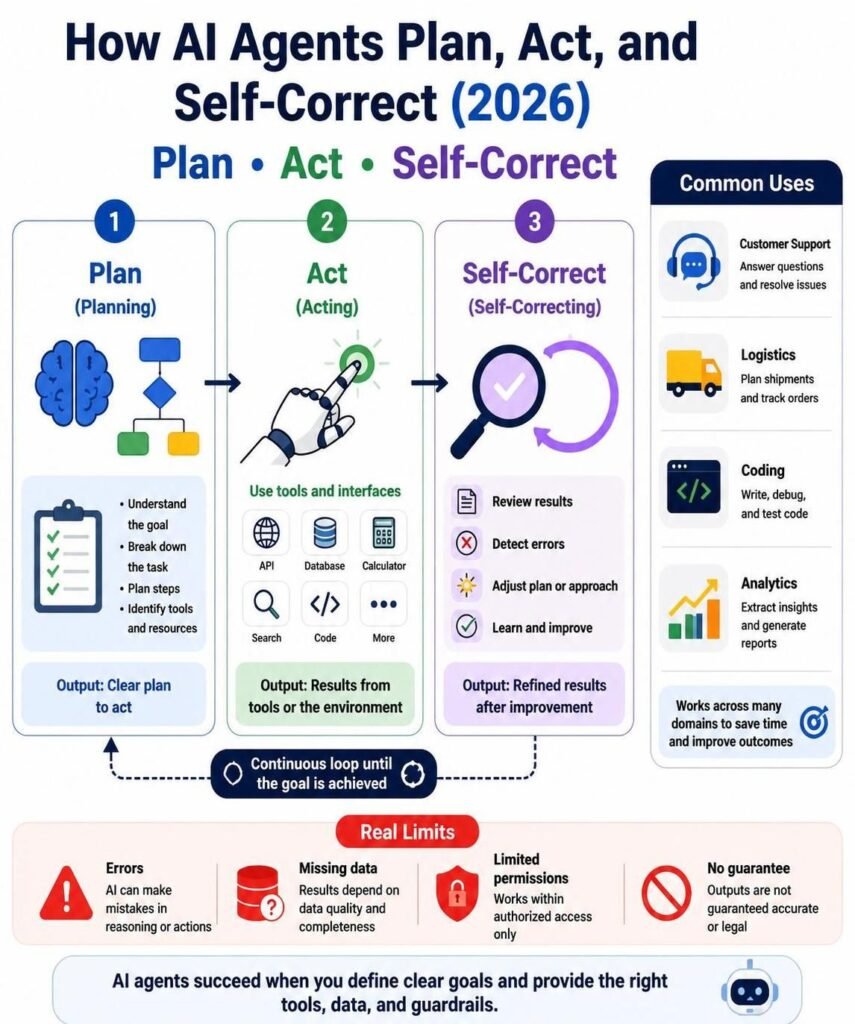
The Three Capabilities That Define an Agent
Not every AI system that uses a tool qualifies as a true agent. Three capabilities, working together, are what separate agentic systems from simpler automated scripts or single-step AI tools
THE ONE-PERSON BUSINESS
https://maryamaitouamzzi.gumroad.com/l/khfvvc?wanted=true: AI Agents 2026: How Autonomous Systems Are Changing Digital Work1. Planning and Task Decomposition
An agent has to take a broad, sometimes vague objective — “prepare a summary of this quarter’s sales data and flag any unusual trends” — and break it down into an ordered list of concrete steps: locate the data, clean it, calculate relevant metrics, compare against historical patterns, identify outliers, and compile the findings into readable form.
This decomposition step is where most of an agent’s “intelligence” is actually spent. Choosing the right sequence of steps, and adjusting that sequence when something doesn’t go as expected, is far harder than executing any single step in isolation.
2. Tool Use and System Interaction
Planning alone doesn’t accomplish anything. An agent needs the ability to actually interact with the outside world: querying a database, browsing a webpage, running code, calling an API, or manipulating a file. This is what gives an agent functional autonomy — the capacity to act on its environment rather than simply describing what should be done.
The quality of an agent’s tool access directly shapes what it can accomplish. An agent connected only to a search engine can research a topic but can’t act on the findings. An agent connected to a code environment, a file system, and a web browser can research, build, test, and deliver a finished result.
3. Self-Correction and Feedback Loops
Real-world tasks rarely go exactly as planned on the first attempt. A file might not exist where expected. An API call might fail. A calculation might produce a result that doesn’t match expectations. An agent needs to notice when something has gone wrong and revise its approach accordingly, rather than blindly continuing down a plan that’s no longer valid.
This feedback loop — act, observe the result, adjust — is what allows agents to handle tasks that involve uncertainty, rather than only tasks where every step can be scripted in advance.
4. Memory Across Steps
A capability that’s easy to overlook but essential in practice is memory — the ability to retain context from earlier steps in the process and apply it later. Without this, an agent working through a ten-step task would effectively start fresh at every step, forgetting what it already tried, what worked, and what didn’t. Persistent working memory allows an agent to build on its own progress instead of repeating work or contradicting an earlier decision
This matters especially in longer tasks. An agent researching a topic across fifteen sources needs to remember which sources it already checked, what conclusions it drew from each one, and where gaps still remain — otherwise it risks either duplicating effort or missing something it already partially covered
How AI Agents Actually Work: A Step-by-Step Breakdown
To make this concrete, here’s a simplified version of what happens when an agent is given a task like “research three competitor pricing pages and summarize the differences in a table”:
- Interpret the goal — the agent parses the instruction and identifies the deliverable (a comparison table) and the required inputs (competitor pricing pages).
- Form a plan — it decides it needs to search for each competitor’s pricing page, extract the relevant data, and organize it consistently
- Execute the first step — it uses a search or browsing tool to locate the first pricing page
- Extract and store information — it reads the page and pulls out the relevant pricing tiers and features.
- Repeat for remaining targets — it moves to the second and third competitors, following the same process.
- Evaluate for consistency — it checks whether the collected data is complete and comparable.
- Compile the output — it formats the findings into the requested table.
- Report back — it presents the result
Notice that at no point does a human need to intervene between steps 3 and 7 — that entire block runs autonomously. The human’s role shifts from executor to reviewer
Where AI Agents Are Already Being Used
Agentic AI isn’t a future promise — it’s already active across several fields, generally in tasks that are repetitive, multi-step, or require pulling together information from more than one place
Software Development
This is arguably the most mature use case. Coding agents can read through an existing codebase, understand its structure, locate a bug or missing feature, write the necessary code, and run automated tests to confirm the change works — iterating if the tests fail. This doesn’t replace a developer’s judgment on architecture or design decisions, but it can dramatically cut down the time spent on well-scoped, mechanical changes.
Research and Information Synthesis
Agents equipped with web search and browsing tools can investigate a topic across many sources, cross-reference claims, and produce a structured summary — a task that would otherwise involve a human manually opening dozens of tabs. This is useful for market research, competitive analysis, and literature reviews, though the output still benefits from human verification, particularly for high-stakes decisions.
Operations, Scheduling, and Workflow Coordination
Agents connected to calendars, email, and project management tools can coordinate multi-step administrative workflows — finding a meeting time across several calendars, sending the invitations, following up with attendees who haven’t responded, and updating a shared task tracker as the process unfolds
Customer Support
Rather than simply suggesting a canned response, a support agent connected to a company’s internal systems can look up an order, check its status, process a return, and confirm the resolution with the customer — resolving the ticket rather than just answering a question about it.
Data Analysis and Reporting
Agents with access to spreadsheets, databases, and visualization tools can take a raw dataset, clean it, calculate the relevant statistics, generate charts, and produce a formatted report — a workflow that traditionally required manual work across several separate applications
Legal and Contract Review
In legal workflows, agents are being used to scan lengthy contracts for specific clause types, flag deviations from a standard template, and compile a summary of risk areas for a lawyer to review. This doesn’t replace legal judgment, but it compresses the time spent on the initial read-through of dense documents, letting a human focus their attention on the sections that actually need scrutiny
E-Commerce and Inventory Management
Retail and e-commerce operations use agents to monitor stock levels across multiple sales channels, flag items approaching a reorder threshold, adjust pricing based on competitor data, and generate purchase orders — coordinating a workflow that would otherwise require someone to manually check several dashboards throughout the day.
Personal Productivity
On an individual level, agents are increasingly built into everyday tools to handle tasks like sorting and drafting replies to email, organizing files, or compiling notes from a meeting into a structured summary with action items assigned to the right people. These are smaller-scale tasks than enterprise deployments, but they follow the same underlying pattern: a goal is stated once, and the agent handles the steps in between
AI Agents vs Traditional Automation: Why This Isn’t Just RPA
People familiar with older automation tools — like Robotic Process Automation (RPA) — sometimes assume AI agents are just a rebranded version of the same idea. The distinction is worth making clear, because it explains why agents can handle tasks that traditional automation never could
Traditional automation follows a fixed script: if X happens, do Y. It’s fast and reliable, but brittle — the moment a situation falls outside the script’s predefined conditions, the automation breaks or does the wrong thing. It has no capacity to reason about a new situation it wasn’t explicitly programmed for.
An AI agent, by contrast, doesn’t follow a fixed script. It interprets a goal, forms its own plan based on the situation in front of it, and adjusts that plan when circumstances change. This is what allows an agent to handle a task it has never encountered in exactly that form before — something a rules-based automation system simply cannot do. The tradeoff is that this flexibility comes with less predictability, which is precisely why oversight matters more for agents than it did for older automation tools.
The Real Limitations of AI Agents
It’s worth being direct about where agentic systems currently fall short, because overstating their reliability leads to real problems when they’re deployed without appropriate safeguards
Compounding Errors
Because each step in an agent’s process builds on the previous one, a mistake early in the sequence can quietly propagate through everything that follows. A small misreading of data in step two might not cause an obvious failure — it might just produce a confidently wrong final report, which is often harder to catch than an outright crash
Difficulty With Ambiguous Goals
Agents perform best on tasks that are well-defined. When a goal is vague or open to interpretation, an agent may confidently pursue an interpretation that isn’t what the user actually intended, and it may not surface that ambiguity before proceeding — simply because it wasn’t designed to pause
Dependence on Tool and Data Quality
An agent’s effectiveness is bounded by what it can access. A poorly documented API, an outdated database, or a website that blocks automated access can all limit an agent just as much as they’d limit a human working manually — sometimes more, since an agent may not recognize that the information it retrieved is stale or incomplete.
Oversight and Verification Challenges
The more autonomy a system has, the harder it becomes to check every intermediate decision it made along the way. This creates a genuine tradeoff: the efficiency gained by letting an agent work independently comes at the cost of reduced visibility into how it reached its result, which matters a great deal for decisions with real consequences — financial, legal, medical, or otherwise.
Cost and Reliability Tradeoffs
Multi-step agentic tasks typically require far more computation than a single question-and-answer exchange, since the system may need to retry failed steps, verify intermediate results, and process large amounts of tool output along the way. This makes agents more expensive and slower than a simple query, which matters for applications operating at scale
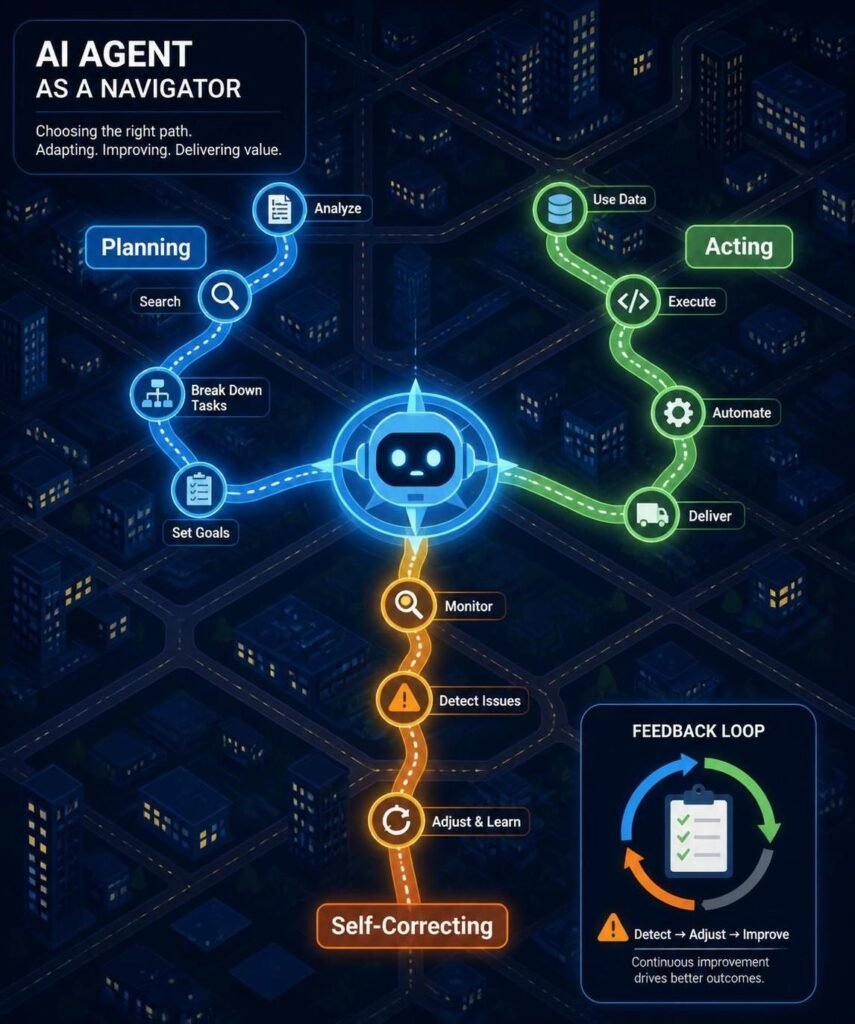
Security and Manipulation Risks
Because agents act on information they retrieve from external sources — web pages, documents, emails — they can potentially be misled by content specifically crafted to manipulate their behavior, a risk sometimes called prompt injection. If an agent browsing a webpage encounters hidden instructions embedded in that page’s content, a poorly safeguarded system might follow those instructions instead of the user’s original request. This is an active area of ongoing security research, and it’s a major reason why agents with access to sensitive actions — like sending payments or deleting files — are typically given narrower permissions than agents used purely for research or drafting tasks
Why Human Oversight Still Matters
Given these limitations, most serious deployments of AI agents today are built around checkpoints — specific points in the process where a human reviews the agent’s plan or output before it proceeds further, particularly for actions that are difficult to reverse (sending an email, making a purchase, deleting data, or publishing content)
This isn’t a temporary workaround that will disappear as the technology matures — it reflects a genuine design principle: the level of autonomy granted to a system should match the reversibility and stakes of the actions it can take. A research agent summarizing public information carries low risk if it makes a mistake. An agent with the ability to move funds or send communications on someone’s behalf carries much higher stakes, and warrants correspondingly tighter oversight.
How to Decide If a Task Is Right for an Agent
Not every task benefits from being handed to an agent, and knowing the difference saves time and avoids frustration. A few questions help clarify whether a task is a good fit.
Is the goal clearly defined? Agents perform best when the desired outcome is specific enough to be broken into concrete steps. “Summarize these five documents into a one-page brief” is well-defined. “Help me think about my career” is not — it requires judgment and back-and-forth dialogue more than execution
Are the necessary tools available? An agent can only act within the tools it has access to. If the task requires interacting with a system the agent isn’t connected to, it can’t complete it end-to-end, no matter how well it plans.
How reversible are the actions involved? Tasks where a mistake is easy to catch and undo — drafting a document, compiling research, generating a first-pass analysis — are lower-risk candidates for agent autonomy. Tasks involving irreversible actions, like sending a communication externally or deleting data, warrant a human checkpoint before the final action executes.
Is there a reliable way to verify the output? If the correctness of a result can be checked automatically — for instance, running a test suite against a code change — an agent can verify its own work as it goes. If correctness depends on subjective judgment, human review becomes more important before the result is considered final
Frequently Asked Questions
What is the difference between an AI agent and a chatbot?
A chatbot responds to a single prompt with a single answer. An AI agent plans and executes a sequence of actions across multiple steps, using external tools, and adjusts its approach based on the results of each step, continuing until the task is complete or it determines it cannot proceed.
Can AI agents work without any human supervision?
Technically, many can operate through an entire task without intervention. Whether they should depends on the stakes involved. For low-risk, easily reversible tasks, full autonomy is often reasonable. For higher-stakes actions, most well-designed systems include checkpoints where a human reviews the agent’s plan or output before it proceeds.
What tools do AI agents typically use?
Common tools include web search and browsing, code execution environments, file systems, databases, calendar and email systems, and APIs for connecting to other software platforms. The specific tools available to an agent directly determine what kinds of tasks it can complete
Are AI agents reliable enough for business use?
They are increasingly used in production settings, particularly for well-scoped tasks like code changes, data compilation, and customer support workflows. Reliability varies significantly based on task complexity, the quality of available tools and data, and whether appropriate human checkpoints are built into the process
What industries are adopting AI agents fastest?
Software development, customer support, research and market analysis, and operations/administrative coordination are among the areas seeing the most active adoption, largely because these fields involve well-defined, multi-step tasks that lend themselves to automation.
Do AI agents replace human jobs entirely?
In most current deployments, agents handle the repetitive or mechanical portions of a workflow while humans retain responsibility for judgment calls, final approval, and handling exceptions the agent wasn’t designed for. The roles most affected tend to be ones built primarily around executing well-defined, repeatable steps — while roles centered on ambiguous judgment, relationship-building, or creative direction remain harder to fully automate.
What is prompt injection, and why does it matter for agents?
Prompt injection refers to a security risk where an agent, while browsing a webpage or reading a document, encounters hidden instructions embedded in that content and follows them instead of the user’s actual request. It matters more for agents than for simple chatbots because agents can take real actions — so a manipulated agent could potentially perform an unintended action rather than just generate a misleading response
Conclusion: What to Watch Going Forward
The trajectory of AI agents points toward an expanding range of tasks they can reliably handle, but the pace of that expansion depends less on how capable the underlying AI models become and more on solving a harder problem: trust. How do you verify that an agent took the right actions along the way, not just that it produced a plausible-looking final result? How do you contain the impact when something goes wrong partway through a multi-step process?
The organizations getting genuine value from AI agents today tend to share a common trait: they’ve scoped the agent’s autonomy carefully to match the task’s actual risk, rather than maximizing autonomy for its own sake. That discipline — matching the level of independence granted to a system with the consequences of it being wrong — is likely to remain the defining factor in how successfully AI agents get deployed, long after the underlying technology itself becomes commonplace
by: mary