
How to Build an AI-Powered Freelance Writing Agency from Scratch (2026 Blueprint)
Meta Description: Learn how to build a profitable AI-powered freelance writing agency from scratch in 2026. Includes pricing models, tool stacks, client acquisition tactics, legal safeguards, and a real-world growth blueprint
Last Updated: August 10, 2026
Reading Time: 14 minutes
Table of Contents
- Why 2026 Is the Defining Year for AI Writing Agencies
- The Economics: What the Data Actually Says
- Phase 1 — Laying the Foundation (Weeks 1–4)
- Phase 2 — Building Your AI-Native Workflow (Weeks 5–8)
- Phase 3 — Pricing for Profit in the AI Era
- Phase 4 — Client Acquisition Without Cold Spam
- Phase 5 — Scaling Beyond Freelancing
- Legal, Ethical & Quality Safeguards
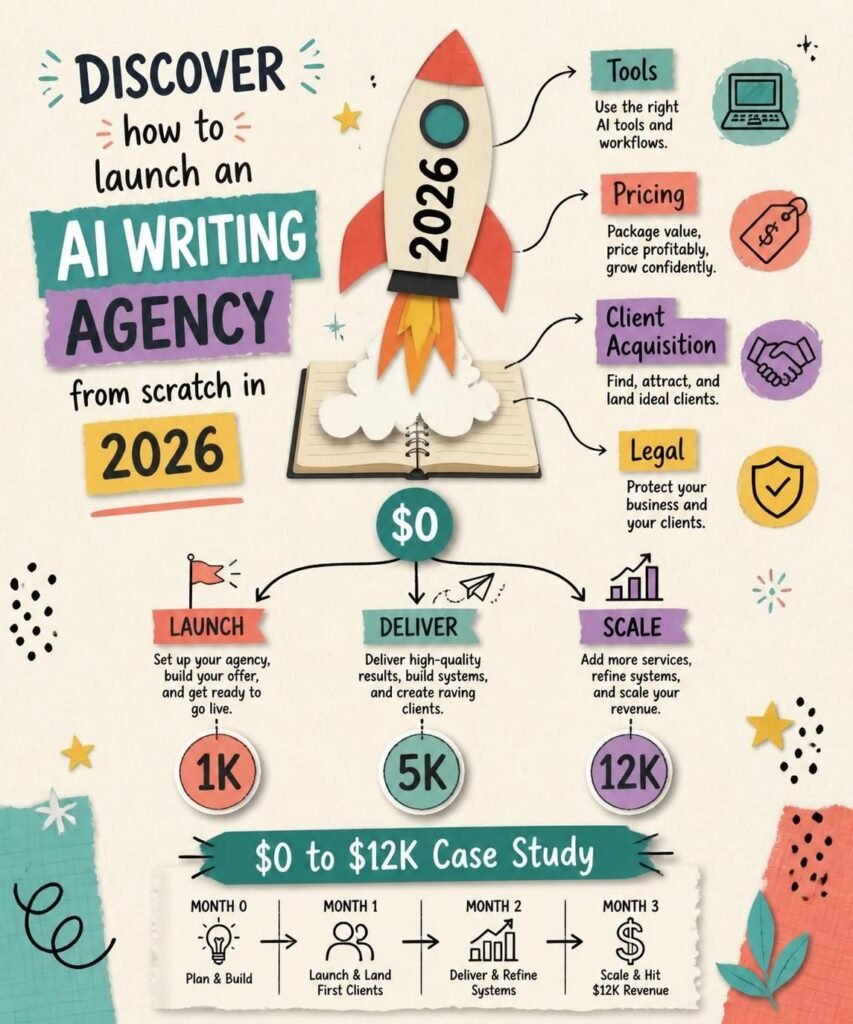
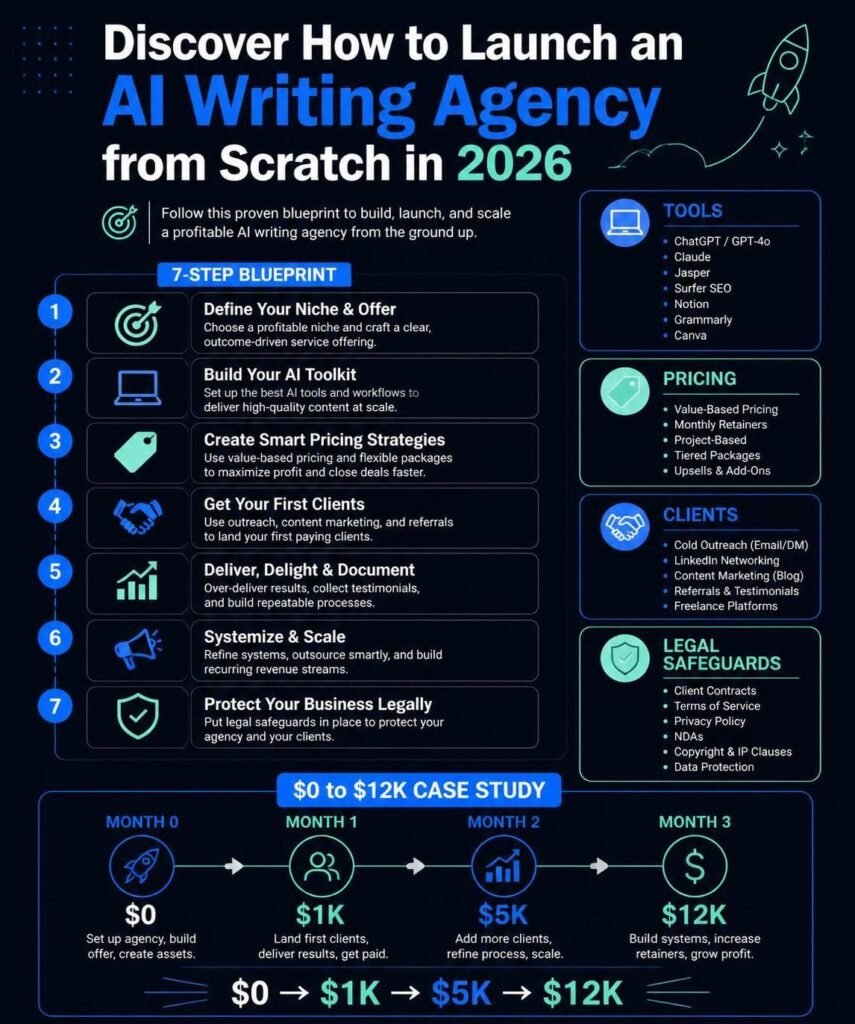
- Case Study: From $0 to $12K/Month in 90 Days
- Frequently Asked Questions
Why 2026 Is the Defining Year for AI Writing Agencies
The freelance writing industry has reached an inflection point. In 2026, the global freelance platform market is valued at $7.3 billion and is projected to hit $24.2 billion by 2033, growing at a CAGR of 18.6% . Simultaneously, the AI writing assistant software market has exploded to $3.33 billion in 2026 and is forecasted to reach $24.78 billion by 2035 at a 25% CAGR
What does this mean for you? Demand for content has never been higher, and the tools to deliver it have never been more powerful. But here is the critical distinction: clients in 2026 are not paying for “AI-generated words.” They are paying for strategic content systems that combine AI velocity with human judgment, brand voice consistency, and SEO authority
Google’s algorithms have evolved far beyond simple keyword matching. The search engine now prioritizes E-E-A-T (Experience, Expertise, Authoritativeness, Trustworthiness) and actively demotes what it classifies as “scaled content abuse” — mass-produced AI spam with no editorial oversight. This creates a massive market gap: businesses need content at scale, but they cannot risk publishing unverified AI drafts that trigger penalties.
That gap is where your agency lives
The Economics: What the Data Actually Says
Before you register a business name, you need to understand the financial landscape you are entering.
Market Adoption Is Universal
According to 2026 data, 90% of content marketers now use AI writing tools in their workflows, and 82% of businesses worldwide have adopted AI-driven automation for content creation . ChatGPT alone boasts 700 million weekly active users and 92% Fortune 500 adoption .
However, adoption does not equal proficiency. Most businesses use AI tools reactively — generating disjointed blog drafts without editorial frameworks, SEO integration, or brand governance. They are stuck in what we call the “DIY Trap”: saving money on writers but losing exponentially more in opportunity cost, brand dilution, and search visibility.
The Pricing Reality
Reputable content writing agencies in 2026 charge:
- Per article: $300–$1,500 depending on research depth and optimization
- Monthly retainers: $3,000–$15,000+ for comprehensive strategy and production
- Hourly strategy consulting: $100–$250/hour
The agencies winning in this market are not competing on price per word. They are competing on outcome-based value: organic traffic growth, lead generation, and revenue attribution. As one industry analysis notes, “The agencies that win in 2026 will stop selling time and start selling results” .
Phase 1 — Laying the Foundation (Weeks 1–4)
Define Your Niche and Value Proposition
Generalist writing agencies are dying. In an AI-saturated market, specialization is survival. Your niche should sit at the intersection of three factors:
- Your domain knowledge (SaaS, healthcare, fintech, e-commerce, etc.)
- High-intent content types (SEO blog clusters, technical whitepapers, conversion copy)
- AI-augmented efficiency (workflows you can systematize)
Example positioning statement:
“We help B2B SaaS companies publish authoritative SEO content clusters 4× faster using a hybrid human-AI editorial system — without the $15K/month enterprise agency retainer.”
Legal Structure & Branding
- Register your business (LLC recommended for liability protection)
- Secure a professional domain and build a minimalist portfolio site
- Create case study templates — even hypothetical ones based on public data
- Draft your Service Level Agreement (SLA) covering revision limits, usage caps, and AI disclosure terms
The Starter Tool Stack Under $200/Month)
You do not need enterprise software to start. Here is a lean, battle-tested stack:
| Function | Tool | Monthly Cost |
|---|---|---|
| AI Drafting | ChatGPT Plus or Claude Pro | $20 |
| SEO Research | Ubersuggest or Ahrefs (trial) | $0–$99 |
| Project Management | Notion or Trello | $0 |
| Invoicing & Contracts | Wave or HelloBonsai | $0–$25 |
| Grammar & Style | Grammarly Business | $15 |
| Plagiarism & AI Detection | Originality.ai or Copyleaks | $15–$30 |
| Total | ~$70–$190 |
Phase 2 — Building Your AI-Native Workflow (Weeks 5–8)
The difference between a freelancer with ChatGPT and an AI-powered agency is workflow architecture. Your agency must operate as a content production system, not a collection of random prompts.
The 5-Stage Editorial Pipeline
Stage 1: Strategic Briefing (Human-Led)
Never let AI choose your topics. Use SEO tools to identify keyword clusters with commercial intent. Map each piece to a stage of the buyer’s journey. The brief should include:
- Primary and secondary keywords
- Search intent classification (informational, commercial, transactional)
- Competitor content gaps
- Required E-E-A-T signals (expert quotes, data citations, original research)
Stage 2: AI-Assisted Research & Outlining
Use Claude Pro or ChatGPT Plus to synthesize top-ranking content, extract key arguments, and generate a structured outline. Feed the AI your brand voice guidelines and target audience persona for alignment.
Stage 3: First Draft Generation (AI + Human Hybrid)
Generate the initial draft using your AI tool of choice, but enforce strict parameters:
- Maximum 800 words per generation to maintain coherence
- Mandatory citation placeholders for all statistics
- Explicit instructions to avoid generic fluff (“In today’s fast-paced world…”)
Stage 4: Human Editorial Layer
This is your moat. Every draft must pass through a senior editor who:
- Verifies factual accuracy and updates stale data
- Rewrites AI-generic transitions into brand-specific voice
- Adds original insights, personal anecdotes, or expert commentary
- Optimizes for NLP (Natural Language Processing) entities that Google uses for semantic understanding
Stage 5: SEO & Technical Optimization
Use Surfer SEO, Clearscope, or Frase to ensure keyword density, heading structure, and internal linking meet ranking thresholds. Run the final text through an AI detector — not to “fool” Google, but to flag passages that read as synthetic and need humanization.
Phase 3 — Pricing for Profit in the AI Era
Traditional hourly billing is fatal for AI-powered agencies. If AI reduces a 20-hour project to 5 hours, billing hourly means you earn 75% less revenue for the same (or better) output
The 6 Pricing Models That Work in 2026
| Model | Best For | Typical Range |
|---|---|---|
| Productized Subscription | Repeatable content (blogs, social) | $1,500–$5,000/mo |
| Value-Based Pricing | High-ROI campaigns | 10–20% of value created |
| Hybrid Retainer + Usage | Variable-volume clients | $2,000–$6,000/mo base + overages |
| Project-Based | One-off deliverables | $3,000–$20,000 |
| Outcome/Performance | Measurable KPIs (traffic, leads) | Base + % of performance |
| Usage-Based | Scalable production | $80–$300 per deliverable |
Pro Tip: Start with productized pricing. For example: “$3,500/month for 8 SEO-optimized blog posts, 2 email sequences, and monthly performance reporting.” This captures AI efficiency as margin while giving clients budget predictability.
Protecting Your Margins
Track your AI token costs per client. A content-heavy client can consume 10× more tokens than a lighter one . Build usage caps into contracts and review pricing quarterly as AI model costs shift.
Phase 4 — Client Acquisition Without Cold Spam
In 2026, cold email blasts announcing “I do AI writing” are ignored. You need a demonstration-first acquisition strategy.
The Portfolio Ladder
- Spec Work for Dream Clients: Create a full content audit and sample article for a target company. Send it with the subject line: “I fixed your blog’s SEO gap — no pitch attached
- Productized Lead Magnets: Offer a “$500 AI Content Audit” that analyzes a prospect’s existing content for AI-detection risks, keyword cannibalization, and E-E-A-T gaps. This converts at 15–20% into full retainers.
- LinkedIn Authority Content: Publish weekly teardowns of content strategies. Tag the companies you analyze. Visibility beats solicitation.
Channel Strategy
- Inbound: SEO your own agency website. If you cannot rank your own site, why should clients trust you with theirs?
- Referrals: Offer existing clients 10% of the first retainer month for warm introductions.
- Partnerships: Partner with web design agencies and fractional CMOs who need content execution partners
Phase 5 — Scaling Beyond Freelancing
Once you hit $8K–$10K/month, you face a choice: stay a high-earning freelancer or build an agency with equity value
The Team Architecture
- Editorial Director (You): Strategy, client relationships, quality control
- AI Prompt Engineers: Specialists who optimize generation workflows
- Subject Matter Editors: Niche experts who add E-E-A-T credibility
- Project Manager: Client communication, deadlines, invoicing
Automation Layer
Implement Zapier or Make.com automations for:
- Client onboarding questionnaires → Brief generation
- Content calendar triggers → AI outline creation
- Draft completion → Editor assignment
- Publication → Performance reporting dashboard
Legal, Ethical & Quality Safeguards
AI Disclosure Requirements
While no federal law in the U.S. currently mandates AI disclosure for marketing content, the FTC’s guidance on deceptive practices means you cannot claim “100% human-written” if AI was substantially involved. Best practice
- Disclose AI usage in your contracts
- Never guarantee specific search rankings (Google explicitly warns against this)
- Maintain editorial records showing human oversight
Copyright & Hallucination Risks
AI models can generate text that inadvertently plagiarizes or fabricates statistics. Your agency must:
- Run all drafts through plagiarism checkers
- Manually verify every statistic and citation
- Carry Errors & Omissions (E&O) insurance tailored for content agencies
The “Cheap Content” Trap
Search engines in 2026 are adept at identifying mass-produced AI spam. As one agency guide warns, “Recovering from a search penalty often costs five times more than the initial investment in high-quality writing would have been” . Your agency’s reputation depends on being the antidote to cheap AI content, not a supplier of it.
Case Study: From $0 to $12K/Month in 90 Days
The Founder: “Maya,” a former in-house content manager for a B2B SaaS company, laid off in early 2026.
Month 1: Maya defined her niche — AI-assisted SEO content for Series A SaaS companies. She built a portfolio of 4 spec articles using her former employer’s public blog gaps (without publishing them). She invested $150 in tools and spent 3 weeks learning advanced prompting techniques.
Month 2: She offered free “Content Gap Audits” to 20 target companies via LinkedIn DMs. Five responded. Two became paying clients at $2,500/month each for 6 blog posts and monthly reporting. She delivered using ChatGPT Plus + Claude Pro + Surfer SEO.
Month 3: She hired a part-time editor ($1,200/month) to handle quality control while she focused on sales. She raised prices to $3,500/month for new clients, using value-based justification (“Our last client gained 340 organic clicks/month from our content cluster”). She landed two more clients and one project-based website rewrite for $4,500.
Result: $12,000 monthly recurring revenue by day 90, with 60% gross margins after tool and contractor costs.
Frequently Asked Questions
How much does it cost to start an AI writing agency?
You can launch with $200–$500 in initial tool subscriptions and legal setup. The real investment is time — expect 15–20 hours/week for the first 60 days to build workflows and acquire initial clients.
Do clients care if I use AI to write their content?
Clients care about results and risk mitigation, not the tool you use. They care that the content ranks, converts, and does not trigger search penalties. Transparently explain your hybrid human-AI process as a quality and speed advantage.
What is the best AI tool for agency writing in 2026?
There is no single “best” tool. Claude Pro excels at long-form thought leadership. Jasper is superior for multi-brand marketing teams needing voice consistency . ChatGPT Plus offers the best flexibility for research and brainstorming. Most agencies use a stack of 2–3 tools.
How do I price AI content without underselling myself?
Never bill by the hour. Use productized or value-based pricing. If AI lets you deliver in 5 hours what used to take 20, a flat project fee captures that efficiency as profit instead of passing the savings to the client as a discount .
Is the AI writing agency market oversaturated?
The low end is saturated — commodity blog mills charging $0.05/word are collapsing under search algorithm updates. The high end — agencies delivering strategic, E-E-A-T-compliant content systems — has more demand than supply. Position upward.
How do I handle AI hallucinations and factual errors?
Implement a two-verification rule: every statistic must be traceable to a primary source, and every claim in YMYL (Your Money or Your Life) niches must be reviewed by a subject matter expert. Use AI as a drafter, not a publisher.
Can I run this agency solo, or do I need a team?
You can reach $5K–$8K/month solo as a high-level freelancer. To scale beyond $10K/month sustainably, you need at least one editor and systems for workflow automation.
What industries pay the most for AI writing services?
In 2026, the highest-paying niches are B2B SaaS, healthcare/medical devices, fintech, legal tech, and cybersecurity. These sectors require technical accuracy and regulatory awareness that generic AI cannot provide without expert oversight.
Final Word: Build the Agency AI Cannot Replace
The AI writing revolution of 2026 is not a threat to writers — it is an exponential lever for those who adapt strategically. Businesses do not need more content. They need better content systems: faster, more authoritative, and aligned with how modern search engines actually work.
Your agency’s competitive advantage will never be the AI tool you use. It will be your editorial judgment, your niche expertise, your client relationships, and your ability to translate business outcomes into content strategy.
Start lean. Price for value. Build systems. And never let AI replace the human layer that turns words into authority