Table of Contents
Introduction: Is the Era of Writing Prompts Ending?
What Is Prompt Engineering and Why Did It Become Important?
Why Traditional Prompt Engineering Is Changing
What Are AI Agents and How Do They Work?
AI Agents vs Prompt Engineering: The Big Difference
7 Reasons AI Agents Are the Future of Artificial Intelligence
Real Case Study: How Businesses Use AI Agents Today
New Skills That Will Replace Traditional Prompt Writing
How to Prepare for the Agentic AI Future
Frequently Asked Questions About AI Agents and Prompt Engineering
note:
Over the years, I’ve had several investment experiences, and I’ve always asked about the reasons for success. The answer is always that learning, knowledge, and perseverance are among the most important reasons for success, God willing
Introduction: Is the Era of Writing Prompts Ending?
For the last few years, learning how to write better prompts became one of the most valuable skills in the world of artificial intelligence. Millions of people learned how to communicate with AI models by creating detailed instructions, adding context, defining roles, and improving their questions to get better results.
This new skill was called prompt engineering.
At the beginning of the AI revolution, a person who knew how to write a powerful prompt had a significant advantage. A simple request like:
“Write an article about marketing”
could produce an average answer, while a carefully designed prompt such as:
“Act as an experienced SEO content strategist. Create a detailed article for beginners using simple language, search intent analysis, and practical examples”
could generate a much better result
This difference created an entire industry around prompt writing. Courses, jobs, and communities appeared because businesses needed people who understood how to communicate effectively with artificial intelligence
However, artificial intelligence is changing quickly
The next evolution is not only about giving better instructions to AI. It is about creating AI systems that can understand goals, plan actions, use different tools, analyze information, and complete complex tasks with less human guidance
These systems are known as AI agents.
The question many experts are asking today is:
Is the era of writing prompts ending, and are AI agents becoming the future of how humans interact with artificial intelligence?
The answer is more complex than a simple yes or no
Prompt engineering is not disappearing completely. Instead, it is becoming part of a bigger system. In the future, people may spend less time writing individual prompts and more time designing intelligent workflows where AI agents can operate independently.
The shift is similar to what happened when people moved from manually writing every computer instruction to using modern software platforms that automate complicated processes.
The future belongs to people who understand how to work with AI agents, not only people who know how to write better prompts.
What Is Prompt Engineering and Why Did It Become Important?
Prompt engineering is the process of creating instructions that help artificial intelligence models generate more accurate, useful, and reliable responses.
Large language models such as ChatGPT, Gemini, and Claude work by predicting and generating text based on patterns learned from massive amounts of data. They do not think like humans, so the way users communicate with them has a major impact on the quality of their answers
A good prompt usually contains several elements:
Clear objective: What result do you want?
Context: Why is the task important?
Role definition: Who should the AI act as?
Examples: What type of answer do you expect?
Rules: What limitations should the AI follow?
For example, instead of asking:
“Create a business plan.”
A stronger prompt would be:
“Act as a startup consultant. Create a detailed business plan for a small online education company targeting beginners. Include market research, pricing strategy, customer acquisition methods, and financial projections.”
The second instruction gives the AI more information, which usually leads to a better response.
Because of this, prompt engineering became a valuable skill for:
Content creators
Developers
Marketing specialists
Researchers
Entrepreneurs
Business teams
Many companies started hiring specialists who could improve productivity by helping employees use AI tools effectively.
However, traditional prompt engineering has a limitation.
The user still needs to guide every important step.
If someone wants AI to analyze data, create a report, send emails, compare options, and make recommendations, they often need to provide multiple instructions manually.
This creates a new challenge:
What if AI could understand the final goal and decide the steps by itself?
This is where AI agents enter the picture.
Why Traditional Prompt Engineering Is Changing
Prompt engineering was built around a simple relationship:
Human gives instruction → AI generates response
This model works well for simple tasks.
For example:
Writing a social media post
Summarizing a document
Translating text
Creating ideas
Answering questions
But modern businesses need more advanced solutions.
Companies do not only need answers. They need actions.
A business owner may want an AI system that can:
Research competitors
Analyze customer feedback
Create marketing campaigns
Update reports
Manage schedules
Communicate with customers
Improve processes over time
A normal chatbot cannot easily handle these tasks because it waits for instructions.
An AI agent works differently
Instead of only responding, an AI agent can:
Understand the objective
Create a plan.
Choose the necessary tools
Complete different steps
Check results.
Adjust its strategy
This is a major change in the relationship between humans and artificial intelligence.
The user moves from being an instruction writer to becoming a goal designer.
The Limitations of Traditional Prompt Writing
Although prompts are powerful, they have several weaknesses.
1. Prompts Depend on Human Input
A traditional AI model usually does not know what to do next unless the user explains every step.
If the instruction is incomplete, the result may not match expectations.
2. Complex Tasks Require Many Prompts
A large project may require dozens of separate instructions.
For example, creating an SEO article could require prompts for:
Keyword research
Competitor analysis
Article structure
Writing
Editing
Fact checking
Optimization
An AI agent can potentially manage these steps inside one workflow
3. Prompts Do Not Create Real Autonomy
A prompt tells AI what to generate, but it does not automatically give the system the ability to make decisions, remember objectives, or execute external actions.
AI agents are designed to solve this problem.
What Are AI Agents and How Do They Work?
AI agents are advanced artificial intelligence systems designed to perform tasks independently based on a specific goal.
Unlike traditional chatbots, AI agents are not limited to answering questions. They can interact with software, access information, use tools, and make decisions within defined boundaries.
A simple way to understand the difference:
Traditional AI:
Human → Prompt → AI Answer
AI Agent:
Human → Goal → AI Agent → Planning → Actions → Result
For example:
A traditional AI user might ask:
“Find the best marketing strategies for my website.”
The AI provides suggestions.
An AI agent could:
Analyze the website
Study competitors
Find keywords
Create a marketing plan
Generate content ideas
Track performance
The agent transforms AI from a writing assistant into a digital worker
AI Agents vs Prompt Engineering: How the Way We Use AI Is Changing
The biggest difference between AI agents and prompt engineering is not simply about technology. It is about the role humans play when working with artificial intelligence.
For years, humans were the decision makers who gave AI detailed instructions. The AI model waited for commands, processed information, and returned an answer
This relationship can be described as:
Human intelligence → Instructions → Artificial intelligence → Response
But AI agents introduce a different approach:
Human goal → AI agent → Planning → Execution → Improvement → Final result
The difference may look small, but it represents a major transformation
A prompt-based system depends heavily on the quality of the user’s instructions. An AI agent depends more on its ability to understand objectives, organize tasks, and use available resources
This does not mean prompts are becoming useless. Instead, prompts are becoming one component inside larger AI systems.
In the future, people may not spend hours trying to discover the perfect sentence to ask an AI model. They may create intelligent systems that understand business goals and complete complex processes automatically.
The Evolution From Prompt Writing to AI Agent Management
Every major technology shift changes the skills people need
When computers first became popular, users needed to understand complicated commands. Later, graphical interfaces allowed more people to use computers without knowing programming languages
A similar change is happening with artificial intelligence
The early AI era rewarded people who could write detailed prompts
The next AI era will reward people who can:
– Design AI workflows
– Manage AI agents
– Create automation systems
– Connect AI with business tools
– Define clear objectives
– Evaluate AI performance
The skill is moving from telling AI what to do step by step to building systems that know how to achieve goals
Example: From Prompt Engineering to AI Agent Execution
For example, imagine an online store owner who wants to improve sales.
With traditional prompt engineering, they might ask AI:
“Create 20 product descriptions.”
Then:
“Analyze my competitors.”
Then:
“Suggest marketing strategies.”
Then:
“Create email campaigns.”
The person must guide every stage
With an AI agent, the owner could provide one main objective:
“Help increase online store revenue by analyzing customers, improving product pages, and creating marketing campaigns.”
The AI agent could then organize the work into smaller tasks and execute them
This is the fundamental difference between generating answers and completing missions
Why AI Agents Are Becoming More Powerful
The growth of AI agents is connected to several important improvements in artificial intelligence
Better Language Understanding
Modern AI models can understand complex instructions, business context, and human intentions much better than earlier systems
They can analyze:
– Documents
– Conversations
– Data
– Images
– Code
– Customer behavior
This allows AI agents to make more informed decisions.
Access to External Tools
A normal chatbot mainly works with the information available inside its model.
AI agents can be connected to external tools such as:
– Databases
– Search engines
– Customer relationship management systems
– Project management platforms
– Business applications
This gives them the ability to perform real actions
For example, an AI sales agent could:
– Find potential customers
– Analyze customer profiles
– Prepare personalized messages
– Update the sales database
– Create reports for the sales team
The AI is no longer only producing text. It is participating in a workflow
Memory and Continuous Improvement
One major limitation of traditional AI conversations is that many systems forget previous interactions
AI agents are designed to work with memory systems
This allows them to remember:
– Previous tasks
– User preferences
– Business information
– Past decisions
– Performance results
A marketing AI agent, for example, could learn which campaigns performed well and adjust future strategies
This creates a more personalized and efficient experience
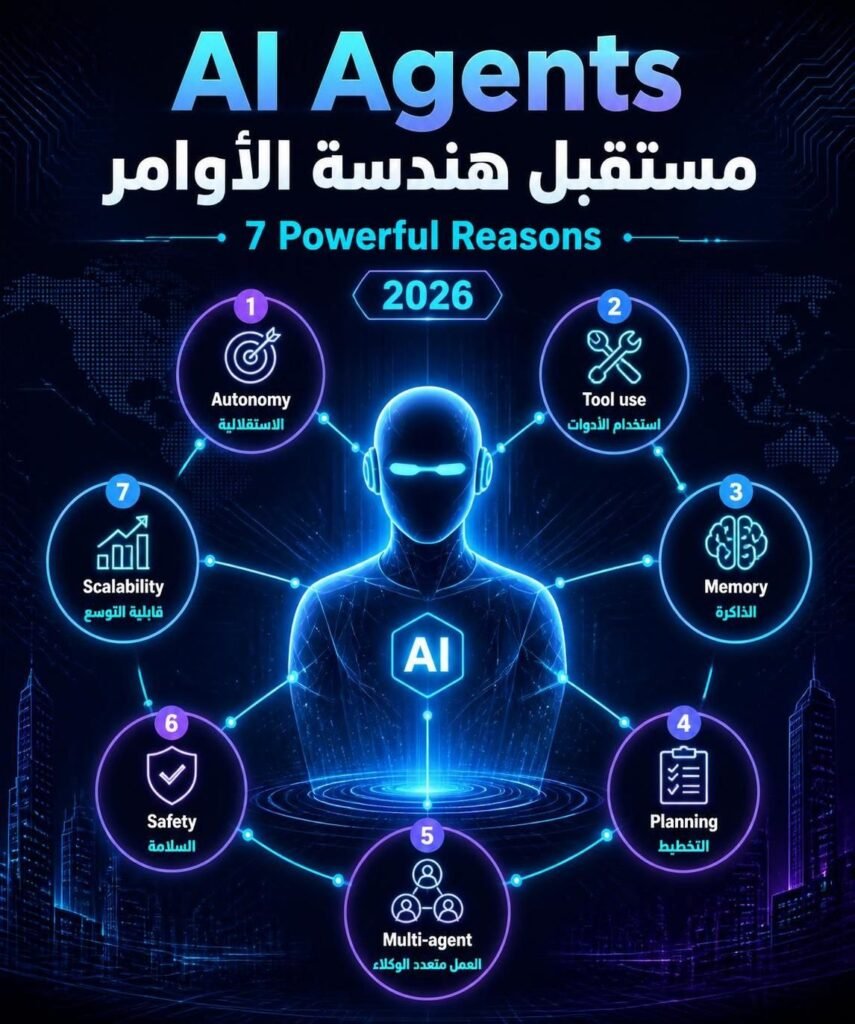
7 Powerful Reasons AI Agents Are the Future of Artificial Intelligence
AI Agents Save Time by Automating Complex Tasks
The biggest advantage of AI agents is their ability to handle multiple steps automatically
Many professional tasks are not difficult because of one action. They are difficult because they require many connected actions
A human employee may spend hours collecting information, organizing data, creating documents, and reviewing results
An AI agent can reduce this workload by managing repetitive processes
Examples include:
– Automated research assistants
– Customer support agents
– Financial analysis agents
– Marketing automation agents
– Coding assistants
The value is not only speed. The real value is allowing humans to focus on creativity, strategy, and decision-making.
AI Agents Can Work 24/7
Traditional employees need breaks, working hours, and schedules.
AI agents can operate continuously
For global companies working across different time zones, this creates new opportunities.
A customer support AI agent can answer questions at any time.
A business monitoring agent can analyze performance overnight.
A research agent can collect information continuously.
This does not mean companies will replace every human worker. Instead, many organizations will combine human expertise with AI automation.
AI Agents Understand Goals Instead of Only Commands
One of the most important changes is the movement from commands to objectives.
A command tells the system exactly what action to perform.
A goal explains the desired outcome.
For example:
Command:
“Write a report about website traffic.”
Goal:
“Analyze our website performance and suggest ways to increase organic traffic.”
The second request gives the AI more freedom to investigate, evaluate, and recommend solutions.
This is closer to how humans solve problems
AI Agents Will Transform Business Operations
Businesses are already exploring AI agents because they can improve productivity across different departments
Marketing
AI agents can:
– Research audiences
– Generate campaign ideas
– Analyze competitors
– Optimize content strategies
Customer Service
AI agents can:
– Answer common questions
– Classify customer problems
– Suggest solutions
– Escalate complex cases
Software Development
AI agents can:
– Review code
– Find errors
– Suggest improvements
– Help developers build applications faster
The future workplace will likely include human teams working alongside specialized AI agents
AI Agents Reduce the Need for Technical Skills
In the early stages of AI adoption, users needed to learn how to communicate with machines.
The future goal is making AI easier for everyone.
A business owner should not need to become a prompt expert to benefit from artificial intelligence
Instead, they should be able to explain:
“What do I want to achieve?”
The AI system should help organize the solution.
This could make advanced technology available to millions of people who do not have technical backgrounds.
AI Agents Create New Career Opportunities
Some people believe AI agents will only remove jobs.
However, history shows that new technologies often create new types of work.
The rise of AI agents may increase demand for roles such as:
– AI workflow designers
– AI automation specialists
– AI strategy consultants
– AI system managers
– Agent developers
The important skill will not only be using AI but understanding how to build productive relationships between humans and intelligent systems

AI Agents Represent the Next Step Toward Autonomous AI
The long-term direction of artificial intelligence is greater independence.
Today’s AI systems answer questions.
Tomorrow’s AI systems may manage projects, coordinate teams, analyze opportunities, and complete complex objectives.
AI agents are an important step toward this future because they combine:
– Reasoning
– Planning
– Memory
– Tools
– Action
This creates a new generation of artificial intelligence that works with humans instead of simply responding to them
How Companies Are Using AI Agents to Change the Way They Work
The Future of AI Agents: From Digital Assistants to Autonomous Partners
The development of artificial intelligence is moving toward a new stage where AI systems will not only answer questions but also actively participate in solving problems.
The first generation of AI tools focused on providing information.
The second generation focused on generating content.
The next generation is focused on taking action.
This is where AI agents become important.
An AI agent is not valuable because it can write faster than a human. Many tools can already generate text. The real transformation comes from the ability to understand objectives, make plans, interact with other systems, and complete tasks with limited supervision.
In the coming years, AI agents may become common in many areas of daily and professional life.
A business owner may have an AI agent managing customer research.
A marketing specialist may have an AI agent analyzing campaigns.
A developer may have an AI agent testing software.
A student may have an AI learning assistant that adapts to their personal learning style.
The future will not be about having one powerful AI tool.
It will be about creating a network of specialized AI agents working together.
The Rise of Specialized AI Agents
One important trend in the future of artificial intelligence is specialization.
Today, many AI assistants try to do everything.
They can write, answer questions, summarize documents, and help with coding.
However, future AI systems may become more specialized.
Instead of one general assistant, people may use different AI agents for different goals.
Examples:
A specialized SEO agent could:
Analyze search trends
Find long-tail keywords
Monitor competitors
Suggest content improvements
Track ranking changes
It would act like a digital SEO specialist working continuously.
Business Intelligence AI Agent
A business agent could:
Analyze sales data
Identify market opportunities
Create reports
Predict possible challenges
Suggest strategic actions
This would help companies make faster decisions based on real information.
Personal Productivity AI Agent
A personal AI agent could:
Organize schedules
Prioritize tasks
Manage emails
Prepare summaries
Recommend improvements
Instead of users managing many digital tools, the AI agent could coordinate them.
Will Prompt Engineering Completely Disappear?
The answer is no
Prompt engineering will change, but it will not completely disappear.
The reason is simple:
AI agents still need instructions, objectives, and human guidance.
The difference is that prompts will become less like simple commands and more like system design instructions.
In the past:
“Write an article about artificial intelligence.”
In the future:
“Create an AI content workflow that researches trends, analyzes competitors, develops SEO strategies, writes drafts, checks accuracy, and improves articles based on performance data.”
The prompt becomes a blueprint for an intelligent system.
This means prompt engineering will evolve into a broader skill that includes:
AI system design
Workflow automation
Agent management
Human-AI communication
The New Digital Workforce: Humans Working With AI Agents
One of the biggest changes created by AI agents will be the transformation of the workplace.
For decades, companies organized work around human employees using software tools.
The future may look different
Companies may organize work around:
Human specialists
AI agents
Automated workflows
Data-driven systems
For example
a small company that previously needed a large marketing department may use:
One human marketing strategist
One content AI agent
One analytics AI agent
One customer research AI agent
The human remains responsible for direction and creativity, while AI agents increase productivity
This could allow smaller businesses to compete with larger companies by using technology more effectively.
The Importance of Trust, Security, and Human Control
Although AI agents offer many opportunities, their growth also creates important challenges.
A powerful AI system needs proper control
Companies must consider:
Data privacy
Security risks
Incorrect decisions
Transparency
Human supervision
An AI agent that can perform actions must operate within clear limits
For example
a financial AI agent should not make major decisions without human approval
A healthcare AI agent should support professionals but not replace medical responsibility
The future of AI will depend not only on making systems more powerful but also on making them safer and more reliable
How Content Creators Can Benefit From AI Agents
Content creation is one of the industries that will experience major changes.
Many creators currently use AI only for writing assistance.
Future AI agents can support the entire content process.
A content AI workflow may include:
Research Agent
Finds:
Trending topics
Audience questions
Competitor content gaps
Search opportunities
Writing Agent
Helps create:
Article drafts
Social media posts
Email newsletters
Content variations
SEO Agent
Improves:
Keywords
Internal linking
Search intent matching
Content structure
Analytics Agent
Monitors:
Traffic
User behavior
Ranking changes
Engagement
The creator becomes less focused on repetitive tasks and more focused on creativity, strategy, and building trust with audiences.
Frequently Asked Questions (FAQ)
What is the future of prompt engineering in 2026?
Prompt engineering will continue to exist, but it will become part of a larger AI skill set. The future will focus more on designing AI workflows, managing AI agents, and creating systems that can complete complex tasks.
Are AI agents replacing prompt engineers?
AI agents are changing the role of prompt engineers rather than simply replacing them. Professionals who understand both prompts and AI workflows will have an advantage because they can design better intelligent systems.
What is the difference between AI agents and chatbots?
A chatbot mainly responds to user questions. An AI agent can understand goals, plan actions, use tools, remember information, and complete multi-step tasks.
Why are AI agents considered the future of artificial intelligence?
AI agents represent a move from passive responses to active problem-solving. They can combine reasoning, planning, memory, and external tools to complete useful tasks.
Can AI agents work without humans?
AI agents can automate many processes, but human supervision remains important. Humans provide goals, ethical guidance, creativity, and final decision-making.
What skills should people learn for the AI agent era?
Important skills include:
AI workflow design
Critical thinking
Problem solving
Data analysis
Automation
Understanding business processes
Will companies use AI agents in everyday work?
Yes. Many companies are exploring AI agents for customer support, marketing, software development, research, and business operations.
How can beginners start learning about AI agents?
Beginners can start by understanding AI basics, experimenting with AI automation tools, creating simple workflows, and learning how AI can solve real problems
Are AI agents better than traditional prompts?
AI agents are better for complex tasks because they can manage multiple steps. Traditional prompts remain useful for direct questions and creative assistance.
What is the biggest advantage of AI agents?
The biggest advantage is their ability to transform a goal into a series of actions. Instead of waiting for instructions after every step, they can manage processes more independently.
Final Conclusion:
The Prompt Era Is Not Ending, It Is Transforming
The history of technology is a history of changing human interaction with machines
At first, people had to understand computers deeply
Then software became easier to use
Now artificial intelligence is becoming more capable of understanding human goals
The rise of AI agents does not mean that prompts have lost their value. Instead, prompts are becoming one element inside a much larger AI ecosystem
The future belongs to people who can combine human creativity with artificial intelligence
The winners will not necessarily be those who write the longest prompts.
They will be those who understand:
How to define valuable goals
How to design intelligent workflows
How to manage AI systems
How to create better results through human-AI collaboration
AI Agents Are the Future of Prompt Engineering because artificial intelligence is moving from answering instructions to achieving objectives
The next era of AI will not be about talking to machines
It will be about working with intelligent partners
About the Author
Mariam is an investment professional with 15 years of experience in financial markets, investment strategies, and business development. Through years of studying market trends and analyzing opportunities, she has developed a deep understanding of how technology and innovation influence the future of businesses and industries
Her passion for artificial intelligence, digital transformation, and emerging technologies led her to explore the role of AI agents in shaping the future of work and investment. She shares insights that connect technology, business strategy, and real-world opportunities to help readers better understand the changing digital landscape