Introduction: The Paradigm Shift That Changed Everything
The year 2026 marked a watershed moment in the history of artificial intelligence. What began as a era of conversational chatbots and text-generating models evolved into something far more transformative: the age of autonomous AI agents capable of executing complex tasks without human intervention. This isn’t merely a technological upgrade—it’s a fundamental reimagining of how humans interact with machines, delegate work, and scale productivity
If you’re reading this in 2026, you’ve likely witnessed this transformation firsthand. The chatbots of 2023-2024, impressive as they were, had a critical limitation: they could talk, but they couldn’t act. You could ask ChatGPT to write a marketing plan, but you still had to execute it yourself. You could request a data analysis, but you still needed to open Excel and input the numbers. The AI was a consultant, not a worker.
2026 changed all of that. The emergence of AI agents—systems that can plan, execute, and complete multi-step tasks autonomously—has shifted the paradigm from “conversation” to “accomplishment.” This guide will explore everything you need to know about this revolution: what AI agents are, how they work, the trends that defined 2026, and most importantly, how you can leverage them to transform your business, career, and daily life
“When I first started experimenting with AI agents in early 2026, I was skeptical. But after automating my first customer service workflow, I was hooked
For those ready to dive deeper into the practical implementation of AI automation and time-management strategies, this comprehensive guide offers actionable frameworks for leveraging these technologies effectively
Chapter 1: Understanding AI Agents – The New Frontier
What Are AI Agents?
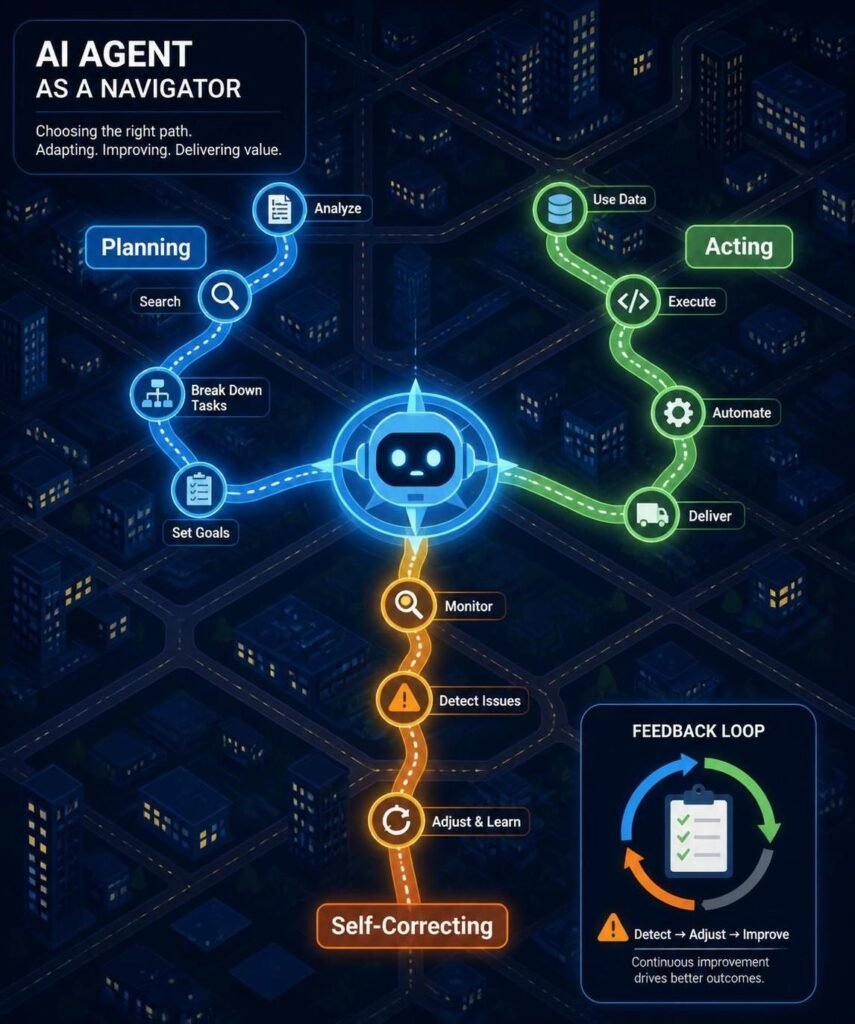
An AI agent is an autonomous system that can perceive its environment, make decisions, and take actions to achieve specific goals. Unlike traditional AI models that respond to prompts, agents can:
Plan multi-step workflows (e.g., “Launch a marketing campaign” → research audience → create content → schedule posts → analyze results)
Interact with external tools and APIs (email, calendars, databases, social media platforms)
Learn from outcomes and adjust strategies accordingly
Operate continuously without constant human oversight
Think of it this way: a chatbot is like a knowledgeable advisor who gives you instructions. An AI agent is like a skilled employee who executes those instructions end-to-end
The Technical Evolution: From LLMs to Agentic Systems
The foundation of AI agents lies in Large Language Models (LLMs), but the architecture is fundamentally different:
Traditional LLM (2023-2024):
Input: User prompt
Output: Text response
Limitation: No memory, no action capability, no persistence
AI Agent (2026):
Input: Goal or objective
Process: Planning → Tool use → Execution → Feedback loop
Output: Completed task with measurable results
Capability: Persistent memory, API integration, autonomous decision-making
This evolution was made possible by several breakthrough technologies:
Function Calling and Tool Use: LLMs gained the ability to call external functions (send emails, query databases, post on social media).
Memory Systems: Agents can now retain context across sessions, remembering past interactions and outcomes
Reasoning Models: Advanced models like Claude 3.5+, GPT-o3, and DeepSeek R1 introduced extended reasoning capabilities, allowing agents to break down complex problems into manageable steps.
Multi-Agent Systems: Instead of one agent doing everything, specialized agents collaborate (e.g., a research agent, a writing agent, a design agent).
Chapter 2: The Major AI Trends of 2026
Trend 1: The Rise of Agentic Automation
The most significant trend of 2026 was the shift from “AI as a tool” to “AI as a worker.” Companies stopped using AI merely for content generation and started deploying agents to handle entire business processes:
Real-World Examples:
Customer Service: AI agents now handle 80-90% of support tickets end-to-end, from initial inquiry to resolution, without human intervention
E-commerce: Agents manage inventory, update product listings, respond to customer queries, and even negotiate prices within predefined parameters.
Content Creation: Instead of writing one blog post, agents now research topics, write articles, create accompanying visuals, optimize for SEO, and schedule publication across multiple platforms.
Data Analysis: Agents can ingest raw data from multiple sources, perform analysis, generate insights, and create presentation-ready reports—all automatically
Trend 2: Specialized Vertical Agents
While 2024-2025 saw the rise of general-purpose AI assistants, 2026 witnessed the emergence of highly specialized agents designed for specific industries and use cases:
Healthcare Agents:
Schedule patient appointments
Analyze medical records for patterns
Generate preliminary diagnostic reports
Manage prescription refills
Legal Agents:
Draft standard contracts
Review documents for compliance
Research case law
Summarize depositions
Financial Agents:
Monitor market trends
Execute trades within risk parameters
Generate financial reports
Detect fraudulent transactions
Marketing Agents:
Analyze customer behavior
Create personalized campaigns
A/B test ad creatives
Optimize ad spend in real-time
This specialization was driven by the realization that while general AI is impressive, domain-specific agents deliver far more value in professional contexts
Trend 3: Edge AI and On-Device Processing
Another major trend was the move toward running AI models directly on devices (phones, laptops, IoT devices) rather than relying solely on cloud-based processing. This shift was motivated by:
Privacy concerns: Keeping sensitive data on-device
Latency reduction: Faster response times without network dependency
Reliability: Functionality even without internet connectivity
Apple, Google, and Microsoft all released on-device AI capabilities in 2026, enabling features like real-time translation, image recognition, and voice assistants that work offline
Trend 4: AI Security and Adversarial Defense
As AI agents became more powerful, so did the threats against them. 2026 saw a surge in:
Prompt injection attacks: Malicious inputs designed to manipulate AI behavior
Data poisoning: Corrupting training data to compromise AI outputs
Deepfake proliferation: AI-generated content used for fraud and misinformation
Agent hijacking: Taking control of autonomous agents for malicious purposes
In response, the industry developed:
AI firewalls: Systems that filter and validate inputs before they reach the agent
Content authentication: Watermarking and verification tools for AI-generated content
Adversarial training: Teaching agents to recognize and resist manipulation attempts
Regulatory frameworks: Governments began implementing AI safety standards
Trend 5: The Human-AI Collaboration Model
Perhaps the most overlooked trend of 2026 was the redefinition of the human role in an AI-driven world. Rather than replacing humans, AI agents amplified human capabilities:
Strategic oversight: Humans focus on high-level strategy while agents handle execution
Creative direction: AI generates options, humans make final creative decisions
Ethical governance: Humans establish guardrails and ethical boundaries for AI actions
Quality assurance: Humans review and validate critical AI outputs
This collaboration model proved more effective than full automation, combining AI efficiency with human judgment.
Chapter 3: How AI Agents Transform Business Operations
Small Business Revolution
For small business owners, AI agents in 2026 became the ultimate force multiplier. Here’s how:
1. 24/7 Customer Support AI agents handle inquiries across multiple channels (website chat, email, social media) without sleep, breaks, or holidays. They can:
Answer FAQs instantly
Process returns and exchanges
Escalate complex issues to humans
Maintain consistent brand voice
2. Automated Marketing Instead of hiring a marketing team, small businesses deployed agents to:
4. Sales Enablement AI agents enhanced sales processes:
Lead scoring and prioritization
Personalized outreach emails
Follow-up automation
CRM data entry
Sales forecasting
Enterprise Transformation
Large enterprises took agent deployment to another level, integrating AI into core business functions:
Supply Chain Optimization: Agents monitor global supply chains in real-time, predicting disruptions, rerouting shipments, and negotiating with suppliers autonomously
HR and Recruitment: AI agents screen resumes, schedule interviews, conduct initial candidate assessments, and even onboard new employees.
IT Operations: Self-healing IT systems powered by AI agents detect and resolve issues before they impact users, manage server loads, and optimize cloud costs
Compliance and Risk Management: Agents continuously monitor transactions, flag suspicious activities, ensure regulatory compliance, and generate audit reports.
Chapter 4: The Economic Impact of AI Agents in 2026
Job Market Disruption and Creation
The widespread adoption of AI agents in 2026 had profound effects on employment:
Jobs Most Impacted:
Data entry clerks
Customer service representatives
Content writers (for routine content)
Administrative assistants
Bookkeepers (for basic tasks
Jobs in High Demand:
AI agent trainers and supervisors
Prompt engineers
AI ethicists and compliance officers
Human-AI collaboration specialists
Data curators and quality auditors
The Reskilling Imperative: Organizations that invested in reskilling employees to work alongside AI agents saw 3-5x productivity gains compared to those that simply replaced workers with AI.
ROI and Business Value
The economic value of AI agents was quantifiable:
Cost Reduction: Companies reported 40-60% reduction in operational costs for automated processes.
Revenue Growth: Businesses using AI agents for sales and marketing saw 25-40% increase in revenue.
Time Savings: Employees freed from repetitive tasks reclaimed 15-20 hours per week for strategic work
Scalability: AI agents enabled businesses to scale operations without proportional increases in headcount.
The Freelance Economy
AI agents also transformed the freelance and gig economy:
Freelancers using AI agents could take on 3-5x more clients without burnout.
New service categories emerged: AI agent management, prompt engineering, automation consulting.
Platform-based agents: Fiverr, Upwork, and similar platforms introduced AI agent services alongside human freelancers
Chapter 5: Practical Implementation – How to Leverage AI Agents
For Individuals
1. Personal Productivity Agent Set up an AI agent to:
2. Learning and Development Agent Create an agent that:
Curates learning resources based on your goals
Creates personalized study plans
Tests your knowledge with quizzes
Tracks your progress over tim
3. Financial Management Agent Deploy an agent to:
Monitor your spending patterns
Categorize expenses
Alert you to unusual transactions
Suggest budget optimizations
Track investment performance
For Small Businesses
Step 1: Identify Repetitive Tasks Map out all tasks that are:
Time-consuming
Rule-based
Low-value strategically
High-volume
Step 2: Prioritize by Impact Rank tasks by:
Time saved
Cost reduction
Revenue impact
Customer experience improvement
Step 3: Select the Right Tools Based on your needs:
Customer service: Intercom, Zendesk AI, Tidio
Marketing: Jasper, Copy.ai, Pippit
Operations: Zapier, Make.com, Notion AI
Sales: HubSpot AI, Salesforce Einstein
Step 4: Start Small, Scale Fast
Begin with one agent for one task
Test and refine
Measure results
Expand to other areas
Step 5: Monitor and Optimize
Review agent performance weekly
Gather human feedback
Adjust parameters and workflows
Continuously improve
For Enterprises
1. Create an AI Center of Excellence Establish a dedicated team to:
Evaluate AI agent technologies
Develop implementation standards
Train employees on AI collaboration
Ensure ethical and compliance adherence
2. Build a Pilot Program
Select high-impact use cases
Deploy agents in controlled environments
Measure KPIs rigorously
Document learnings
3. Scale Systematically
Create reusable agent templates
Develop integration frameworks
Establish governance policies
Train change managers
4. Foster a Culture of Human-AI Collaboration
Communicate AI as augmentation, not replacement
Involve employees in agent design
Provide upskilling opportunities
Celebrate AI-human success stories
Chapter 6: The Technology Stack Behind AI Agents
Core Components
1. Foundation Models The base LLMs that power agents:
GPT-4o, GPT-o3 (OpenAI)
Claude 3.5+ (Anthropic)
Gemini (Google
Llama 3 Meta
DeepSeek R1 (Chinese open-source)
2. Agent Frameworks Platforms for building and deploying agents:
LangChain
AutoGen
CrewAI
LlamaIndex
Haystack
3. Tool Integration APIs and connectors that enable agents to interact with external systems:
Zapier (5000+ app integrations)
Make.com (visual automation)
n8n (open-source automation)
Custom API development
4. Memory Systems Databases and vector stores for agent memory:
Pinecone
Weaviate
Chroma
Redis
PostgreSQL with pgvector
5. Orchestration Platforms Systems for managing multiple agents:
Kubernetes for AI workloads
Ray for distributed computing
Celery for task queues and Custom orchestration layers
Emerging Technologies
Multimodal Models: Agents that can process and generate text, images, audio, and video simultaneously.
Reasoning Models: Advanced architectures that enable multi-step logical reasoning and problem-solving.
Embodied AI: Agents integrated with robotics for physical world interaction (warehouses, manufacturing, healthcare).
Federated Learning: AI training across distributed devices without centralizing data, enhancing privacy.
Chapter 7: Challenges and Risks
Technical Challenges
1. Reliability and Consistency AI agents can still make errors, especially in edge cases. Ensuring consistent performance remains a challenge.
2. Hallucination and Factual Accuracy Agents may generate plausible-sounding but incorrect information, particularly in specialized domains.
3. Integration Complexity Connecting agents to legacy systems and ensuring seamless data flow requires significant technical expertise.
4. Scalability As agent deployments grow, managing resources, costs, and performance becomes increasingly complex.
Ethical and Social Risks
1. Job Displacement While AI creates new jobs, the transition can be painful for displaced workers without adequate reskilling programs.
2. Bias and Fairness AI agents can perpetuate or amplify biases present in training data, leading to discriminatory outcomes.
3. Privacy Concerns Agents that access personal data raise significant privacy questions, especially in healthcare and finance.
4. Accountability When an AI agent makes a mistake, determining liability (developer, deployer, user) remains legally ambiguous.
5. Concentration of Power The AI agent ecosystem risks being dominated by a few large tech companies, limiting competition and innovation.
Security Risks
1. Adversarial Attacks Malicious actors can exploit vulnerabilities in AI agents to manipulate outcomes or steal data.
2. Unauthorized Access Poorly secured agents can be hijacked for fraudulent activities.
3. Data Breaches Agents with access to sensitive data become attractive targets for cybercriminals.
4. Supply Chain Attacks Compromising AI model providers or integration platforms can affect thousands of downstream deployments.
Chapter 8: The Future Beyond 2026
Predictions for 2027-2030
1. Fully Autonomous Enterprises By 2028-2030, we’ll see the first companies that operate almost entirely with AI agents, with humans in purely strategic and oversight roles.
2. Personal AI Agents for Everyone Every individual will have a personal AI agent managing their digital life, from scheduling to finances to health monitoring
3. AI Agent Marketplaces Platforms where you can browse, purchase, and deploy pre-built AI agents for specific tasks
4. Regulatory Frameworks Governments will establish comprehensive AI agent regulations covering safety, accountability, and ethical use.
5. Human-AI Mergers Brain-computer interfaces and other technologies will enable more direct human-AI collaboration, blurring the lines between human and machine intelligence.
The Next Frontier: Artificial General Intelligence (AGI)
While AI agents of 2026 are narrow (specialized for specific tasks), the long-term goal remains AGI—AI that can perform any intellectual task a human can do. Key milestones on this path:
2026-2027: Multi-domain agents that can switch between tasks
2028-2029: Agents with human-level reasoning in specific domains
2030+: Early AGI prototypes with general problem-solving capabilities
However, most experts caution that true AGI remains years or even decades away, and the focus should remain on maximizing the value of narrow AI agents
Chapter 9: Getting Started – Your Action Plan
For Complete Beginners
Week 1: Education
Read introductory guides on AI agents
Watch tutorial videos on YouTube
Join AI communities (Reddit, Discord, LinkedIn groups)
Week 2: Experimentation
Sign up for free AI tools (ChatGPT, Claude, Google AI Studio)
For those ready to move beyond theory and into practical implementation of AI automation and time-management strategies, this comprehensive guide provides actionable frameworks, step-by-step tutorials, and real-world case studies for leveraging AI agents effectively in business and personal productivity.
Conclusion: The Dawn of a New Era
The year 2026 will be remembered as the inflection point when artificial intelligence transitioned from a conversational tool to an autonomous workforce. The shift from chatbots to agents wasn’t just a technological upgrade—it was a fundamental reimagining of what’s possible when humans and machines collaborate.
For individuals, AI agents offer the promise of reclaiming time, amplifying creativity, and achieving more with less effort. For businesses, they represent an unprecedented opportunity to scale operations, reduce costs, and focus human talent on strategic innovation.
However, this transformation also brings challenges: the need for reskilling, the imperative of ethical deployment, and the responsibility of ensuring that AI benefits all of humanity, not just a privileged few.
As we move forward from 2026, one thing is clear: the question is no longer whether AI agents will transform your industry, but how quickly you can adapt to harness their potential. The organizations and individuals who embrace this shift will thrive. Those who resist will be left behind.
The age of AI agents has arrived. The question is: are you ready?
FAQ: Common Questions About AI Agents in 2026
Q: Are AI agents safe to use for sensitive business data? A: Yes, when properly configured with enterprise-grade security, encryption, and access controls. However, always conduct a security audit before deployment.
Q: Do I need coding skills to use AI agents? A: No. Many no-code and low-code platforms (Zapier, Make.com, Bubble) allow you to build and deploy agents without programming knowledge.
Q: How much do AI agents cost? A: Costs vary widely. Free tiers are available for basic use. Enterprise solutions can range from $100 to $10,000+ per month depending on complexity and scale.
Q: Can AI agents replace human workers? A: They can automate many tasks, but the most effective approach is human-AI collaboration, where agents handle repetitive work and humans focus on strategy, creativity, and judgment.
Q: What’s the biggest mistake companies make with AI agents? A: Deploying agents without clear objectives, governance, or human oversight. Start with specific use cases, measure results, and iterate.
Q: How do I measure the ROI of an AI agent? A: Track metrics like time saved, cost reduction, revenue increase, error reduction, and customer satisfaction improvements.
Q: Will AI agents become obsolete quickly? A: The technology is evolving rapidly, but well-designed agents with proper architecture can be updated and improved over time, extending their useful life.
Q: What industries will benefit most from AI agents? A: Healthcare, finance, e-commerce, customer service, legal, marketing, and manufacturing are seeing the highest ROI currently.
About the Author
by : maryam
This comprehensive guide was created to help individuals and businesses navigate the AI agent revolution of 2026. For those seeking deeper, actionable implementation strategies, detailed frameworks, and practical automation blueprints, additional resources are available through specialized guides focused on AI-driven productivity and business transformation.
Note: This article is intended for informational purposes. Always conduct your own research and consult with professionals before implementing AI solutions in critical business operations