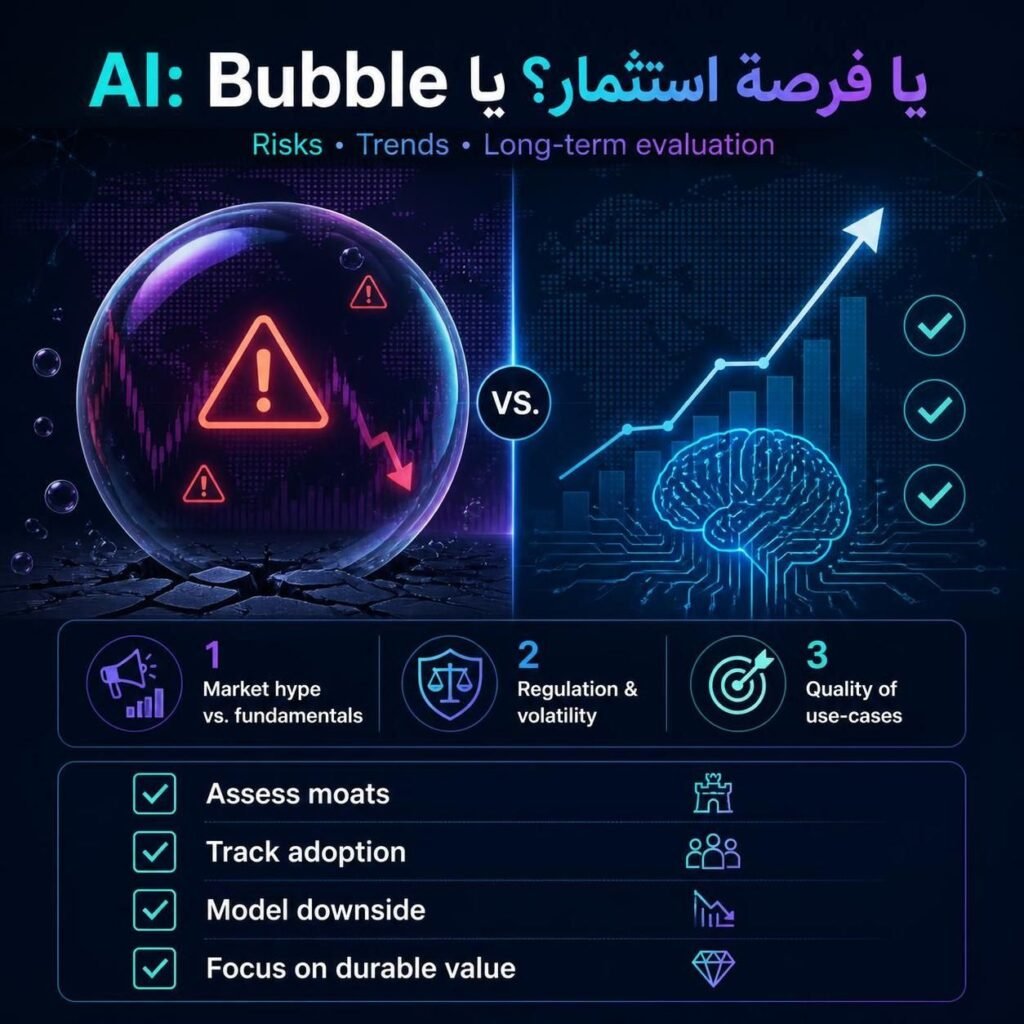
AI Bubble or Investment Opportunity Estimated Reading Time: 20–25 Minutes
Introduction
AI Bubble or Investment Opportunity is one of the biggest questions investors, entrepreneurs, and technology enthusiasts are asking today.
From billion-dollar AI startups to record-breaking investments in AI infrastructure, artificial intelligence has become one of the fastest-growing industries in history. Yet many experts also warn that excessive hype, inflated company valuations, and unrealistic expectations could lead to another technology bubble.
So, how should investors separate genuine long-term opportunities from short-term excitement?
This question matters now more than ever.
Since the release of advanced generative AI models, businesses of every size have begun integrating AI into their daily operations. Governments are investing billions in AI research, while technology companies are competing to build faster chips, larger data centers, and more capable AI systems
At the same time, financial markets have rewarded many AI-related companies with dramatic stock price increases, raising concerns that speculation may be running ahead of reality.
The truth is more nuanced than either extreme.
Artificial intelligence is undoubtedly transforming industries, but not every AI company will succeed, and not every investment will generate strong returns.
Understanding where the real value lies requires looking beyond headlines and examining technology, business fundamentals, market trends, and historical lessons
In this guide, we’ll explore whether today’s AI boom resembles previous speculative bubbles or represents a genuine technological revolution with decades of growth ahead.
You’ll learn how experienced investors evaluate AI companies, where the biggest opportunities may emerge, and which warning signs deserve careful attention before investing
As I always say, and based on every experience I’ve had in this field and others, learning, patience, and perseverance are the path to success
Table of Contents
What Does “AI Bubble or Investment Opportunity” Really Mean?
Why AI Is Attracting Record Investment
Lessons from Previous Technology Bubbles
How AI Creates Real Economic Value
The Difference Between Hype and Sustainable Innovation
Industries Benefiting Most from AI
Risks Every Investor Should Understand
Case Studies of AI Successes and Failures
How Beginners Can Evaluate AI Investments
Common Mistakes Investors Make
People Also Ask
Frequently Asked Questions
Key Takeaways
Conclusion
What Does “AI Bubble or Investment Opportunity” Really Mean?
Before deciding whether artificial intelligence represents a bubble or a genuine investment opportunity, it’s important to understand what financial markets actually mean by the word “bubble.”
An investment bubble occurs when asset prices rise far beyond their intrinsic value, mainly because investors expect prices to continue climbing rather than because businesses are generating sustainable profits
History has seen many famous examples, from the Dutch Tulip Mania in the 1600s to the Dot-Com Bubble around the year 2000.
Not every rapidly growing industry becomes a bubble, however.
Many revolutionary technologies initially appear overvalued because investors correctly anticipate decades of future growth.
The challenge lies in distinguishing temporary speculation from long-term economic transformation.
Artificial intelligence currently sits at the center of this debate
Supporters argue that AI is becoming as essential as electricity or the internet.
Skeptics counter that investors are paying extraordinary prices for companies whose future profits remain uncertain.
Both perspectives contain elements of truth.
Understanding the Difference Between Hype and Innovation
Every groundbreaking technology experiences a period of intense excitement.
This excitement often produces three distinct phases:
Stage
Market Behavior
Investor Psychology
Early Innovation
Limited adoption, high uncertainty
Curious but cautious
Rapid Hype
Massive investment and media attention
Fear of Missing Out (FOMO)
Market Maturity
Strong companies survive while weaker ones disappear
Focus shifts toward profitability
Artificial intelligence appears to be transitioning between the second and third phases.
While media coverage often focuses on dramatic breakthroughs, professional investors increasingly ask deeper questions:
Can this company generate sustainable profits?
Does its AI technology solve real business problems?
Are customers willing to pay for these solutions?
Does the company possess a durable competitive advantage?
These questions matter far more than short-term stock price movements.
Why Investors Are Divided
One reason the debate continues is that AI combines characteristics of both a transformational technology and a highly speculative market.
Optimists point to impressive achievements:
AI assists doctors in detecting diseases earlier
Manufacturers reduce production costs through predictive maintenance.
Financial institutions automate fraud detection.
Software developers improve productivity using AI coding assistants.
Scientists accelerate drug discovery using machine learning
These are measurable improvements that create real economic value
On the other hand, critics observe warning signs commonly associated with speculative bubbles:
Companies adding “AI” to their branding to attract investors
Startups raising billions before proving profitable business models
Stock prices rising much faster than company earnings
Extremely high expectations for future growth
Both observations can be accurate simultaneously
History shows that revolutionary technologies often experience speculative excess before settling into sustainable long-term growth
Why AI Is Attracting Record Investment
Artificial intelligence is not receiving unprecedented investment simply because it is fashionable
Several structural forces are driving capital into the sector
Productivity Growth
Businesses constantly seek ways to reduce costs while increasing efficiency
AI can automate repetitive tasks, analyze enormous datasets in seconds, improve customer service, and support faster decision-making
These improvements directly influence profitability
Demographic Change
Many developed countries face aging populations and labor shortages.
AI helps organizations accomplish more work without proportionally increasing their workforce
Competitive Pressure
Once one company successfully integrates AI into its operations, competitors often feel pressure to adopt similar technologies simply to remain competitive
This creates a powerful cycle of investment across entire industries
The AI Investment Ecosystem
Unlike previous technology booms, today’s AI economy extends far beyond software companies.
The ecosystem includes multiple interconnected sectors.
Sector
Role in AI Economy
Semiconductor Manufacturers
Design AI chips and processors
Cloud Computing Providers
Supply computing infrastructure
AI Model Developers
Build large language models
Enterprise Software Companies
Integrate AI into business workflows
Cybersecurity Firms
Protect AI systems and data
Healthcare Technology Companies
Apply AI in medical research
Robotics Companies
Combine AI with automation
This diversity reduces the likelihood that all AI investments will succeed—or fail—at the same time.
Some companies sell the infrastructure powering AI, while others build applications using that infrastructure.
Understanding this distinction is essential for investors
Infrastructure vs Applications
One lesson experienced investors have learned from previous technology revolutions is that infrastructure providers often benefit regardless of which application becomes dominant
During the California Gold Rush, many merchants selling tools and equipment earned steadier profits than individual gold miners.
A similar analogy applies to AI
Companies producing advanced processors, networking equipment, cloud services, and data center technologies may benefit from widespread AI adoption even if individual AI applications change over time
Meanwhile, application developers face greater competitive pressure because software markets evolve rapidly.
Neither approach is inherently superior, but each carries different risks and reward profiles
Historical Lessons: Every Technology Revolution Looked Like a Bubble
One of the most valuable perspectives comes from history.
Investors often compare today’s AI enthusiasm with previous technological revolutions.
However, history suggests an important pattern.
Many revolutionary technologies initially experienced speculative bubbles without invalidating their long-term impact.
Examples from History
The railroad boom of the nineteenth century attracted enormous investment, followed by financial crashes.
The internet experienced a spectacular bubble in the late 1990s
Electricity generated intense investor excitement during its early commercial expansion
Despite temporary market corrections, each technology permanently transformed the global economy.
The critical question was never whether the technology mattered
The real question was which companies would survive long enough to capitalize on that transformation
Artificial intelligence may follow a similar path
The technology itself could reshape nearly every industry while many individual companies disappear through competition, poor execution, or unsustainable business models.
That distinction helps explain why experienced investors spend more time evaluating business fundamentals than predicting short-term market sentiment
AI Bubble or Investment Opportunity? The Complete 2026 Investor’s Guide (Part 2)
The Dot-Com Bubble vs. Today’s AI Boom
Whenever investors discuss whether artificial intelligence has become overvalued, one historical comparison appears almost immediately: the Dot-Com Bubble of the late 1990s.
At first glance, the similarities seem obvious. Both periods were driven by revolutionary technologies that promised to reshape the global economy. Investors rushed to fund new companies, venture capital reached record levels, and stock prices climbed rapidly.
However, looking beyond the headlines reveals several important differences.
What Happened During the Dot-Com Bubble?
The commercialization of the internet created enormous excitement. Businesses believed that simply having a website would transform their future, and investors rewarded almost any company associated with the internet.
Many firms had little revenue, no clear path to profitability, and business models based largely on expectations rather than proven demand.
When market sentiment changed, many of those companies disappeared. Yet the internet itself continued to grow and ultimately became one of the most important technologies in modern history.
Companies with strong fundamentals, such as Amazon, survived the crash and became global leaders because they focused on solving real customer problems rather than chasing short-term market enthusiasm.
The lesson is clear: revolutionary technology can be real even when many investments fail.
Why Today’s AI Market Is Different
Artificial intelligence shares some characteristics with the internet boom, but the business environment has changed considerably.
Unlike many internet startups in the late 1990s, numerous AI products already generate measurable value.
Organizations are using AI to:
Reduce customer support costs.
Improve software development productivity.
Detect financial fraud more efficiently.
Analyze medical images.
Automate repetitive administrative work.
Improve logistics and supply chain planning.
These are not theoretical use cases. Many businesses report measurable efficiency gains after implementing AI solutions.
Another key difference is the maturity of today’s technology companies.
Large firms investing billions in AI often have established revenue streams, experienced leadership teams, and global customer bases. Their AI investments are supported by profitable businesses rather than speculation alone.
This does not eliminate risk, but it changes the nature of that risk.
Where Hype Still Exists
Even if artificial intelligence creates genuine value, not every AI-related company deserves its valuation.
Investors should remain cautious when they encounter businesses that:
Promote AI without explaining how it creates customer value.
Depend entirely on future expectations rather than current progress.
Spend heavily on marketing while producing little innovation.
Frequently change their business strategy to follow market trends.
Use AI primarily as a branding tool.
History shows that market enthusiasm often attracts opportunistic businesses hoping to benefit from popular trends.
Careful research becomes increasingly important during periods of rapid technological change.
How AI Creates Real Economic Value
One reason many analysts remain optimistic about artificial intelligence is that it can improve productivity across nearly every sector of the economy.
Unlike technologies limited to one industry, AI functions as a general-purpose technology.
This means it can support manufacturing, finance, healthcare, education, retail, agriculture, transportation, engineering, and scientific research simultaneously.
Productivity Is the Real Investment Story
Investors sometimes focus too heavily on exciting product announcements while overlooking the factor that ultimately drives long-term business success: productivity.
When organizations save time, reduce operational costs, improve quality, or increase customer satisfaction, they create economic value.
Artificial intelligence contributes to each of these areas.
For example:
Business Function
Traditional Process
AI-Enhanced Process
Customer Support
Manual responses
AI-assisted support with human oversight
Marketing
Broad campaigns
Personalized recommendations
Manufacturing
Scheduled maintenance
Predictive maintenance using machine learning
Healthcare
Manual image review
AI-assisted diagnostics supporting clinicians
Software Development
Manual coding
AI-assisted code generation and review
Finance
Manual fraud detection
Real-time anomaly detection
The important point is that AI usually complements human expertise rather than replacing it entirely.
Organizations that combine skilled professionals with effective AI tools often achieve better outcomes than relying on either alone.
Case Study: AI in Healthcare
Healthcare demonstrates how AI can create lasting value when applied responsibly.
Modern AI systems help medical professionals analyze imaging data, identify patterns in large datasets, and prioritize cases that may require immediate attention.
Rather than replacing physicians, these systems often serve as decision-support tools.
Benefits include:
Faster image analysis.
Improved workflow efficiency.
Earlier identification of potential abnormalities.
Better allocation of specialist resources.
The technology still requires careful clinical validation, regulatory oversight, and human judgment, but it illustrates how AI can enhance existing professions instead of eliminating them.
Case Study: AI in Software Development
Software engineering has experienced one of the fastest rates of AI adoption.
Developers increasingly use AI assistants to:
Generate code suggestions.
Explain unfamiliar programming concepts.
Detect potential bugs.
Create documentation.
Write automated tests.
Experienced engineers consistently report that AI helps accelerate routine tasks, allowing more time for architecture, problem-solving, and collaboration.
However, successful teams also recognize AI’s limitations.
Generated code still requires review, testing, and security evaluation before deployment.
This balanced approach reflects a broader lesson for investors: sustainable AI businesses generally focus on augmenting human expertise rather than promising complete automation.
What Determines Whether an AI Company Will Succeed?
Experienced investors evaluate AI companies using several practical questions:
1. Does the Company Solve a Real Problem?
Innovative technology has limited value if customers do not need it.
Successful AI companies usually address specific business challenges with measurable outcomes.
2. Can the Business Generate Recurring Revenue?
Subscription models, enterprise contracts, and long-term customer relationships often provide greater stability than one-time sales.
3. Is the Technology Difficult to Replicate?
Competitive advantages may include proprietary datasets, specialized expertise, trusted customer relationships, or strong integration within existing workflows.
4. Can the Company Adapt?
Artificial intelligence evolves rapidly.
Organizations that continuously improve their products are often better positioned than those relying on a single breakthrough.
Warning Signs Investors Should Watch
Not every opportunity deserves investment.
Several warning signs appear repeatedly in speculative markets:
Revenue growth without improving profitability.
Extremely optimistic financial projections unsupported by evidence.
Frequent changes in strategic direction.
Heavy dependence on one product or one customer.
Weak corporate governance.
Limited transparency regarding AI capabilities.
These factors do not necessarily indicate failure, but they justify deeper investigation before making investment decisions.
Expert Insight
One pattern has become increasingly clear during every major technology revolution
The companies that create lasting value usually spend less time making extraordinary promises and more time solving practical problems for customers
Markets may reward excitement in the short term, but over longer periods they tend to reward businesses that consistently deliver useful products, retain customers, and improve profitability
For investors, that distinction often matters far more than predicting the next headline
AI Bubble or Investment Opportunity? The Complete 2026 Investor’s Guide
Industries That Could Benefit Most from Artificial Intelligence
One of the strongest arguments supporting the idea that AI is more than just a speculative trend is the sheer number of industries already integrating AI into their operations.
Unlike previous technological innovations that transformed only a handful of sectors, artificial intelligence is proving to be a general-purpose technology capable of improving productivity across the entire economy.
For investors, this means the opportunity isn’t limited to companies building AI models. Many businesses adopting AI effectively may become long-term winners.
Healthcare
Healthcare remains one of the most promising AI markets.
Hospitals, pharmaceutical companies, and research organizations increasingly use AI to support diagnosis, accelerate drug discovery, improve patient scheduling, and analyze medical images.
While AI cannot replace doctors, it can significantly reduce administrative work and assist professionals in making faster, more informed decisions.
Key Investment Drivers
Aging populations worldwide.
Rising healthcare costs.
Demand for faster diagnostics.
Growth in personalized medicine.
However, investors should remember that healthcare is highly regulated, meaning AI adoption often takes longer than in other industries.
Financial Services
Banks and financial institutions were early adopters of machine learning long before generative AI became mainstream.
Today, AI supports:
Fraud detection.
Credit risk analysis.
Customer support automation.
Investment research.
Regulatory compliance.
Personalized financial recommendations.
Financial institutions invest heavily in AI because even small improvements in efficiency can generate substantial savings.
The sector is expected to remain one of AI’s largest enterprise customers over the next decade.
Manufacturing
Manufacturing demonstrates how AI creates measurable economic value rather than simply generating excitement.
Manufacturers use AI to:
Predict equipment failures.
Improve quality control.
Reduce downtime.
Optimize supply chains.
Forecast inventory demand.
These improvements directly reduce costs and increase profitability.
For investors, companies providing industrial AI software or automation infrastructure may offer attractive long-term opportunities.
Software and Enterprise Technology
Enterprise software companies are integrating AI into nearly every category of business software.
Examples include:
Customer relationship management (CRM).
Human resources platforms.
Project management tools.
Cybersecurity software.
Data analytics platforms.
Customer service systems.
Rather than selling standalone AI products, many software providers are embedding AI into existing services, increasing customer value while creating new revenue opportunities.
Education
Education is another sector experiencing rapid AI adoption.
AI-powered learning platforms can:
Personalize lesson plans.
Provide instant feedback.
Support language learning.
Assist teachers with administrative work.
Create adaptive learning experiences.
Although AI will not replace teachers, it can enhance learning efficiency and improve access to educational resources worldwide.
Where Investors Should Be More Careful
While AI offers significant opportunities, some market segments deserve additional caution.
Companies Using “AI” Only as a Marketing Label
Whenever a technology becomes popular, some businesses attempt to capitalize on investor enthusiasm without offering meaningful innovation.
Warning signs include:
Vague product descriptions.
Limited technical expertise.
No measurable customer outcomes.
Excessive promotional language.
Frequent strategic changes.
Investors should look beyond branding and understand how AI contributes to the company’s actual business model.
Startups Without Sustainable Revenue
Innovation often requires years of investment before profitability.
However, companies that rely solely on continuous fundraising may struggle if market conditions change.
Before investing, consider questions such as:
Does the company have paying customers?
Is customer retention improving?
Can operating expenses be supported over time?
Is there a realistic path toward profitability?
These questions are often more important than short-term revenue growth alone.
Risks Every AI Investor Should Understand
Every investment carries risk.
Artificial intelligence is no exception.
Understanding these risks helps investors make more informed decisions instead of reacting emotionally to market headlines.
Regulatory Risk
Governments worldwide are developing AI regulations covering:
Privacy.
Copyright.
Consumer protection.
Transparency.
Data security.
Future regulations could increase compliance costs or limit certain AI applications.
Companies that prioritize responsible AI development may adapt more successfully to changing regulations.
Competition
The AI industry evolves at remarkable speed.
Today’s market leader may face intense competition tomorrow.
New startups emerge continuously, while established technology companies invest billions in AI research.
This dynamic environment makes competitive advantages especially important.
Infrastructure Costs
Developing advanced AI systems requires significant computing resources.
Training large AI models involves:
Expensive processors.
Massive data centers.
High electricity consumption.
Skilled engineering teams.
Companies unable to manage these costs efficiently may struggle financially despite having impressive technology.
Market Expectations
Perhaps the greatest investment risk is unrealistic expectations.
Markets sometimes price companies based on future optimism rather than current business performance.
If growth slows—even temporarily—stock prices may decline sharply despite continued business progress.
Experienced investors understand that excellent companies can still become poor investments when purchased at excessive valuations.
Common Mistakes Beginners Make
New investors often repeat similar mistakes during periods of technological excitement.
Learning to recognize these mistakes can improve long-term investment decisions.
Mistake #1: Investing Based Only on Headlines
News stories often highlight breakthrough announcements without explaining financial fundamentals.
Instead of reacting immediately, examine:
Revenue growth.
Profit margins.
Customer adoption.
Competitive positioning.
Long-term strategy.
Mistake #2: Assuming Every AI Company Will Win
Artificial intelligence is transforming industries.
That does not mean every company using AI will become successful.
History shows that technological revolutions create both winners and losers.
Diversification remains an important risk management strategy.
Mistake #3: Ignoring Valuation
A great company can still represent a poor investment if purchased at an unrealistic price.
Successful investing involves evaluating both:
Business quality.
Purchase price.
Ignoring either factor increases investment risk.
Mistake #4: Following Social Media Hype
Online discussions often focus on rapid price movements instead of business fundamentals.
While social media can introduce interesting ideas, investment decisions should be based on careful research rather than viral trends.
A Practical Framework for Evaluating AI Investments
Professional investors rarely rely on excitement alone.
Instead, they ask structured questions before making decisions.
Step 1: Understand the Business
Can you explain—in simple language—what the company actually sells?
If the business model is difficult to understand, additional research may be necessary.
Step 2: Identify the Customer
Who pays for the product?
Businesses with strong customer demand generally have more sustainable growth opportunities.
Step 3: Measure Competitive Advantage
Does the company possess something competitors cannot easily copy?
Examples include:
Proprietary datasets.
Industry expertise.
Strong brand recognition.
Long-term enterprise contracts.
Specialized infrastructure.
Step 4: Evaluate Financial Health
Key indicators include:
Revenue growth.
Gross margins.
Cash flow.
Debt levels.
Research and development investment.
Financial strength often provides flexibility during periods of market uncertainty.
Step 5: Think Long Term
Artificial intelligence will likely evolve over decades rather than months
Long-term investors generally focus more on business execution than short-term market volatility
Patience has historically rewarded investors who identify genuinely innovative companies with sustainable competitive advantages
Expert Perspective: The Real Question Investors Should Ask
The debate is often framed as:
“AI Bubble or Investment Opportunity?”
However, experienced investors usually ask a different question
Instead of wondering whether AI itself represents a bubble, they ask:
Which companies are building durable businesses that will still matter ten years from now?
This subtle shift changes the entire investment process
Rather than chasing excitement, investors begin evaluating products, leadership, customer relationships, financial performance, and competitive advantages
Technology trends come and go
Businesses that consistently solve meaningful problems tend to create lasting value
AI Bubble or Investment Opportunity? The Complete 2026 Investor’s Guide
People Also Ask
Is Artificial Intelligence a Bubble Like the Dot-Com Era?
Artificial intelligence shares some similarities with the dot-com boom, such as rapid investment, strong market enthusiasm, and high expectations.
However, AI is already creating measurable value in many industries, including healthcare, finance, manufacturing, and software development.
The main risk is not the technology itself but investing in companies with unrealistic valuations or weak business models.
Is AI Still a Good Investment Opportunity?
Artificial intelligence may offer significant long-term opportunities because it is becoming an important business tool across multiple sectors.
However, investment decisions should be based on careful analysis of individual companies, their financial health, competitive advantages, and ability to generate sustainable value.
What Industries Will Benefit Most from AI?
Industries likely to benefit significantly from AI include:
Healthcare.
Financial services.
Cybersecurity.
Manufacturing.
Software.
Education.
Logistics.
Scientific research.
Companies that successfully integrate AI into existing workflows may gain efficiency advantages and improve their competitiveness
How Can Beginners Invest in Artificial Intelligence?
Beginners can start by learning about the AI ecosystem, understanding different types of companies involved, and researching investment options carefully
Some investors choose individual companies, while others prefer diversified funds that include multiple technology businesses
The appropriate approach depends on personal goals, risk tolerance, and investment knowledge
Will AI Replace Human Workers?
AI is expected to change many jobs by automating certain tasks and improving productivity
In many cases, the biggest impact may come from people using AI tools becoming more productive rather than AI completely replacing human professionals
What Is the Biggest Risk of Investing in AI?
The biggest risks include:
Excessive valuations
Intense competition.
Regulatory changes
High infrastructure costs
Investing in companies that use AI mainly as a marketing term without creating real business value
Frequently Asked Questions
Is AI a Bubble or a Genuine Investment Opportunity?
The answer is more complex than a simple yes or no
Artificial intelligence is a real technological transformation with practical applications, but some companies connected to AI may become overvalued
Investors should separate the long-term potential of AI technology from the short-term excitement surrounding individual investments
What Makes an AI Company Valuable?
A valuable AI company usually combines strong technology with a clear business model
Important factors include:
Customer demand
Recurring revenue.
Competitive advantages
Experienced leadership
Efficient operations
The ability to improve products over time
Should Investors Focus on AI Startups or Established Technology Companies?
AI startups may offer exposure to innovation and rapid growth potential, but they usually carry higher risks because many lack proven revenue models.
Established technology companies often have stronger financial resources, existing customers, and large research budgets.
The choice depends on the investor’s goals and risk tolerance.
How Can Someone Evaluate an AI Company Before Investing?
Investors should examine:
The problem the company solves.
Customer demand.
Revenue growth.
Profitability.
Competitive advantages.
Management quality.
Long-term strategy.
Is Artificial Intelligence the Next Industrial Revolution?
Many experts consider AI one of the most important technological shifts since the internet.
However, major technologies often require years before reaching their full economic impact.
The strongest companies are usually those that successfully turn innovation into practical solutions.
Can AI Generate Passive Income?
AI can help create products, automate processes, and improve business efficiency.
However, sustainable income usually requires skills, planning, customers, and continuous effort.
AI should be considered a powerful tool, not an automatic income machine.
What Skills Will Become More Valuable Because of AI?
Important skills include:
Critical thinking.
Creativity.
Problem solving.
Communication.
Data analysis.
Business strategy.
Effective use of AI tools.
What Should Investors Avoid During an AI Boom?
Investors should avoid:
Following hype without research.
Investing in companies they do not understand.
Assuming every AI company will succeed.
Ignoring valuation.
Making emotional decisions.
Key Takeaways
AI is a major technological transformation, but not every AI investment will succeed.
The important question is not whether AI exists, but which companies can create sustainable value.
Real business problems and customer demand matter more than marketing promises.
Investors should study financial health, competition, and long-term strategy.
Healthcare, finance, manufacturing, software, and education are among the industries benefiting from AI.
Market excitement can create opportunities but also unrealistic expectations.
Long-term research and risk management remain essential.
Conclusion
The question “AI Bubble or Investment Opportunity?” represents one of the biggest investment discussions of the modern technology era.
Artificial intelligence is already changing industries, improving productivity, and creating new business models.
However, investors should understand that technological importance does not automatically mean every related company will succeed.
The future winners will likely be businesses that combine strong technology with real customer value, efficient operations, and sustainable growth.
Rather than simply chasing the AI trend, investors should focus on understanding the technology, evaluating companies carefully, and thinking long term.
Artificial intelligence may become one of the defining technologies of this century.
The real opportunity is not just investing in AI, but recognizing where lasting value will be created.