Based on my past experiences and experiences over the years, I always recommend that patience, perseverance, and continuous learning are the best way to reach your goal
Introduction: How AI Agents Are Changing the Future of Work and Business
AI Agents are becoming one of the most important technologies shaping the future of work, business, and digital opportunities. Unlike traditional software tools that only respond to commands, AI Agents can understand goals, analyze information, make decisions, and complete complex tasks with limited human supervision
For many years, artificial intelligence was mainly used for answering questions, generating text, or analyzing data. Today, AI is moving into a new phase where intelligent systems are not only providing information but also taking action.
This change matters because businesses and professionals are searching for better ways to increase productivity, reduce costs, and compete in a rapidly changing digital economy.
AI Agents can help companies automate repetitive processes, improve customer service, analyze data, and create new products and services. For individuals, they may create opportunities to build AI-powered businesses, develop new skills, and increase personal productivity
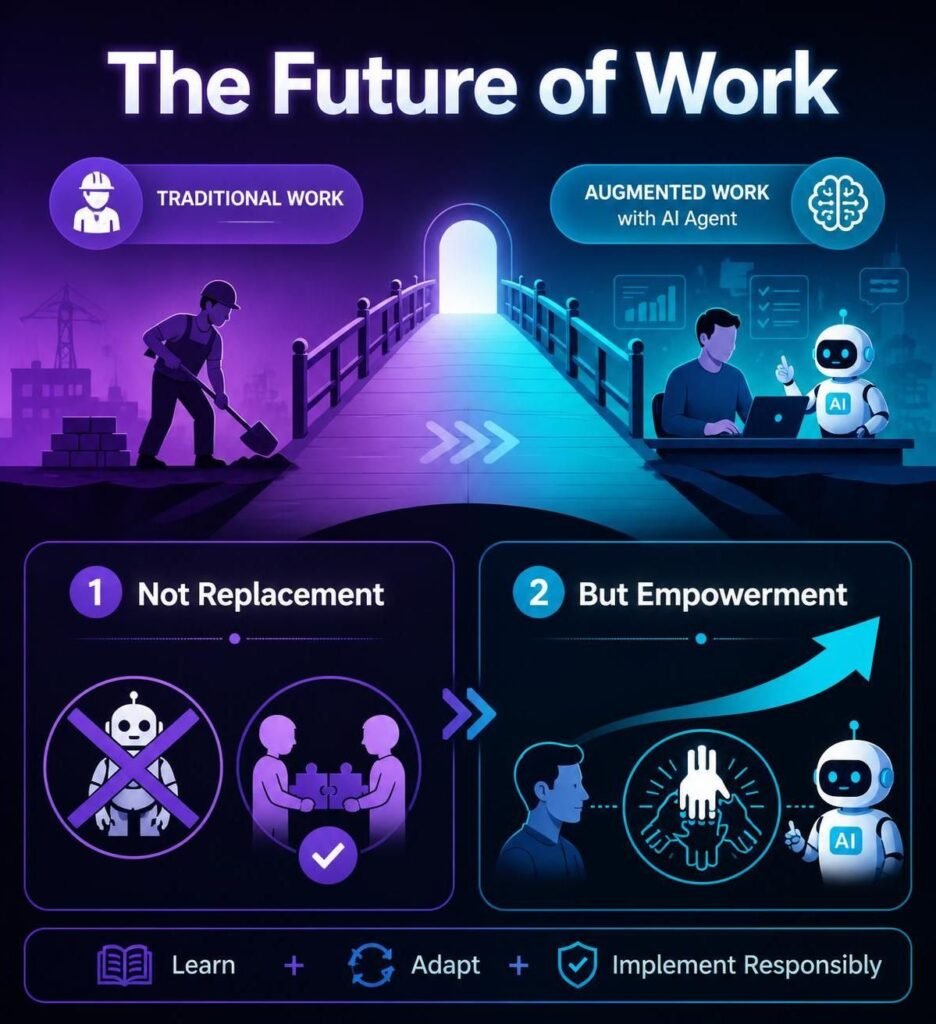
However, the future of AI Agents is not about replacing humans completely. The strongest results will come from combining artificial intelligence with human creativity, experience, critical thinking, and decision-making
In this guide, we will explore what AI Agents are, how they work, how they will transform work and profit, and how beginners can prepare for the opportunities created by this technology.
Table of Contents
- What Are AI Agents?
- How Do AI Agents Work?
- AI Agents vs Traditional AI Tools
- Why AI Agents Are Becoming Important
- How AI Agents Will Transform the Future of Work
- How Businesses Can Use AI Agents
- How AI Agents Create New Income Opportunities
- Best AI Business Ideas for Beginners
- Realistic AI Agent Examples
- Benefits and Challenges of AI Agents
- Skills Needed to Succeed With AI Agents
- The Future of AI Agents
- Frequently Asked Questions
- Key Takeaways
- Conclusion
What Are AI Agents?
AI Agents are intelligent software systems designed to achieve specific goals by understanding instructions, analyzing information, planning actions, and completing tasks
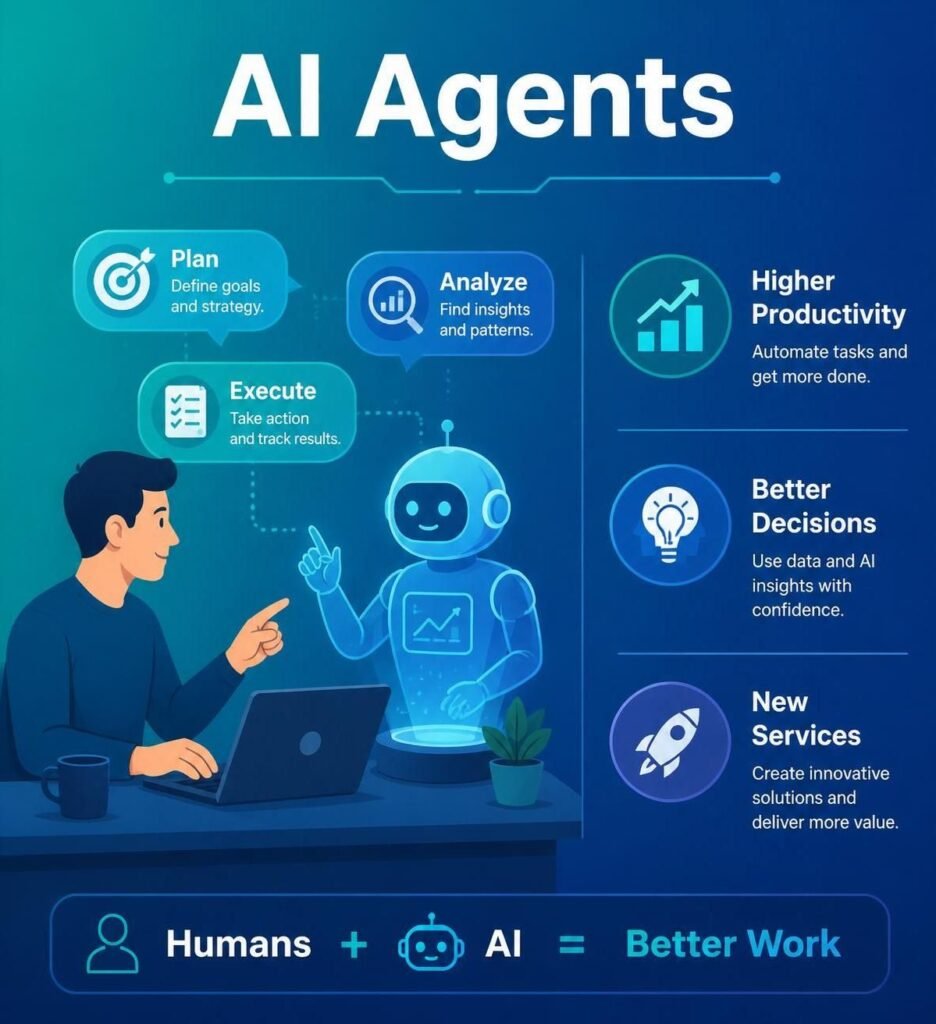
The biggest difference between AI Agents and traditional AI tools is their ability to operate with a higher level of independence.
A traditional AI tool usually follows a simple process:
- The user provides a request.
- The system generates a response.
- The user takes the next action.
An AI Agent follows a more advanced process:
- The user defines a goal.
- The AI Agent analyzes the objective.
- It creates a plan.
- It uses available tools.
- It completes multiple steps.
- It evaluates the results.
For example, a traditional AI writing tool may help create a product description.
An AI Agent could potentially:
- Research customer interests.
- Analyze competitors.
- Suggest marketing strategies.
- Create content ideas.
- Organize campaigns.
- Measure performance.
The difference is that AI Agents are designed to help complete workflows, not only generate answers.
How Do AI Agents Work?
AI Agents combine several technologies that allow them to understand information, make decisions, and perform actions.
Artificial Intelligence Models
Most modern AI Agents are powered by advanced artificial intelligence models known as large language models
These models allow systems to understand human language, analyze information, and generate useful responses
Organizations such as OpenAI, Google AI, and Anthropic are developing advanced AI technologies that support increasingly powerful AI applications
Planning and Decision-Making
One of the most important abilities of AI Agents is their capacity to break large objectives into smaller tasks
For example, a company may want to improve customer satisfaction.
An AI Agent could:
- Review customer feedback
- Identify common problems
- Suggest improvements.
- Prepare reports
- Track future changes.
This ability makes AI Agents valuable for business operations where multiple steps are required.
Tool Integration
AI Agents become more powerful when they can connect with external tools and systems.
Examples include:
- Databases.
- Business software
- Customer management platforms.
- Analytics systems
- Scheduling applications.
This allows AI Agents to move from simple conversations to real-world actions.
Memory and Personalization
Some AI Agent systems can remember previous interactions and use information from earlier conversations.
For businesses, this can help create personalized experiences based on:
- Customer preferences
- Company policies
- Previous decisions
- Business objectives.
AI Agents vs Traditional AI Tools
Although many applications use artificial intelligence, not all AI systems are AI Agents.
| Feature | Traditional AI Tools | AI Agents |
|---|---|---|
| Main purpose | Generate answers or content | Complete goals and tasks |
| Human involvement | Needed frequently | Reduced after setup |
| Decision-making | Limited | More advanced |
| Workflow management | Basic | Multi-step automation |
| Business use | Individual tasks | Complete processes |
A traditional AI tool may help write an email.
An AI Agent could:
- Understand the purpose of the email
- Analyze previous communication
- Prepare different versions
- Schedule follow-up actions
- Track responses.
This difference explains why AI Agents are expected to become increasingly important in business.
Why AI Agents Are Becoming Important in 2026
Businesses Need More Efficiency
Companies around the world are looking for ways to improve productivity while controlling costs
Many daily activities consume valuable time:
- Customer support
- Data organization.
- Reporting.
- Administrative work.
- Market research
AI Agents can help automate these processes and allow employees to focus on more valuable activities
Small Businesses Can Access Advanced Technology
In the past, many powerful business solutions were available mainly to large companies.
AI Agents are changing this by allowing smaller businesses to access intelligent systems that support:
- Marketing
- Sales.
- Customer service.
- Business analysis.
This creates new opportunities for entrepreneurs and small teams.
The Rise of AI-Powered Entrepreneurship
AI Agents may reduce some barriers to starting a digital business
A solo entrepreneur can use AI systems to support:
- Research.
- Planning.
- Content creation
- Customer communication.
- Business analysis.
The technology does not remove the need for skills, but it can help individuals achieve more with limited resources
How AI Agents Will Transform the Future of Work
AI Agents as Digital Work Assistants
One of the biggest changes will be the growth of AI-powered assistants that support professionals in their daily activities.
A manager may use an AI Agent to:
- Summarize meetings.
- Organize projects.
- Prepare reports.
A researcher may use an AI Agent to:
- Collect information
- Compare sources
- Organize findings.
A marketer may use an AI Agent to:
- Analyze audiences.
- Improve campaigns.
- Generate new ideas.
The future of work will likely focus on collaboration between humans and intelligent systems
How AI Agents Create New Income Opportunities
The rise of AI Agents is creating a new digital economy where businesses and individuals can use intelligent systems to provide better services, automate complex processes, and create new products
However, the biggest opportunities will not come from simply using AI tools. The real value comes from understanding problems and building solutions that save time, improve results, or reduce costs
A company does not pay because a service uses artificial intelligence. It pays because the service creates a measurable benefit.
For example:
A business owner is not interested in buying an AI Agent just because it is advanced technology. They are interested in:
- Receiving faster customer support
- Increasing sales
- Reducing repetitive work
- Understanding customers better.
- Improving business decisions
This difference is important for anyone who wants to build an AI-based business.
AI Agents and the New Digital Business Model
Traditional businesses often require different employees for different functions:
- Marketing.
- Customer support.
- Research.
- Administration.
- Data analysis.
AI Agents can support many of these activities, allowing smaller teams to operate more efficiently.
A future small business may combine:
- Human experts who make important decisions.
- AI Agents that manage repetitive processes.
- Automated systems that organize information.
For example, an online store with a small team could use:
- A customer service AI Agent to answer common questions.
- A marketing AI Agent to analyze campaigns.
- A research AI Agent to study competitors.
- A data AI Agent to identify sales trends.
The business still needs human leadership, but AI Agents can increase the team’s capabilities.
Best AI Money-Making Ideas for Beginners in 2026
Many beginners are interested in learning how to make money with AI without coding. While technical knowledge is valuable, many opportunities depend more on understanding business needs and applying existing AI solutions effectively.
The following ideas represent realistic opportunities rather than unrealistic promises of quick wealth
AI Automation Services for Small Businesses
Small businesses often lose many hours every week on repetitive tasks.
Examples include:
- Answering the same customer questions.
- Organizing appointments.
- Processing documents.
- Preparing reports.
- Managing emails.
An AI Agent can help automate these processes.
Example: AI Agent for a Local Service Business
Imagine a small fitness center that receives many daily messages asking:
- What are the membership prices?
- What classes are available?
- How can someone book a session?
- What are the opening hours?
Instead of employees answering every question manually, an AI Agent can handle common requests instantly
The employees can focus on:
- Building relationships with customers.
- Improving services.
- Managing important situations.
The person who creates this AI solution provides value because they solve a real operational problem
AI Content and Marketing Services
Marketing is another area where AI Agents can create significant opportunities.
Businesses need content, but creating effective content requires more than writing words.
Successful marketing requires:
- Understanding the audience.
- Researching competitors.
- Identifying customer problems.
- Creating useful messages.
- Measuring results
AI Agents can support marketers by helping with:
- Market research.
- Content planning.
- Customer analysis.
- Campaign organization
- Performance reports.
However, quality remains essential.
Publishing large amounts of low-quality AI content is unlikely to create long-term success
The strongest approach is using AI Agents as assistants while humans provide:
- Strategy
- Creativity
- Experience
- Final judgment
AI Research and Data Analysis Services
Modern companies collect enormous amounts of information
The challenge is not always finding data. The challenge is understanding what the data means.
AI Agents can help businesses analyze:
- Customer reviews
- Market trends.
- Sales information
- Competitor activity
Example
An online clothing company receives thousands of customer reviews
An AI Agent can analyze these reviews and identify:
- The most requested product improvements
- Common customer complaints
- Popular features
- Reasons customers return products
This information can help the company make better decisions.
People who combine AI skills with research and analytical thinking can create valuable services in this area
Building Specialized AI Agents
One of the strongest opportunities in the AI market is specialization
General AI tools can help many people, but businesses often need solutions designed for specific industries.
A specialized AI Agent solves a clear problem for a specific group.
Real Estate AI Agent
A real estate professional could use an AI Agent to:
- Organize property information
- Create property descriptions
- Answer customer questions
- Analyze market changes
- Prepare reports
Education AI Agent
Schools and teachers could use AI Agents to:
- Create personalized learning materials.
- Prepare exercises
- Explain difficult concepts
- Organize student progress
Healthcare Administration AI Agent
Healthcare organizations could use AI systems to support:
- Appointment management
- Document organization
- Administrative workflows
Important decisions would still require qualified professionals.
The opportunity comes from improving efficiency, not replacing expertise.
How to Make Money With AI Without Coding
Many people believe that artificial intelligence opportunities require advanced programming skills.
Programming can certainly help, but beginners can also create value by learning how to design useful AI workflows.
Step 1: Understand AI Capabilities
Before creating any service, learn:
- What AI Agents can do
- What tasks they cannot perform reliably
- How automation works
- How businesses can benefit
Understanding limitations is just as important as understanding possibilities.
Step 2: Find a Real Problem
The most successful AI solutions usually start with a problem.
Good questions to ask:
- What tasks take too much time?
- What processes are repetitive?
- Where do businesses lose money?
- What information is difficult to manage?
A clear problem creates a clear opportunity.
Step 3: Create a Simple Solution
Beginners often make the mistake of trying to build a complex AI system immediately.
A better approach is starting small.
Examples:
- A customer FAQ assistant.
- A document summarization workflow.
- A simple reporting system.
- A research assistant.
A simple solution that works is more valuable than a complicated system nobody needs.
Step 4: Improve Through Real Feedback
Successful AI services are developed through continuous improvement.
Listen to users and measure:
- Time saved.
- Problems solved.
- Customer satisfaction.
- Areas needing improvement.
Feedback helps transform an experiment into a professional solution
Case Study: How a Small Online Business Uses AI Agents
Consider a small e-commerce company selling handmade products online.
The company has talented employees but faces several challenges:
- Customers ask repetitive questions.
- Marketing requires too much time.
- Sales data is difficult to analyze.
- Employees spend hours organizing information.
The company decides to introduce AI Agents.
Before Using AI Agents
Customer Support Problems
Employees spend hours answering questions about:
- Shipping times.
- Product availability.
- Return policies.
- Order updates.
Marketing Challenges
The company struggles with:
- Creating content ideas.
- Understanding customer interests.
- Planning campaigns.
Business Analysis Problems
The team has sales data but lacks time to study it.
They cannot easily identify:
- Best-selling products.
- Customer behavior patterns.
- Market opportunities.
After Implementing AI Agents
The company creates several specialized AI systems.
Customer Support AI Agent
The system handles common questions and provides immediate responses.
Human employees continue managing:
- Complex complaints.
- Special requests.
- Important customer relationships.
Marketing AI Agent
The system helps with:
- Finding content opportunities.
- Organizing campaigns.
- Studying customer interests.
The marketing team uses this information to create better strategies.
Analytics AI Agent
The system analyzes business information and identifies patterns.
It helps answer questions such as:
- Which products perform best?
- Which customers are most engaged?
- Which marketing activities create better results?
The Business Impact
The company does not remove human workers.
Instead, employees spend more time on valuable activities:
- Improving products.
- Developing relationships.
- Creating new ideas.
- Making strategic decisions.
This demonstrates an important principle:
AI Agents are most powerful when they increase human capability rather than simply replace human work.
AI Side Hustles Powered by AI Agents
AI Agents are creating new possibilities for people who want to build additional income streams.
| AI Side Hustle | How AI Agents Help | Important Skills |
|---|---|---|
| AI automation consulting | Create business workflows | Problem-solving |
| AI content services | Improve research and production | Writing and editing |
| AI customer support setup | Build support solutions | Communication |
| AI research services | Analyze information | Research skills |
| AI training services | Teach businesses AI usage | Presentation skills |
These opportunities require learning and effort. AI can increase productivity, but success depends on providing real value.
Benefits and Challenges of AI Agents
AI Agents offer many advantages, but businesses should also understand their limitations.
| Benefits | Challenges |
|---|---|
| Increase productivity | Need human supervision |
| Reduce repetitive tasks | Can produce incorrect results |
| Help small businesses compete | Require learning and setup |
| Create new services | Security and privacy concerns |
| Improve decision-making | Depend on quality information |
A responsible approach is to use AI Agents where they provide clear benefits while keeping human control over important decisions.
Skills Needed to Succeed With AI Agents
Technology alone is not enough. People who succeed with AI Agents will combine technical understanding with human skills.
Problem-Solving Skills
The most valuable ability is identifying problems worth solving.
Successful AI users ask:
“What improvement does this create?”
instead of:
“What AI tool can I use?”
Communication Skills
AI Agents depend on clear goals and instructions.
People who communicate ideas clearly can create better results.
Industry Knowledge
Understanding a specific field creates a major advantage.
A person who understands finance, marketing, education, or healthcare can design better AI solutions than someone who only understands technology.
Critical Thinking
AI systems can make mistakes.
Users must evaluate:
- Accuracy
- Reliability
- Business impact
- Ethical concerns
Human judgment remains one of the most important skills in the AI era
The Future of AI Agents and the Next Era of Work
The development of AI Agents is still in its early stages, but their influence is expected to expand across almost every industry.
The future will not be defined only by more powerful artificial intelligence models. It will be defined by how effectively people and organizations use these systems to create value.
AI Agents may become a normal part of everyday professional life, similar to how computers and smartphones became essential tools in previous decades.
The difference is that AI Agents will not only store information or run programs. They will actively assist with planning, analysis, communication, and decision support.
The Growth of Personal AI Assistants
One of the most important future trends is the rise of personal AI assistants.
In the future, individuals may have AI Agents that understand their goals, preferences, and working style.
A personal AI Agent could help with:
- Organizing daily tasks.
- Managing schedules.
- Researching information.
- Learning new skills.
- Preparing documents.
- Analyzing decisions.
For professionals, this could feel like having a digital assistant available at any time.
However, the quality of these systems will depend on responsible use. Users will need to understand what information they provide and how they manage privacy and security
AI Agents and the Future of Entrepreneurship
AI Agents may create a new generation of entrepreneurs who can build businesses with smaller teams.
In previous decades, launching a company often required:
- Large financial resources.
- Multiple employees.
- Expensive technology.
AI Agents may reduce some of these barriers.
A single entrepreneur could potentially use AI systems to support:
- Market research.
- Customer communication.
- Business planning.
- Marketing operations.
- Administrative tasks.
This does not mean starting a business will become effortless.
Successful entrepreneurs will still need:
- Creativity.
- Market understanding.
- Persistence.
- Customer knowledge.
- Strategic thinking.
AI Agents can increase a person’s abilities, but they cannot replace vision and leadership.
How Companies Should Prepare for AI Agents
Businesses that want to benefit from AI Agents should avoid adopting technology without a clear purpose.
A successful AI strategy begins with understanding business needs.
Companies should consider:
Identify Repetitive Processes
The first step is finding tasks that consume time but do not require complex human judgment.
Examples:
- Basic customer questions.
- Data organization.
- Routine reports.
- Scheduling.
Start With Small Experiments
Instead of changing the entire organization immediately, businesses should test AI Agents in specific areas.
Small experiments allow companies to:
- Measure results.
- Discover problems.
- Improve workflows.
Train Employees
Employees need education about how AI systems work.
The goal should not be replacing workers but helping them become more productive.
Companies that combine AI technology with skilled employees may create stronger results.
Risks and Ethical Considerations of AI Agents
Although AI Agents offer many opportunities, responsible implementation is essential.
Powerful technology also creates challenges.
Accuracy Problems
AI Agents can sometimes produce incorrect information or make unsuitable decisions.
For important areas such as finance, healthcare, and legal services, human review remains necessary.
Data Privacy
AI systems often require access to information.
Businesses must protect:
- Customer data.
- Company information.
- Private documents.
Strong security practices are essential.
Overdependence on Automation
Companies should avoid removing human judgment from important decisions.
Some situations require:
- Empathy.
- Experience.
- Ethical reasoning.
- Personal communication.
The best approach is cooperation between humans and AI systems.
People Also Ask About AI Agents
What are AI Agents in simple words?
AI Agents are intelligent programs that can understand goals, plan actions, and complete tasks with less direct human control.
Unlike simple AI tools that only answer questions, AI Agents can perform multiple steps to achieve an objective.
For example, an AI chatbot may answer a customer question, while an AI Agent may answer the question, update customer information, schedule a follow-up, and prepare a report.
Will AI Agents replace human jobs?
AI Agents will likely change many jobs, but the impact will vary depending on the industry.
Some repetitive tasks may become automated, but new opportunities may appear in areas such as:
- AI management.
- Automation consulting.
- AI training.
- Digital entrepreneurship.
The most important skill will be learning how to work effectively with AI systems.
Can I build a business using AI Agents?
Yes, AI Agents can support many business models.
Examples include:
- AI automation services.
- Industry-specific AI assistants.
- AI consulting.
- AI-powered research services.
However, successful businesses still require understanding customers and solving real problems.
Do I need programming skills to use AI Agents?
Programming skills are helpful but not always required.
Many modern platforms allow users to create AI workflows without advanced coding.
Beginners can start by learning:
- AI concepts.
- Automation principles.
- Business problem analysis.
- Effective communication with AI systems.
Are AI Agents expensive?
The cost depends on the complexity of the system.
Simple AI workflows may be affordable, while advanced business solutions can require significant investment.
The important question is not only the cost but the value created.
A useful AI Agent that saves a company many hours each month may provide a strong return on investment.
What industries will benefit most from AI Agents?
Almost every industry can benefit from AI Agents.
Some areas with strong potential include:
- Marketing.
- Customer service.
- Education.
- Healthcare administration.
- Finance.
- E-commerce.
- Software development.
The biggest opportunities often appear where there are repetitive processes and large amounts of information.
How can beginners start learning about AI Agents?
Beginners can start by:
- Understanding basic AI concepts.
- Experimenting with existing AI tools.
- Learning automation principles.
- Studying business problems.
- Creating small practical projects.
Practical experience is often more valuable than only studying theory.
Are AI Agents reliable enough for businesses?
AI Agents are improving quickly, but they still require monitoring.
Businesses should use them for tasks where they provide clear benefits while maintaining human oversight for important decisions.
Reliability depends on:
- The quality of the AI system.
- The information provided.
- The way it is configured.
- Human supervision.
Frequently Asked Questions About AI Agents
1. What is the main advantage of AI Agents?
The main advantage of AI Agents is their ability to complete complex workflows instead of only performing single tasks.
They can help people save time, improve productivity, and focus on higher-value activities.
2. Can AI Agents create passive income?
AI Agents can support automated business processes, but they do not guarantee passive income.
Successful AI-based businesses usually require:
- Planning.
- Customer research.
- Maintenance.
- Continuous improvement.
The realistic opportunity is building efficient systems that create value.
3. What are the best AI business ideas for beginners?
Some beginner-friendly ideas include:
- AI automation services.
- AI content assistance.
- Customer support solutions.
- Research services.
- AI training.
The best choice depends on personal skills and market needs.
4. How will AI Agents affect small businesses?
AI Agents may help small businesses compete by providing access to automation and advanced analysis tools.
They can help small teams perform tasks that previously required larger resources.
5. What skills should I learn for the AI future?
Important skills include:
- Problem-solving.
- Communication.
- Data understanding.
- Business knowledge.
- Critical thinking.
Technical skills help, but the ability to apply technology effectively is equally important.
Key Takeaways
- AI Agents represent a major evolution in artificial intelligence because they can perform tasks, make decisions, and support complete workflows.
- The biggest opportunities come from solving real problems, not simply using new technology.
- Businesses can use AI Agents to improve efficiency, customer service, marketing, and decision-making.
- Beginners can benefit from AI without becoming expert programmers by learning practical applications.
- Human skills such as creativity, communication, and judgment remain essential
- AI Agents will likely become important tools in future workplaces and businesses
- Responsible use, security, and human oversight are necessary for successful AI adoption
Conclusion: AI Agents and How They Will Change Work and Profit
AI Agents and how they will change work and profit represent one of the most important technological shifts of the coming years
These intelligent systems are changing the relationship between humans and technology. Instead of only using software as a passive tool, people and businesses can work alongside AI systems that help them plan, analyze, and complete tasks.
The biggest opportunity is not replacing human ability. It is increasing it.
Entrepreneurs can use AI Agents to create new services. Businesses can improve operations. Employees can become more productive by focusing on tasks that require creativity and human judgment.
However, success with AI Agents will depend on learning, adaptation, and responsible implementation.
The people who benefit most will not necessarily be those who know the most about technology. They will be those who understand problems, create valuable solutions, and know how to combine artificial intelligence with human expertise.
The future of work is not humans versus AI.
It is humans using AI Agents to achieve more