Introduction
Search online for the phrase rich mindset, and you will find thousands of articles promising that changing your thoughts will change your bank account. Most of them repeat the same advice: think positively, wake up early, write down your goals, and believe that success is coming. While these habits may improve discipline, they do not explain why some people consistently build wealth over decades while others, despite working just as hard, remain financially stuck.
The problem is not that mindset is unimportant. The problem is that it is often misunderstood.
A wealthy mindset is not a collection of motivational beliefs. It is a decision-making framework that influences how a person evaluates opportunities, manages risk, allocates time, and responds to uncertainty. In other words, it shapes the invisible choices that eventually determine visible financial outcomes.
This distinction matters more today than at any point in recent history
The economic environment of 2026 is fundamentally different from the one that existed even a decade ago. Artificial intelligence has reduced the cost of building businesses, creating products, and reaching global audiences. At the same time, technological change has shortened the lifespan of many traditional careers. Knowledge becomes outdated faster, competition moves faster, and opportunities emerge in industries that barely existed a few years ago.
In such an environment, financial success depends less on working harder and more on learning how to think better.
Throughout this guide, we will examine what a rich mindset actually is, why psychology plays a larger role in wealth creation than most people realize, and which practical strategies continue to produce results even as markets and technologies evolve. Rather than relying on motivational slogans, this article combines insights from behavioral economics, cognitive psychology, long-term investing, and entrepreneurship to explain how wealthy individuals approach decisions differently.
The goal is not to imitate millionaires. It is to understand the principles that consistently help people create value, adapt to change, and compound financial progress over time.
Table of Contents
What Is a Rich Mindset?
Why Mindset Alone Does Not Create Wealth
The Psychology Behind Wealth Creation
Rich Mindset vs. Scarcity Mindset
9 Rich Mindset Strategies That Actually Work
A Real-World Case Study
A 30-Day Wealth Thinking Challenge
Frequently Asked Questions
Final Thoughts
What Is a Rich Mindset?
One of the biggest misconceptions surrounding wealth is the belief that successful people simply “think positively.” This idea has become popular because it is easy to communicate, but it ignores the far more important mechanisms that influence financial success.
A rich mindset is not optimism.
It is not confidence
It is not repeating affirmations every morning
Instead, it is the ability to consistently make decisions that increase future value, even when those decisions require short-term sacrifice.
Economists often describe wealth as the accumulation of productive assets. Psychologists, however, would argue that before assets can accumulate, individuals must repeatedly choose actions whose rewards are delayed rather than immediate. This ability to prioritize long-term outcomes over instant gratification is one of the defining characteristics shared by successful investors, entrepreneurs, executives, and creators
Consider two professionals with identical salaries.
The first spends nearly all disposable income upgrading lifestyle every time earnings increase. A larger apartment, a newer car, premium subscriptions, expensive vacations, and frequent impulse purchases gradually absorb every additional dollar earned.
The second individual receives the same income but approaches each financial decision differently. Instead of asking, “Can I afford this?” they ask a more valuable question:
“Will this decision improve my future earning power or simply increase my current lifestyle?”
At first glance, the difference appears subtle. Over ten or fifteen years, however, it becomes enormous
The first person accumulates consumption.
The second accumulates assets.
This illustrates an important principle that is often overlooked in discussions about mindset. Wealth is rarely created through isolated financial decisions. Instead, it emerges from thousands of small choices that reinforce one another over time. Reading instead of scrolling, investing before spending, learning instead of consuming entertainment, and building relationships before asking for opportunities may appear insignificant individually. Collectively, they create powerful compounding effects that become visible only after years of consistent execution.
This is why many financially successful individuals appear to make ordinary decisions. Their advantage does not come from extraordinary intelligence or perfect timing. It comes from repeatedly making slightly better decisions than average and allowing those decisions to compound.
Wealth Begins Long Before Money Appears
One of the reasons many people struggle to improve their financial lives is that they associate wealth only with money. They measure success by income, possessions, or investment portfolios while overlooking the process that produces those outcomes.
In reality, money is often the final result of a much longer chain of events.
A valuable skill creates opportunities.
Opportunities create trust.
Trust creates demand.
Demand creates income.
Income, when managed intelligently, creates capital.
Capital invested wisely becomes wealth.
Seen from this perspective, financial success is less about chasing money directly and more about strengthening each link in the chain that eventually produces it.
This explains why many entrepreneurs spend years creating products before earning significant profits, why experienced investors devote countless hours to research before making a single investment, and why highly paid professionals continue learning long after formal education ends.
They understand that wealth is usually a by-product of creating value rather than the starting objective itself.
For this reason, individuals with a rich mindset tend to evaluate opportunities differently from the average person. Instead of focusing exclusively on immediate financial rewards, they ask whether a decision increases their future capacity to create value. A course that teaches an in-demand skill, software that improves productivity, or relationships that expand professional opportunities may not generate instant income, but each has the potential to increase earning capacity for many years.
This shift—from evaluating purchases by their price to evaluating them by their long-term return—is one of the earliest behavioral differences between consumers and wealth builders
Why Mindset Alone Does Not Create Wealth
The phrase “your mindset determines your future” has become one of the most repeated ideas in personal development. It appears in books, podcasts, and social media posts, often presented as the primary explanation for financial success. While there is some truth in the statement, it is incomplete to the point of being misleading.
A mindset can influence behavior, but it cannot replace competence
Believing that you can build wealth is valuable because confidence encourages action, persistence, and resilience. However, confidence without capability rarely produces meaningful results. An entrepreneur who understands marketing, finance, negotiation, and customer psychology has a far greater chance of building a profitable business than someone who simply believes they will succeed.
This distinction explains why motivation often fades without producing lasting change
Many people experience short bursts of inspiration after reading a book or watching a motivational video. They feel energized, set ambitious goals, and promise themselves that everything will be different. Yet within weeks, daily routines return to normal because the underlying systems, skills, and habits have not changed.
Lasting wealth is built on a combination of psychology and execution
Mindset influences the decisions you make.
Skills determine the quality of those decisions
Systems ensure those decisions are repeated consistently
Remove any one of these elements, and long-term progress becomes significantly more difficult.
This is why successful investors continue studying markets despite decades of experience. It is why entrepreneurs invest heavily in learning new technologies, and why executives spend time improving leadership rather than relying solely on intelligence or experience. They understand that confidence opens the door, but competence keeps it open.
In the modern economy, where industries evolve rapidly and technology continuously reshapes competitive advantages, learning has become one of the most valuable financial assets an individual can own.
The New Economics of Wealth Creation
For much of the twentieth century, financial success followed a relatively predictable path. A university degree increased the likelihood of securing stable employment. Years of experience often translated into promotions, higher salaries, and eventually a comfortable retirement.
Although this model still exists, it no longer guarantees economic security.
Digital technologies have transformed the way value is created. A software developer can build products used by millions of people from a small office. A designer can sell digital assets to customers worldwide. A content creator can establish an international audience without working for a traditional media company. An educator can teach thousands of students through online platforms instead of a physical classroom.
The barriers to entrepreneurship have declined dramatically
At the same time, competition has become global
This shift has changed one of the most important questions professionals must ask themselves.
Instead of asking, “How can I find a better job?”, increasing numbers of successful individuals ask, “How can I become more valuable in an economy where technology constantly changes the rules?”
The answer rarely lies in working longer hours
It lies in developing skills that remain valuable regardless of changing tools.
Critical thinking, communication, problem-solving, creativity, strategic decision-making, and emotional intelligence continue to appreciate because they complement technology rather than compete with it.
Artificial intelligence can automate many repetitive tasks. It can analyze information, generate content, and accelerate workflows. Yet deciding which problems deserve attention, interpreting complex human situations, negotiating partnerships, or leading organizations remains fundamentally human.
This is one reason why wealth increasingly flows toward individuals who combine technological leverage with uniquely human judgment.
Wealth Is the Result of Compounding, Not Dramatic Breakthroughs
Popular culture often celebrates extraordinary success stories
Media headlines focus on billion-dollar startups, overnight stock market gains, or entrepreneurs who appear to become wealthy almost instantly. These stories attract attention because they are unusual.
Reality is considerably less dramatic.
Research on long-term investing, business growth, and skill development consistently points toward the same principle: sustainable wealth compounds gradually before it becomes visible.
Compounding is commonly associated with investing, but its influence extends far beyond financial markets
Knowledge compounds.
Relationships compound.
Reputation compounds
Professional credibility compounds
Even decision-making improves through repeated experience
The first dedicates thirty minutes each day to reading industry research, improving technical skills, and expanding professional relationships. The second spends the same amount of time consuming entertainment with little long-term benefit.
Neither individual notices a significant difference after a single week.
After one year, the gap remains modest.
After ten years, however, the accumulated effect of thousands of small decisions becomes difficult to ignore.
The first professional possesses broader expertise, stronger relationships, greater credibility, and significantly more opportunities. Their financial progress appears rapid from the outside, even though it resulted from years of invisible accumulation.
This is the true nature of compounding.
Most of its power is hidden until enough time has passed for small improvements to reinforce one another.
Individuals with a rich mindset understand this intuitively. They rarely expect immediate results from worthwhile activities because they recognize that meaningful progress often follows an exponential rather than linear pattern.
The Psychology Behind Wealth Creation
Economists often describe markets using numbers, models, and probabilities. Psychologists, on the other hand, study something less predictable: human behavior.
When these two disciplines intersect, an important insight emerges.
Financial success depends as much on psychology as it does on mathematics.
People rarely make perfectly rational financial decisions. Instead, they are influenced by emotions, cognitive biases, habits, social expectations, and the way information is presented. Understanding these hidden influences can improve financial decisions more effectively than simply learning technical investment strategies.
Behavioral economists have demonstrated that individuals consistently deviate from rational decision-making in predictable ways. These predictable mistakes explain why intelligent people overspend, panic during market declines, postpone investing, or reject valuable opportunities because of short-term uncertainty.
Developing a rich mindset therefore requires more than learning how money works.
It requires understanding how the human mind works.
Delayed Gratification: The Invisible Foundation of Wealth
One psychological trait appears repeatedly in studies of long-term achievement: the ability to delay gratification.
Delayed gratification is the willingness to sacrifice a smaller immediate reward in exchange for a larger future benefit.
Although this concept sounds simple, its influence extends into nearly every financial decision a person makes.
Choosing to invest instead of spending.
Building a business instead of seeking quick income.
Learning difficult skills instead of pursuing constant entertainment.
Saving capital for future opportunities instead of upgrading lifestyle after every salary increase.
Each of these decisions involves resisting immediate comfort in favor of future growth.
Modern society, however, constantly encourages the opposite behavior.
Digital platforms compete for attention by delivering instant stimulation. Online shopping makes purchasing effortless. Financial products often promote immediate consumption rather than long-term investment.
In this environment, practicing delayed gratification has become more challenging—and more valuable—than ever before.
People who consistently prioritize future value develop an advantage that compounds over decades. Their financial progress is not driven by extraordinary intelligence but by their ability to remain patient while others seek immediate rewards.
Identity Shapes Financial Behavior
One of the most overlooked aspects of wealth psychology is the relationship between identity and behavior.
Most people attempt to change financial habits by focusing on external goals.
They promise themselves they will save more money.
They decide to invest regularly.
They set income targets.
While goals are useful, they often fail because they do not address the beliefs people hold about themselves.
Someone who unconsciously views themselves as “bad with money” will often return to familiar financial habits, even after temporary improvements. Likewise, a person who identifies as a disciplined investor is more likely to continue making rational financial decisions during periods of uncertainty.
Behavior follows identity more consistently than motivation.
For this reason, many successful individuals stop asking, “What should I do?” and begin asking a more powerful question:
“What would a person committed to building long-term wealth do in this situation?”
This subtle shift transforms isolated financial actions into consistent patterns of behavior.
Over time, those patterns become habits.
Habits shape character.
Character influences reputation.
Reputation creates opportunities.
And opportunities, when managed wisely, often become wealth
Rich Mindset vs. Scarcity Mindset: The Hidden Difference Behind Financial Success
Most discussions about wealth reduce the difference between rich and poor to one simple factor: money. In reality, money is often the visible outcome of something far less obvious.
Long before two people reach different financial positions, they usually begin making different decisions. Those decisions are influenced by the mental models they use to interpret risk, opportunity, time, and uncertainty.
This is where the distinction between a rich mindset and a scarcity mindset becomes meaningful.
A scarcity mindset is not defined by a low income. Likewise, a rich mindset is not reserved for millionaires. They are two fundamentally different ways of processing the same reality.
When individuals operate from scarcity, their attention naturally shifts toward protecting what they already have. Every decision is evaluated through the lens of potential loss. Uncertainty feels dangerous, experimentation appears expensive, and long-term investments become difficult because immediate needs dominate attention.
Psychologists have observed that prolonged financial pressure narrows cognitive bandwidth. Instead of considering multiple possibilities, people become preoccupied with solving today’s problems. This does not indicate a lack of intelligence; it reflects the way the human brain responds to limited resources. Survival takes priority over strategy.
A rich mindset operates differently.
Rather than asking, “What could I lose?”, it asks, “What value could I create?”
This subtle difference changes how opportunities are evaluated.
For example, imagine two professionals who discover that artificial intelligence is transforming their industry.
The first immediately worries about job security and focuses on the possibility of being replaced.
The second recognizes the same risk but asks a different question:
“Which skills will become more valuable because of this technological shift?”
Both individuals face identical circumstances.
Only one begins searching for new opportunities.
This illustrates an important principle: wealthy thinking does not ignore risk. It simply refuses to let fear become the only variable in the decision-making process.
Another defining characteristic of abundance thinking is the belief that value can be expanded rather than merely divided. People operating from scarcity often assume that someone else’s success reduces their own chances of succeeding. In contrast, entrepreneurs, investors, and innovators frequently look for ways to enlarge markets, create new products, or solve problems that did not previously have solutions.
History repeatedly supports this perspective.
The internet did not merely redistribute existing businesses; it created entirely new industries. Artificial intelligence is following a similar trajectory today. While some occupations are disappearing, entirely new categories of work are emerging around AI implementation, workflow automation, prompt engineering, cybersecurity, and human-centered consulting.
Individuals with a rich mindset tend to adapt more quickly because they assume that change creates opportunities alongside challenges.
This does not mean they are always correct.
It means they are willing to explore possibilities before dismissing them.
Strategy #1: Invest in Skills That Increase Your Economic Value
One of the most common financial mistakes is viewing education as something that ends after graduation.
In today’s economy, learning has become a lifelong investment rather than a one-time achievement.
Technological change is accelerating the rate at which professional skills become obsolete. A degree earned ten years ago may still provide valuable foundational knowledge, but it rarely guarantees long-term competitiveness. Industries evolve, software changes, customer expectations shift, and new business models emerge at a pace that traditional education cannot always match.
For this reason, individuals with a rich mindset treat learning as an appreciating asset
Instead of asking whether a course, certification, or book is expensive, they evaluate whether it increases their future earning capacity.
This perspective changes the economics of personal development.
A program that costs several hundred dollars may appear expensive in isolation. However, if it enables someone to secure higher-paying clients, negotiate better salaries, or launch a profitable business, its long-term return can exceed almost any traditional consumer purchase.
The most valuable skills in 2026 increasingly share one characteristic: they amplify the value of other skills.
Artificial intelligence is an excellent example.
Learning how to work effectively with AI does not replace communication, marketing, design, programming, or leadership. Instead, it multiplies the productivity of professionals in each of those fields.
The same principle applies to analytical thinking, negotiation, storytelling, and decision-making. These capabilities create leverage because they improve performance across multiple industries rather than a single occupation.
People with a rich mindset therefore focus less on collecting certificates and more on acquiring capabilities that remain valuable as technology evolves.
Strategy #2: Stop Chasing Income—Start Building Assets
Most people measure financial progress by asking one question:
“How much money did I earn this month?”
While income is important, it is only one component of wealth.
True financial resilience comes from owning assets that continue generating value regardless of whether you are actively working.
An asset is anything that has the potential to produce future economic benefit.
This includes traditional investments such as stocks, real estate, and businesses, but it also extends to digital assets, intellectual property, specialized knowledge, software products, online communities, educational content, and even a trusted personal brand.
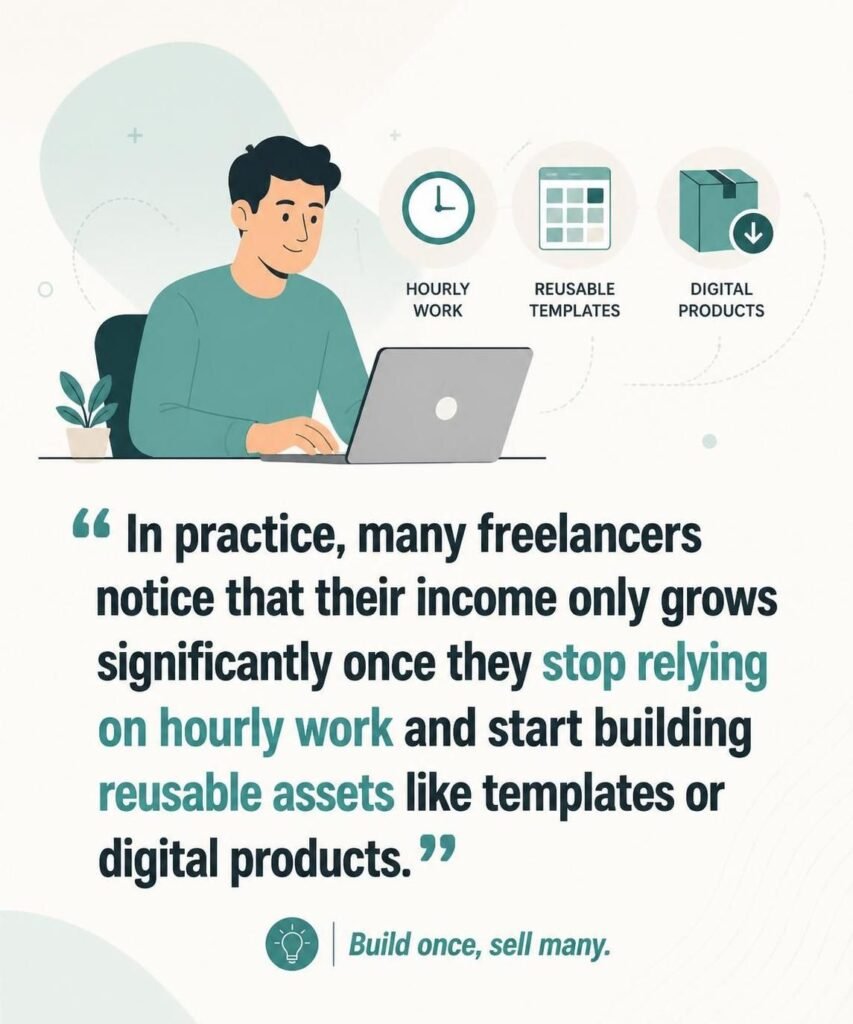
Consider two freelance designers.
The first completes client projects every day and receives payment for each assignment. When work stops, income stops as well.
The second also serves clients but gradually builds a library of design templates, educational resources, digital products, and online courses. Over time, these assets begin generating revenue independently of the hours worked.
Both professionals possess similar technical skills.
Only one systematically converts labor into scalable assets.
This distinction explains why some individuals experience continuous financial growth while others remain dependent on exchanging time for money.
A rich mindset encourages people to ask a different question after every project:
“Can this work become an asset that continues creating value in the future?”
Sometimes the answer is yes.
Sometimes it is no.
The habit of asking the question is what matters.
Strategy #3: Learn to Think in Decades, Not Months
Modern culture rewards speed.
News changes every hour.
Social media trends disappear within days.
Businesses compete to deliver instant results.
In such an environment, it becomes surprisingly easy to judge every decision according to its short-term outcome.
Yet many of history’s greatest fortunes were built precisely because their owners resisted this pressure.
Long-term thinking is not simply patience.
It is the discipline of making present decisions based on future consequences rather than immediate emotions.
Investors who understand compounding rarely panic during temporary market volatility because they evaluate performance across decades instead of weeks.
Entrepreneurs frequently spend years refining products before achieving significant profitability.
Researchers devote entire careers to solving problems whose importance may not become fully visible until much later.
The common thread connecting these examples is the ability to delay immediate gratification without losing commitment to the larger objective.
Developing this perspective requires changing the questions we ask ourselves.
Instead of asking:
“Will this decision benefit me this month?”
Ask:
“How will this decision influence my life five years from now?”
This single question often leads to remarkably different choices regarding health, education, investments, relationships, and career development.
Time magnifies the consequences of both good and bad decisions.
The earlier individuals recognize this principle, the greater the benefits they are likely to experience.
Strategy #4: Build Decision Leverage Instead of Working More Hours
One of the biggest misconceptions about wealth is the belief that financial success is directly proportional to the number of hours worked. This assumption was relatively accurate during the industrial economy, where income was closely tied to physical labor and time spent on the job. In today’s knowledge economy, however, the relationship between effort and income has changed dramatically.
The highest earners are not always those who work the longest hours. More often, they are the people whose decisions influence the greatest amount of value.
This concept can be described as decision leverage.
Every decision produces consequences, but not every consequence carries the same weight. Choosing what to eat for lunch has a limited impact on your future. Choosing a career, selecting business partners, investing in a new technology, or entering a growing industry can influence your financial trajectory for decades.
People with a rich mindset recognize this difference. Instead of trying to optimize every small decision, they devote disproportionate attention to decisions that create long-term leverage.
For example, spending weeks researching a business opportunity may appear inefficient to someone focused only on immediate productivity. Yet a single well-informed decision can generate returns that outweigh years of routine work.
This explains why experienced entrepreneurs often spend more time thinking than acting. They understand that improving the quality of a few critical decisions frequently produces better results than increasing the quantity of ordinary work.
Rather than asking, “How can I become busier?”, they ask a more valuable question:
“Which decision, if made correctly today, could create opportunities for years to come?”
This approach encourages strategic thinking instead of reactive behavior. It shifts attention away from constant activity and toward meaningful progress.
Strategy #5: Learn to Benefit From Change Instead of Resisting It
Most people instinctively seek stability.
Stable income.
Stable routines.
Stable markets.
Stable careers.
From a psychological perspective, this preference is understandable. Human beings evolved to reduce uncertainty because uncertainty often represented danger. Yet in modern economies, change is not an exception—it is the normal condition.
Industries rise and fall.
Technologies become obsolete.
Consumer preferences evolve.
Economic cycles reshape entire sectors.
The individuals who consistently build wealth are rarely those who predict every change correctly. Instead, they are the ones who develop systems that allow them to adapt quickly.
This idea is closely related to what researchers and strategists describe as adaptability. Rather than attempting to preserve the status quo, adaptable people continuously update their assumptions as new information becomes available.
Consider the rapid adoption of artificial intelligence.
Some professionals viewed AI solely as a threat to existing jobs.
Others treated it as a productivity tool.
A third group recognized something more important: every major technological shift creates new markets, new customer needs, and entirely new business models.
These individuals were among the first to build AI consulting agencies, automation services, educational platforms, and specialized software solutions.
The technology itself did not make them wealthy.
Their willingness to adapt faster than the average person created the opportunity.
A rich mindset therefore avoids becoming emotionally attached to old methods. It values flexibility over certainty and continuous learning over fixed expertise.
In a rapidly changing world, the ability to evolve may be one of the most valuable financial skills anyone can develop.
Strategy #6: Build Networks That Exchange Value, Not Just Contacts
Networking is often misunderstood.
Many people associate it with collecting business cards, attending conferences, or adding hundreds of strangers on professional platforms. While these activities may increase the size of a contact list, they rarely create meaningful opportunities.
A rich mindset approaches relationships differently.
Instead of asking, “Who can help me?”, successful individuals tend to ask, “How can I become useful to the people I know?”
This distinction changes the nature of professional relationships.
Relationships built on immediate personal gain tend to disappear once the transaction ends. Relationships built on trust, expertise, and mutual value often continue generating opportunities for years.
Research in organizational psychology consistently shows that access to high-quality networks influences career advancement, innovation, and entrepreneurial success. The reason is straightforward: opportunities rarely circulate evenly across society. They move through trusted relationships.
A recommendation from a respected colleague can open doors that hundreds of online applications cannot.
A conversation with an experienced entrepreneur may prevent costly mistakes.
A long-term collaboration can lead to new products, partnerships, or investments that would have been impossible individually.
People with a rich mindset therefore invest in relationships before they need them.
They share knowledge freely.
They introduce useful connections.
They contribute without expecting immediate returns.
Ironically, this generosity often becomes one of the most valuable long-term investments they make.
Strategy #7: Develop an Opportunity Filter
Every day presents countless possibilities.
A new investment.
A trending business idea.
An emerging technology.
Another side hustle.
At first glance, abundance appears beneficial. In reality, excessive choice can become a serious obstacle.
One of the defining characteristics of successful decision-makers is not their ability to recognize every opportunity but their ability to reject most of them.
This requires what can be described as an opportunity filter.
Rather than reacting emotionally to every promising idea, individuals with a rich mindset evaluate opportunities through a consistent framework.
Questions such as:
Does this align with my long-term goals?
Do I possess a genuine competitive advantage?
Is this solving a meaningful problem?
Can it scale over time?
What risks am I not seeing?
These questions reduce impulsive decisions and encourage strategic thinking.
The purpose of an opportunity filter is not to eliminate uncertainty. That is impossible.
Its purpose is to prevent attention from being scattered across dozens of unrelated pursuits.
Focus compounds just as investments do.
When energy is concentrated on high-quality opportunities, progress accelerates.
When attention is divided among countless distractions, even talented individuals struggle to produce exceptional results.
A rich mindset values disciplined focus more than endless activity.
Strategy #8: Use Artificial Intelligence as a Multiplier, Not a Replacement
Artificial intelligence has become one of the defining economic forces of this decade.
Yet discussions about AI often become trapped between two extremes.
Some believe it will replace nearly every profession.
Others dismiss it as another temporary technological trend.
Both perspectives overlook a more practical reality.
For most professionals, AI functions best as a force multiplier.
It enhances productivity.
It accelerates research.
It automates repetitive processes.
It expands creative possibilities.
However, it does not eliminate the need for human judgment.
The professionals creating the greatest value in 2026 are not competing against artificial intelligence. They are learning how to combine technological efficiency with human expertise.
For writers, AI accelerates drafting while humans refine ideas and maintain originality.
For marketers, AI analyzes customer behavior while strategic decisions remain human.
For software developers, AI generates code, but architecture, security, and system design continue to require experienced oversight.
This pattern appears across nearly every knowledge-based industry.
People with a rich mindset do not ask whether AI will replace them.
Instead, they ask:
“Which parts of my work become significantly more valuable when combined with AI?”
That question shifts attention from fear toward leverage.
History demonstrates that individuals who adopt transformative technologies early often gain advantages that compound over many years.
Artificial intelligence is unlikely to be an exception.
Strategy #9: Think in Second-Order Consequences
Most financial mistakes do not result from poor intentions.
They result from incomplete thinking.
People naturally focus on the first consequence of a decision because it is the easiest to imagine.
For example:
Accepting a higher-paying job appears beneficial because income increases.
But what happens next?
Will longer working hours reduce health?
Will relocation weaken valuable professional relationships?
Will constant stress limit future opportunities?
These are second-order consequences.
Similarly, declining a promotion to pursue advanced education may reduce short-term income.
Yet the additional expertise may dramatically increase earning potential over the following decade.
Individuals with a rich mindset routinely evaluate decisions beyond their immediate outcomes.
They ask not only:
“What happens if I do this?”
but also:
“What happens after that?”
This habit encourages patience, reduces emotional reactions, and improves strategic judgment.
Second-order thinking does not eliminate mistakes.
No decision-making framework can.
What it does accomplish is reducing the likelihood of making choices that appear attractive today but create significant problems tomorrow.
Over time, avoiding major mistakes often contributes more to wealth creation than making spectacular investments.
This principle is reflected repeatedly in the histories of successful investors, entrepreneurs, and business leaders.
Their achievements were not built solely on extraordinary opportunities.
They were equally shaped by the costly mistakes they consistently avoided.
Transition to the Next Section
By this point, one pattern has become increasingly clear.
A rich mindset is not a collection of motivational habits or optimistic beliefs. It is a practical framework for making better decisions under uncertainty, allocating resources wisely, and creating value that compounds over time.
Yet even individuals who understand these principles frequently struggle to apply them consistently. Deeply rooted cognitive biases, emotional reactions, and common financial misconceptions often undermine long-term progress without people realizing it.
For that reason, the next section examines the most common mistakes that quietly prevent capable individuals from building wealth—despite working hard, earning good incomes, and genuinely wanting financial freedom.
The Most Common Mistakes That Prevent People From Building Wealth
If building wealth were simply a matter of working hard, millions of hardworking people around the world would become financially independent. Reality tells a different story.
Income alone does not explain long-term financial success. Two individuals can earn similar salaries for years and still end up in completely different financial positions. One gradually accumulates assets, financial flexibility, and investment opportunities, while the other remains trapped in a cycle of increasing expenses and constant financial pressure.
The difference often lies not in intelligence or opportunity, but in the habits and assumptions that quietly shape everyday decisions.
One of the most damaging mistakes is confusing a higher income with greater wealth.
A salary increase certainly improves earning potential, but it does not automatically improve financial security. As income grows, many people unconsciously increase their standard of living at the same pace. Larger homes, newer vehicles, premium services, and more expensive lifestyles absorb additional earnings before they can be converted into assets.
Economists describe this pattern as lifestyle inflation.
It is subtle because it often feels like progress. Each purchase appears reasonable when viewed in isolation. Over time, however, higher expenses reduce flexibility, leaving individuals dependent on maintaining the same level of income simply to sustain their lifestyle.
People with a rich mindset approach increased earnings differently.
Rather than allowing every raise to finance higher consumption, they allocate a meaningful portion toward investments, business opportunities, education, or other assets capable of generating future returns.
The goal is not to avoid enjoying money.
The goal is to prevent temporary income from disappearing without creating lasting value.
Another common mistake is constantly searching for shortcuts.
The internet is filled with promises of rapid financial success, from overnight trading systems to unrealistic passive income claims. These ideas are attractive because they appeal to a natural human desire for immediate results.
Unfortunately, lasting wealth rarely develops through shortcuts.
It is more commonly the product of consistent execution, intelligent risk management, and years of disciplined decision-making.
Individuals who continually jump from one trend to another often spend more time chasing opportunities than building expertise.
Depth almost always outperforms constant novelty.
A third mistake involves underestimating the importance of reputation.
Financial opportunities frequently arise through trust rather than advertising.
Clients recommend professionals they respect.
Investors support founders they believe can execute.
Companies promote employees whose judgment has been proven over time.
Reputation functions as an invisible asset. Although it does not appear on a balance sheet, it influences access to opportunities that money alone cannot purchase.
Building credibility requires patience, integrity, and consistent performance, but once established, it becomes one of the strongest forms of long-term leverage.
Case Study: How Long-Term Thinking Created Extraordinary Results
To understand how these principles work in practice, consider the transformation of Nvidia during the past decade.
For many years, the company was primarily recognized for designing graphics processing units for video games. While this market was profitable, it represented only a fraction of the technology’s long-term potential.
Instead of focusing exclusively on short-term revenue, Nvidia invested heavily in research, software ecosystems, and specialized hardware capable of supporting artificial intelligence, scientific computing, and large-scale data processing.
These investments required significant capital long before demand reached its current level.
At the time, many observers questioned whether such spending would generate meaningful returns.
The company’s leadership viewed the situation differently.
Rather than asking what customers needed immediately, they asked what industries would require five or ten years into the future.
When artificial intelligence experienced explosive global adoption, Nvidia was uniquely positioned to meet that demand.
Its years of research, infrastructure development, and strategic patience became a competitive advantage that competitors could not replicate overnight.
The lesson extends far beyond one company.
Long-term thinking often appears inefficient while it is happening because its benefits remain largely invisible.
Only after years of consistent investment do the results become obvious to everyone else.
The same principle applies to individuals.
Someone who spends several years developing expertise, building professional relationships, creating intellectual property, or investing consistently may appear to be progressing slowly.
Then, seemingly all at once, opportunities begin arriving faster than before.
From the outside, this appears to be sudden success.
In reality, it is usually the visible outcome of years of invisible preparation.
This pattern repeats across entrepreneurship, investing, science, athletics, and nearly every field where exceptional performance depends on accumulated knowledge rather than immediate results.
A Practical 30-Day Rich Mindset Challenge
Understanding financial principles has little value unless they influence daily behavior. Small, repeated actions are what transform ideas into lasting habits.
The following thirty-day challenge is designed to help readers apply the concepts discussed throughout this guide without requiring major financial resources or dramatic lifestyle changes.
Week One: Build Awareness
During the first week, focus entirely on observation.
Track every expense without attempting to judge or justify it. Record where your money goes, how you spend your time, and which daily activities contribute to your long-term goals.
At the same time, spend at least twenty minutes each day reading about finance, business, psychology, or technology. The objective is not to master a subject within a week but to begin replacing passive information consumption with intentional learning.
By the end of the week, identify one recurring habit that consistently consumes either time or money without creating meaningful value.
Week Two: Increase Your Personal Value
Choose one professional skill that is becoming increasingly valuable in your industry.
Dedicate focused time each day to improving that skill through practical application rather than passive consumption.
Build a small project.
Solve a real problem.
Publish something publicly.
Request feedback from experienced professionals.
The goal is not perfection.
The goal is measurable progress.
Skills become valuable when they are demonstrated, not merely studied.
Week Three: Think Like an Investor
This week, evaluate your daily decisions through the perspective of long-term return.
Before making discretionary purchases, ask yourself whether the same amount of money could create greater future value if invested in education, productivity, or income-generating assets.
Similarly, review your calendar.
Identify activities that consume significant time without improving your health, relationships, knowledge, or earning capacity.
Replacing even a small portion of low-value activities with high-value learning often produces meaningful long-term benefits.
Week Four: Design Your Wealth System
The final week focuses on creating systems that continue operating after the challenge ends.
Automate savings or investments where possible.
Schedule regular learning sessions.
Establish quarterly financial reviews.
Define clear long-term objectives rather than vague aspirations.
Most importantly, write down the principles that will guide future decisions.
Systems reduce dependence on motivation.
When positive behaviors become part of a routine, consistency becomes far easier than relying on temporary inspiration.
At the end of thirty days, financial circumstances may not have changed dramatically.
Your decision-making process, however, should begin to reflect the habits associated with long-term wealth creation.
And over time, improved decisions tend to produce improved outcomes
What the Data Reveals About Wealth Creation in the AI Economy
One of the biggest mistakes people make when discussing wealth is assuming that economic success is driven mainly by luck or exceptional talent. While both can influence outcomes, decades of research in economics, psychology, and business suggest that long-term wealth is more strongly associated with adaptability, continuous learning, and the ability to create value in changing markets.
The rapid adoption of artificial intelligence offers a clear example.
Businesses across finance, healthcare, education, manufacturing, logistics, and marketing are integrating AI into daily operations—not simply to reduce costs, but to improve productivity and make better decisions. This shift is creating demand for professionals who understand how to combine technical tools with human judgment.
According to recent reports from the World Economic Forum, technological transformation is expected to reshape millions of jobs over the next several years. While certain repetitive tasks are becoming automated, demand continues to grow for skills such as analytical thinking, creative problem-solving, leadership, resilience, and AI literacy.
This trend highlights an important reality.
Technology rarely rewards people simply for using new tools.
It rewards those who understand how to use those tools to solve meaningful problems.
That distinction explains why two individuals with access to the same AI software often achieve completely different results. The technology is identical; the quality of their thinking is not.
A rich mindset recognizes that every technological revolution creates two groups of people.
The first group asks how to protect existing routines.
The second asks how to create new value.
History consistently shows which group benefits the most.
Rich Mindset vs. Scarcity Mindset: A Practical Comparison
Understanding the difference between these two ways of thinking becomes easier when viewed through everyday decisions rather than abstract definitions.
Situation Scarcity Mindset Rich Mindset
Learning “I can’t afford this course.” “Will this skill increase my earning potential?”
Career Looks for job security above all else. Builds adaptable skills that remain valuable across industries.
Technology Fears automation. Learns how to use technology as leverage.
Spending Prioritizes immediate satisfaction. Prioritizes long-term return on investment.
Networking Asks, “Who can help me?” Asks, “How can I create value for others?”
Failure Treats mistakes as evidence to stop. Uses feedback to improve future decisions.
Time Focuses on today’s income. Focuses on building assets that generate future income.
These differences may appear small in isolation, but they compound over years. Financial success is rarely the result of one extraordinary decision; it is usually the accumulation of hundreds of better decisions made consistently.
Lessons From Some of the World’s Most Successful Wealth Builders
Although industries differ, many of the world’s most successful entrepreneurs and investors share remarkably similar decision-making principles.
Warren Buffett: Protect Your Ability to Compound
One of the defining characteristics of Warren Buffett’s investment philosophy is patience. Rather than pursuing constant activity, he emphasizes making a small number of high-quality decisions and allowing them to compound over long periods.
The lesson extends beyond investing.
Many people interrupt compounding by constantly changing direction, abandoning projects too early, or pursuing every new trend. A rich mindset understands that consistency often produces greater results than constant change.
Jeff Bezos: Focus on What Will Not Change
When asked about Amazon’s long-term strategy, Jeff Bezos explained that he prefers concentrating on things customers will always value, such as lower prices, wider selection, and faster delivery.
This way of thinking is powerful because it shifts attention away from temporary trends toward enduring principles.
Individuals can apply the same idea to their own careers by investing in abilities that remain valuable regardless of technological change, including communication, critical thinking, leadership, and problem-solving.
Morgan Housel: Wealth Is What You Don’t See
Financial writer Morgan Housel makes an important distinction between being rich and being wealthy.
Being rich often reflects high current income.
Being wealthy reflects assets that have not yet been spent.
This perspective challenges one of modern society’s biggest misconceptions.
Visible consumption is not reliable evidence of financial strength.
In many cases, genuine wealth is invisible because it exists in investments, businesses, savings, and productive assets rather than luxury purchases.
Building a Personal Wealth System
Many people rely on motivation to improve their finances.
The problem with motivation is that it fluctuates.
Some days you feel inspired
Other days you do not
Successful wealth builders therefore rely on systems instead of emotions
A practical personal wealth system might include the following components:
Automatically invest a fixed percentage of every paycheck before spending anything else.
Reserve dedicated time each week for learning new professional skills
Review financial goals at the end of every month.
Read at least one high-quality book on business, psychology, investing, or leadership every quarter.
Build one new income-producing asset each year, whether it is a digital product, a portfolio investment, a website, intellectual property, or a small business
Each individual habit appears modest
Together, they create a framework that gradually increases financial resilience while reducing dependence on willpower
This is one of the defining characteristics of a rich mindset
Rather than hoping for better results, it builds systems that make better results more likely over time
My personal experience
I once had a personal experience where I got involved in a project after hearing about its huge potential profits. Without enough thinking or proper knowledge, I decided to join. I made a small profit in the first month, so I told myself to try again. In the second month, I lost money, but I still convinced myself to continue. The same thing happened in the third month, with even more losses
After significant financial losses, I realized that the idea of “huge profits” I had initially heard was actually what led me into those losses. I understood that a person should not be driven by greed or excitement without understanding the reality of what they are entering
In the end, I left that field and started looking for a better alternative. This experience made me truly understand the importance of having proper knowledge and awareness before entering any field or making any financial decision
Frequently Asked Questions
How can I develop a rich mindset if I have very little money?
A rich mindset is not determined by the size of your bank account. It begins with how you allocate the resources already available to you, including time, attention, and knowledge. Developing valuable skills, improving financial discipline, reading consistently, and making thoughtful long-term decisions are habits that can be practiced regardless of income level. While limited financial resources create real challenges, adopting better decision-making habits can gradually expand future opportunities.
Is a rich mindset enough to become financially successful?
No.
A productive mindset provides direction, but financial success also depends on developing valuable skills, creating economic value, managing risk effectively, and executing consistently over time. Motivation without competence rarely produces sustainable results.
What is the difference between a rich mindset and a scarcity mindset?
A scarcity mindset primarily focuses on protecting existing resources and avoiding loss, often leading to short-term decision-making. A rich mindset, by contrast, emphasizes creating value, investing in future opportunities, and viewing change as a potential source of growth rather than only a source of risk.
Which skills are most valuable for building wealth in 2026?
While technical skills vary across industries, several capabilities remain valuable in almost every profession. These include critical thinking, communication, problem-solving, data literacy, adaptability, financial literacy, leadership, and the ability to work effectively alongside artificial intelligence. Individuals who combine technical expertise with strong interpersonal skills are likely to remain highly competitive as technology continues to evolve.
Can artificial intelligence help build wealth?
Artificial intelligence can significantly improve productivity, automate repetitive tasks, accelerate research, and support better decision-making. However, AI is most valuable when used as a tool to amplify human expertise rather than replace it. Professionals who learn to integrate AI into their workflows often gain meaningful competitive advantages.
Why do many high-income earners still struggle financially?
High income and wealth are not the same.
Many individuals increase their spending as earnings rise, leaving little room for investing or building assets. Sustainable wealth depends not only on how much money is earned but also on how effectively that money is managed, invested, and preserved over time.
How long does it take to build a rich mindset?
Developing a rich mindset is an ongoing process rather than a one-time achievement. Many of its core habits—continuous learning, disciplined decision-making, long-term thinking, and effective risk management—become stronger through repeated practice over years rather than weeks.
What is the biggest mistake people make when trying to build wealth?
One of the most common mistakes is pursuing short-term income while neglecting long-term value creation. Constantly chasing trends, relying on quick financial wins, or spending every increase in income often prevents individuals from building assets that generate lasting financial security
Final Thoughts
The idea of a rich mindset is often reduced to motivational slogans or simplified success formulas. Yet genuine wealth creation is far more practical than inspirational.
It is reflected in the decisions people make when no one is watching.
It is visible in the willingness to invest in learning before rewards are guaranteed, to remain patient when progress appears slow, and to continue creating value even when immediate recognition is absent.
Financial independence rarely arrives through a single breakthrough moment. More often, it emerges from years of disciplined thinking, intelligent adaptation, and consistent execution.
The future will continue bringing uncertainty. Markets will fluctuate, technologies will evolve, and entirely new industries will emerge. Those changes are inevitable.
What remains within your control is the quality of your decisions.
A rich mindset does not promise that every investment will succeed or that every business idea will become profitable. What it offers is something more valuable: a framework for navigating uncertainty with greater clarity, resilience, and purpose.
In the end, wealth is not simply about accumulating money.
It is about building the knowledge, habits, relationships, and judgment that allow you to create lasting value throughout your life
Key Takeaways
Building wealth has never been about finding a single breakthrough idea or following a secret formula. Throughout history, economic conditions have changed, technologies have evolved, and industries have risen and fallen, yet the underlying principles of long-term wealth creation have remained remarkably consistent.
People with a rich mindset do not possess perfect information or extraordinary intelligence. Instead, they develop a disciplined approach to making decisions. They understand that financial success is rarely determined by one exceptional opportunity, but by the cumulative effect of thousands of thoughtful choices made over many years.
Those choices include investing in knowledge before it becomes urgently needed, creating assets instead of relying entirely on earned income, adapting to technological change instead of resisting it, and evaluating opportunities through the lens of long-term value rather than immediate gratification
Perhaps the most important lesson is that wealth is not merely a financial outcome. It is a reflection of how effectively an individual creates value for others while managing time, attention, capital, and risk.
In a world increasingly shaped by artificial intelligence, automation, and global competition, this principle becomes even more relevant. Technology will continue changing the tools people use, but it will not replace the importance of sound judgment, continuous learning, strategic thinking, and ethical decision-making.
Developing a rich mindset, therefore, is not about becoming obsessed with money.
It is about becoming the kind of person who consistently makes decisions that improve future possibilities.
When that happens, financial progress often becomes the natural consequence rather than the primary objective
References
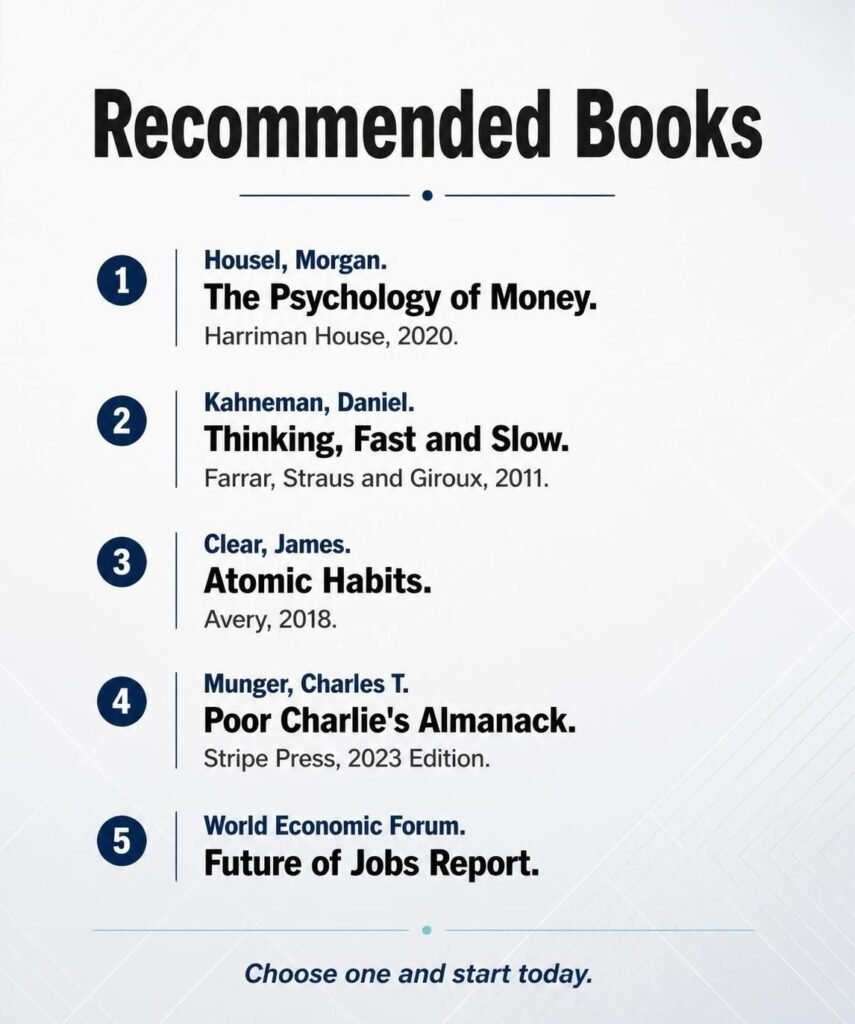
Housel, Morgan. The Psychology of Money. Harriman House, 2020.
Kahneman, Daniel. Thinking, Fast and Slow. Farrar, Straus and Giroux, 2011.
Clear, James. Atomic Habits. Avery, 2018.
Munger, Charles T. Poor Charlie’s Almanack. Stripe Press, 2023 Edition.
World Economic Forum. Future of Jobs Report
About the Author
Maryam is a financial and personal development writer with over 15 years of experience in wealth psychology, business strategy, and digital entrepreneurship. She focuses on helping readers build long-term financial thinking through practical, research-based insights.