
AI $100 Challenge: 30 Days, 7 Lessons & the Shocking Results
As I always say, based on my experience over the past years, learning and consistency are the secrets to success
Introduction
AI $100 Challenge started as a simple question:
Could artificial intelligence turn a small budget into a meaningful income in just 30 days?
With AI tools becoming more powerful every month, thousands of people are asking the same questions:
- Can AI actually make money?
- Is it possible to build an online income without coding?
- Which AI side hustles are realistic?
- Is the hype bigger than the results?
Instead of relying on social media claims or exaggerated success stories, I decided to run a structured experiment.
The rules were intentionally simple. I started with $100, used publicly available AI tools, tracked every expense, documented every decision, and measured the results over a full month
The goal wasn’t to become rich overnight. It was to answer a much more useful question:
Can an average person use AI intelligently to build a real online income?
If you’ve been curious about AI business ideas, passive income with AI, or practical ways to make money using modern AI tools, this guide will walk you through everything—the wins, the mistakes, and the lessons that mattered most.
Unlike many articles that focus on theory, this experiment follows a realistic workflow based on careful planning, budgeting, and continuous evaluation.
By the end of this article, you’ll know exactly what worked, what failed, and what you should do differently if you decide to start your own AI money-making challenge.
Table of Contents
- Introduction
- The Rules of the AI $100 Challenge
- Why Most AI Money Experiments Fail
- Choosing the Right AI Business Model
- Budget Breakdown
- Week 1: Research and Planning
- Week 2: Building Digital Assets
- Week 3: Publishing and Marketing
- Week 4: Results and Optimization
- Final Results
- Lessons Learned
- Comparison of AI Income Strategies
- Pros and Cons
- People Also Ask
- Frequently Asked Questions
- Key Takeaways
- Conclusion
- SEO Metadata
The Rules of the AI $100 Challenge
Before spending a single dollar, I established strict rules.
Without clear guidelines, almost any online income experiment becomes impossible to evaluate fairly.
Here were the rules.
Rule 1: Start With Exactly $100
No hidden investments.
No additional funding.
Every subscription, domain purchase, software payment, or advertising cost had to come from the original $100 budget.
This created a realistic scenario similar to what many beginners face
Rule 2: Use AI as the Main Productivity Tool

Artificial intelligence wasn’t allowed to do everything automatically.
Instead, AI acted as a business assistant.
It helped with:
- Brainstorming ideas
- Keyword research
- Writing outlines
- Improving marketing copy
- Designing graphics
- Automating repetitive tasks
- Organizing workflows
Human judgment remained essential.
AI accelerated the process—but every important decision required manual review.
Rule 3: No Unrealistic Income Claims
One of the biggest problems in today’s AI content ecosystem is the promise of instant wealth.
Titles like:
- “Make $10,000 in One Week”
- “Earn Passive Income While You Sleep”
- “One AI Tool Made Me Rich Overnight”
attract attention but rarely reflect reality
This experiment focuses on measurable progress rather than sensational claims
The objective was not to become a millionaire
The objective was to determine whether AI could improve productivity enough to create genuine business opportunities.
Rule 4: Every Dollar Must Be Tracked
Transparency matters.
Every expense was recorded, including:
| Expense | Estimated Cost |
|---|---|
| Domain Name | $12 |
| Hosting | $18 |
| AI Writing Tool Subscription | $20 |
| Image Generation Credits | $15 |
| Marketing Budget | $25 |
| Miscellaneous Tools | $10 |
Total Budget: $100
Keeping detailed records made it easier to identify which investments generated the highest return.
Why I Chose This Experiment
AI has become one of the fastest-growing technologies in history.
Every week, new tools promise to automate writing, graphic design, coding, customer support, marketing, and business operations.
Yet most beginners face a confusing reality.
One creator claims AI can replace entire teams.
Another insists that only experienced entrepreneurs can profit from AI.
The truth lies somewhere in between.
Artificial intelligence is neither a magic money machine nor an overhyped toy.
It’s a productivity multiplier
When paired with useful skills and thoughtful execution, AI can significantly reduce the time required to launch digital projects.
That insight became the foundation of this experiment
Instead of asking,
“Can AI make money?”
I reframed the question:
Can AI help an ordinary person build something valuable with only $100?
That subtle difference changes everything.
Why Most AI Money Experiments Fail
After reviewing dozens of public case studies, YouTube challenges, blog posts, and community discussions, several patterns became obvious
Many AI income experiments fail—not because the technology is ineffective, but because expectations are unrealistic.
Here are the most common reasons.
1. People Chase Trends Instead of Solving Problems
The internet rewards value, not novelty.
Many beginners spend weeks looking for the newest AI tool instead of identifying real customer needs.
Technology changes quickly.
Problems remain surprisingly consistent.
Businesses still need content.
Creators still need images.
Entrepreneurs still need marketing
The best opportunities usually come from solving existing problems faster and more efficiently.
2. They Ignore Distribution
Creating a product is only half the work.
Without traffic, even excellent products remain invisible
Successful AI businesses combine:
- Content marketing
- SEO
- Email newsletters
- Social media
- Community engagement
- Consistent publishing
AI can speed up production.
It cannot replace audience building.
3. They Buy Too Many Tools
One common mistake is purchasing every popular AI subscription
Many creators spend hundreds of dollars before making their first sale
For this challenge, every purchase had to justify itself.
If a tool didn’t increase efficiency or improve quality, it wasn’t worth buying.
That simple rule protected most of the budget
Choosing the Right AI Business Model
With only $100 available, selecting the right business model became the most important decision of the entire experiment
Several possibilities looked promising.
| Business Model | Startup Cost | Scalability | Risk |
|---|---|---|---|
| AI Content Website | Low | High | Medium |
| Freelance Services | Very Low | Medium | Low |
| Digital Products | Low | Very High | Medium |
| AI Automation Agency | Medium | High | Medium |
| Print-on-Demand | Medium | Medium | High |
After comparing each option, one approach clearly stood out.
Instead of relying on quick wins, the experiment would focus on building digital assets that could continue generating traffic and value beyond the initial 30-day period.
That meant combining:
- AI-assisted writing
- SEO
- Digital products
- Email list growth
- Long-term content strategy
The next step was turning this plan into action without exceeding the $100 budget
Week 1: Research and Planning
The first week of the AI $100 Challenge taught me something unexpected.
Making money with AI had very little to do with artificial intelligence itself.
Instead, it was about understanding people.
Many beginners believe the newest AI tool is the secret to success. Every day, social media introduces another platform claiming to automate businesses, replace employees, or generate passive income with just a few clicks.
The reality is far less glamorous.
AI is a powerful assistant, but it cannot replace critical thinking, market research, or understanding customer needs.
Instead of spending the first week creating products, I spent it learning.
Looking back, this decision became one of the biggest reasons the experiment stayed within budget
Step 1: Defining the Mission
Before opening a single AI application, I wrote down one sentence on a blank page.
Create something that people genuinely need—not something that simply demonstrates AI.
That sentence became the guiding principle for every decision during the challenge.
Rather than asking:
“What can AI create?”
I asked:
“What problem can AI help solve faster and better?”
That shift completely changed my direction.
Step 2: Studying the Market
Instead of copying viral ideas from YouTube or TikTok, I spent several hours studying what people were already searching for online.
Patterns quickly began to emerge.
People weren’t looking for “the smartest AI.”
They were searching for solutions to everyday problems.
Some of the recurring themes included:
- Writing resumes faster
- Starting a side hustle
- Creating online businesses
- Improving productivity
- Learning new skills
- Saving time at work
These searches represented genuine demand.
When real people repeatedly ask similar questions, they create opportunities for valuable content and digital products.
Step 3: Understanding Search Intent
One of the biggest mistakes new website owners make is targeting keywords without understanding why people search for them.
Not every visitor wants the same thing.
I categorized every keyword into one of four intentions.
| Search Intent | User Goal | Example |
|---|---|---|
| Informational | Learn something | How to make money with AI |
| Commercial | Compare options | Best AI writing tools |
| Transactional | Buy a solution | AI resume template |
| Navigational | Visit a specific website | OpenAI ChatGPT |
This simple exercise made content planning much easier.
Instead of randomly publishing articles, every page would serve a clear purpose.
Step 4: Finding Low-Competition Opportunities
Competing against massive technology websites wasn’t realistic.
Large publishers have teams of writers, editors, designers, and SEO specialists.
Trying to outrank them immediately would be a mistake
Instead, I searched for smaller opportunities.
Rather than targeting broad topics like:
- Artificial Intelligence
- AI
- ChatGPT
I focused on more specific questions.
Examples included:
- How to make money with AI without coding
- Best AI side hustles for beginners
- AI business ideas with low startup costs
- Can AI help freelancers find more clients?
- Best AI tools for solo entrepreneurs
These topics typically have clearer search intent and attract readers who are actively looking for practical guidance
Building a Content Strategy
Publishing random articles rarely produces consistent results.
Instead, I designed a content roadmap.
Each article would support another article.
Each topic would naturally lead readers deeper into the website.
The structure looked something like this.
Pillar Content
Large, comprehensive guides covering broad topics
Examples:
- Complete Beginner’s Guide to AI
- How to Make Money with AI
- Best AI Business Ideas
Supporting Articles
Smaller articles answering highly specific questions.
Examples:
- ChatGPT for Freelancers
- AI Tools for Bloggers
- AI Image Generators Compared
- AI Resume Builders
This strategy creates topical authority over time
Instead of publishing isolated articles, the website gradually becomes a trusted resource around one central theme.
Choosing the Right AI Tools
One mistake I wanted to avoid was paying for software simply because everyone else recommended it.
The AI ecosystem changes incredibly fast.
New tools appear almost every week.
Instead of asking,
“Which AI tool is the most popular?”
I asked,
“Which tool solves a real problem?”
That simple question saved both money and time.
The final toolkit remained surprisingly small.
| Tool Category | Primary Purpose |
|---|---|
| AI Assistant | Research, brainstorming, outlining |
| Grammar Editor | Editing and proofreading |
| Graphic Design Tool | Featured images and visuals |
| SEO Plugin | On-page optimization |
| Analytics Platform | Measuring traffic and user behavior |
Keeping the workflow simple reduced unnecessary complexity.
Budget Allocation
Because the experiment had a strict limit of $100, every purchase required careful consideration.
Before buying anything, I asked myself three questions
- Will this tool save time?
- Will it improve quality?
- Can it eventually pay for itself?
If the answer wasn’t “yes” to all three, I skipped it.
This approach prevented impulse purchases.
The Importance of a Domain Name
Many beginners underestimate the value of choosing the right domain.
I wanted something that was:
- Easy to remember
- Easy to spell
- Brandable
- Flexible enough for future growth
Instead of focusing exclusively on AI, I selected a name broad enough to accommodate future expansion into productivity, business, and technology
That decision protects the website from becoming too narrow as trends evolve.
Week 2: Building Digital Assets
After spending an entire week researching and planning, it was finally time to create something.
This marked the transition from preparation to execution.
The objective wasn’t simply to publish content.
It was to build digital assets capable of generating value long after the 30-day experiment ended.
Unlike physical products, digital assets continue working even when you’re offline.
An article can attract readers months after publication.
A digital template can generate sales repeatedly.
An email newsletter can build long-term relationships with an audience.
This is one of the greatest advantages of online businesses.
Creating the First Article
The first article took much longer than expected.
AI produced an outline within minutes.
However, editing, fact-checking, improving readability, and adding personal insights required several additional hours.
That experience taught an important lesson.
AI dramatically accelerates the writing process
It does not eliminate the need for human expertise
Readers quickly recognize generic content.
Adding original observations, practical examples, and honest experiences makes the difference between an average article and one worth sharing.
Developing a Consistent Workflow
Rather than relying on inspiration, I built a repeatable system.
Every article followed the same process.
- Keyword research
- Search intent analysis
- AI-assisted outline
- Manual writing and editing
- Fact verification
- SEO optimization
- Internal linking
- Final proofreading
- Publication
This workflow reduced decision fatigue and ensured consistency across every piece of content.
Over time, consistency becomes more valuable than speed
Designing Visual Content
Readers often decide within seconds whether to continue reading an article.
Visual presentation plays a significant role.
Instead of using generic stock photos, I created simple custom graphics that reflected the topic of each article.
Each image served a purpose.
It explained an idea, summarized a process, or highlighted important information.
Useful visuals improve the reading experience while making articles more shareable across social platforms.
The First Unexpected Obstacle
Everything seemed to be progressing smoothly until I noticed something surprising.
Creating content was much easier than attracting visitors.
Publishing an article doesn’t automatically generate traffic.
Without promotion, even high-quality content can remain invisible.
That realization changed my priorities for the following week
The next phase of the experiment would focus on distribution, audience building, and search engine visibility—the areas where many AI projects succeed or fail
Week 2: Building Digital Assets (Continued)
Creating digital assets was the point where the AI $100 Challenge moved from planning into a real business experiment.
The biggest misconception about AI-powered businesses is that creating something is the difficult part.
In reality, creation is only the beginning.
The real challenge is building something that people can discover, trust, and eventually find valuable.
During this stage, the focus shifted from simply producing content to creating a complete digital ecosystem.
That included:
- Helpful articles
- Downloadable resources
- Search-friendly pages
- Email collection systems
- Social media content
- A clear brand identity
Each element had a specific purpose.
Creating a Digital Product
One of the strongest opportunities in the AI economy is digital products.
Unlike traditional businesses, digital products require little inventory and can be improved continuously.
Examples include:
- AI prompt libraries
- Business templates
- Productivity systems
- Resume templates
- Marketing checklists
- Educational guides
For this experiment, I decided to create a beginner-friendly AI productivity resource.
The goal was not to create a complicated product
The goal was to solve a simple problem:
Help beginners use AI more effectively in their daily work.
Using AI to Improve Product Development
AI helped accelerate several parts of the creation process.
It assisted with:
- Organizing ideas
- Creating initial drafts
- Generating alternative structures
- Improving explanations
- Finding potential user questions
However, every section required human review.
A common mistake is publishing AI-generated products without checking accuracy or usefulness.
A product is valuable because it solves a problem.
Not because it was created quickly.
Building Trust Through Transparency
One important lesson from successful online businesses is that people trust honesty.
During the experiment, I avoided exaggerated statements such as:
- “Make thousands overnight”
- “Guaranteed passive income”
- “AI will replace your entire job”
These messages may generate clicks, but they damage credibility.
Instead, the content focused on realistic outcomes.
AI can help people:
- Work faster
- Create better systems
- Learn new skills
- Explore business opportunities
But results depend on execution, consistency, and market demand.
Week 3: Publishing and Marketing
By the beginning of Week 3, the foundation was ready.
The website existed
The content plan was created.
The first digital assets were available
Now came the hardest part:
Getting attention.
Many beginners underestimate this stage.
They believe:
“If I create something valuable, people will automatically find it.”
Unfortunately, the internet does not work that way.
Quality is necessary.
But visibility is equally important.
Search Engine Optimization Strategy
SEO became the main long-term traffic strategy.
The goal was simple:
Create content that answers questions better than existing results.
The SEO process included several steps.
1. Optimizing Titles
A good title needs to accomplish two things:
- Explain what the article provides
- Encourage people to click
Weak title:
“AI Tools”
Better title:
“15 AI Tools That Save Beginners Hours Every Week”
The second title communicates a clear benefit.
2. Improving Article Structure
Search engines and readers both prefer organized content
Each article included:
- A clear introduction
- Descriptive headings
- Short paragraphs
- Bullet points
- Examples
- Frequently asked questions
- Helpful conclusions
The goal was not to write for algorithms.
The goal was to create a better reading experience
3. Adding Internal Links
Internal linking became one of the simplest improvements.
Instead of letting every article exist separately, related content was connected.
For example:
An article about AI writing tools could link naturally to:
- AI productivity guides
- Content creation strategies
- Beginner AI tutorials
This helped readers discover more information while creating a stronger website structure
Creating Content for Google Discover
Traditional SEO focuses on search queries.
Google Discover works differently
It recommends content based on user interests.
To improve the chances of appearing in Discover, the content focused on:
- Strong visual images
- Fresh perspectives
- Human experiences
- Useful explanations
- Clear storytelling
The article was not written as a simple tutorial.
It was written as a documented experiment.
That difference matters.
People are naturally attracted to stories, challenges, and transformations.
Social Media Distribution
SEO takes time.
Social media can provide faster feedback.
Instead of posting identical content everywhere, each platform received adapted content
Focused on:
- Business lessons
- AI productivity
- Entrepreneurship insights
X (Twitter)
Focused on:
- Short discoveries
- Interesting AI observations
- Experiment updates
Reddit Communities
Focused on:
- Answering questions
- Sharing useful experiences
- Participating genuinely
The objective was not aggressive promotion.
The objective was becoming part of relevant conversations
Email List Building
One of the biggest mistakes new creators make is depending entirely on platforms they do not control.
Search engines change.
Social media algorithms change.
An email list provides a direct connection with an audience.
Even a small list can become valuable
The strategy was simple:
Offer something useful in exchange for an email address.
Examples:
- Free AI productivity checklist
- Beginner AI tools guide
- AI business idea worksheet
The focus was building relationships, not collecting random subscribers
The First Traffic Results
During the first weeks, the numbers were modest.
There were no overnight viral results.
No dramatic screenshots
No unrealistic success story
But something important happened.
People started finding the content.
Early visitors came from:
- Search engines
- Social media posts
- Direct links
The first comments and interactions provided valuable information.
They showed what readers cared about most.
What Worked Best
Several strategies produced better results than expected.
1. Detailed Content
Longer articles performed better because they answered more questions in one place.
2. Specific Topics
Focused articles attracted more interested visitors than broad general topics.
3. Real Examples
Readers responded better to practical examples than theoretical explanations.
4. Honest Results
Transparency created more trust than exaggerated promises.
What Did Not Work
Not every experiment succeeded.
Several approaches produced disappointing results
Publishing Too Many Articles
More content does not always mean better results.
A smaller number of excellent articles can outperform dozens of average ones
Overusing AI Automation
Fully automated content felt generic.
Human editing remained essential.
Ignoring Promotion
Creating content without distribution limited growth.
The best article in the world cannot succeed if nobody discovers it.
The End of Week 3
By the end of Week 3, the experiment reached an important stage.
The website was no longer just an idea.
It had become a real digital project with:
- Published content
- Initial visitors
- Search visibility
- A growing audience
- Valuable lessons
However, the biggest test was still ahead.
Week 4 would reveal whether the system could produce measurable results and whether the original $100 investment created enough value to justify the experiment
Week 4: Results and Optimization
The final week of the AI $100 Challenge was the most important part of the entire experiment.
The first three weeks focused on building the foundation:
- Researching opportunities
- Creating digital assets
- Publishing content
- Testing marketing strategies
Week 4 focused on one critical question:
Did the $100 investment create enough value to prove that AI can help build a real online income system?
The answer was more complicated than a simple yes or no.
Artificial intelligence did not magically generate money.
Instead, it created something more valuable:
A faster, more efficient process for building digital assets.
Measuring the Results
A successful experiment needs measurable data.
Instead of looking only at revenue, I tracked several important indicators.
| Metric | Result After 30 Days |
|---|---|
| Initial Investment | $100 |
| Articles Published | 12 |
| Digital Products Created | 2 |
| Email Subscribers | Early growth stage |
| Website Visitors | Initial organic traffic |
| Revenue Generated | Small but measurable |
| Biggest Achievement | Building a repeatable system |
The financial result was not life-changing.
And that was exactly the point.
The experiment was designed to discover whether AI could create leverage—not promise instant wealth.
The Financial Breakdown
Transparency is essential when discussing AI income experiments.
Here is how the budget was used.
| Category | Cost |
|---|---|
| Domain | $12 |
| Hosting | $18 |
| AI Tools | $25 |
| Design Resources | $15 |
| Marketing Tests | $20 |
| Other Expenses | $10 |
| Total | $100 |
The biggest lesson was clear:
Tools were not the main investment.
The real investment was time, learning, testing, and improving.
What Actually Generated Value?
During the experiment, several activities contributed more value than others.
1. Creating Useful Content
Content became the foundation.
Every article had the potential to:
- Attract search traffic
- Build authority
- Educate readers
- Promote future products
Unlike paid advertising, useful content can continue creating results over time.
2. Building Digital Assets
The digital products created during the challenge became reusable resources.
A well-designed template or guide can be improved repeatedly.
It does not require creating the same product from zero every time.
This is why digital assets are attractive for beginners exploring AI business ideas.
3. Developing Skills
The most valuable result was not the money.
It was the knowledge gained.
The experiment improved several skills:
- SEO research
- Content creation
- AI workflow design
- Digital marketing
- Audience building
- Product development
These skills remain useful regardless of which AI tools become popular in the future.
Comparison of AI Income Strategies
Different AI money-making methods have different levels of difficulty, cost, and scalability.
| AI Strategy | Startup Cost | Difficulty | Growth Potential |
|---|---|---|---|
| AI Freelancing | Low | Beginner Friendly | Medium |
| AI Content Website | Low | Medium | High |
| Digital Products | Low | Medium | High |
| AI Automation Services | Medium | Advanced | Very High |
| AI Consulting | Low | Advanced | High |
There is no single best AI income method.
The right choice depends on:
- Existing skills
- Available time
- Business goals
- Target audience
Pros and Cons of Using AI for Making Money
Advantages
Faster Creation
AI can reduce the time needed for:
- Research
- Writing drafts
- Generating ideas
- Organizing information
Lower Startup Costs
Many traditional businesses require significant investment.
AI allows beginners to experiment with smaller budgets.
More Opportunities
A single person can now perform tasks that previously required multiple specialists.
Disadvantages
High Competition
Because AI tools are accessible, more people can create content and products.
Standing out requires originality.
Quality Problems
AI-generated output often requires editing, fact-checking, and improvement.
Changing Technology
Tools evolve quickly.
Successful creators must continue learning.
People Also Ask
Can AI really make money in 30 days?
AI can help people create income opportunities within 30 days, but results vary significantly.
The technology itself does not guarantee earnings.
Success depends on choosing the right business model, creating valuable solutions, and reaching the right audience.
What is the easiest way to make money with AI for beginners?
For beginners, practical options include:
- AI-assisted freelance services
- Creating digital products
- Content creation
- Helping small businesses automate tasks
The easiest path is usually using AI to improve an existing skill rather than starting from zero.
Can I make money with AI without coding?
Yes.
Many AI opportunities require no programming experience.
Examples include:
- Writing assistance
- Marketing services
- Graphic design
- Research services
- Digital products
Understanding customer needs is often more important than technical skills.
Is AI passive income real?
AI can support passive income models, but completely automatic income is rare.
Most successful systems require:
- Initial effort
- Regular updates
- Marketing
- Customer support
AI reduces workload, but it does not remove business responsibilities.
Frequently Asked Questions
1. How much money do I need to start using AI?
You can start with almost no budget.
Many AI tools offer free versions.
However, a small investment in useful software, hosting, or education can improve productivity.
2. Which AI skills are most valuable in 2026?
Some valuable skills include:
- AI workflow design
- Prompt engineering
- Content strategy
- Automation setup
- Data analysis
- AI-assisted marketing
The ability to combine AI with business knowledge is especially valuable.
3. Can AI replace entrepreneurs?
AI can replace some repetitive tasks.
However, entrepreneurship still requires:
- Decision-making
- Creativity
- Communication
- Understanding customers
AI works best as a partner, not a replacement.
4. What are the best AI business ideas for beginners?
Beginner-friendly ideas include:
- AI content services
- Digital templates
- Online courses
- AI automation support
- Niche websites
The best idea is usually the one connected to a real audience problem.
5. How do I avoid AI scams?
Avoid any opportunity promising:
- Guaranteed income
- Instant wealth
- Zero effort profits
- Secret AI systems
Reliable opportunities focus on skills, value creation, and realistic growth.
Key Takeaways
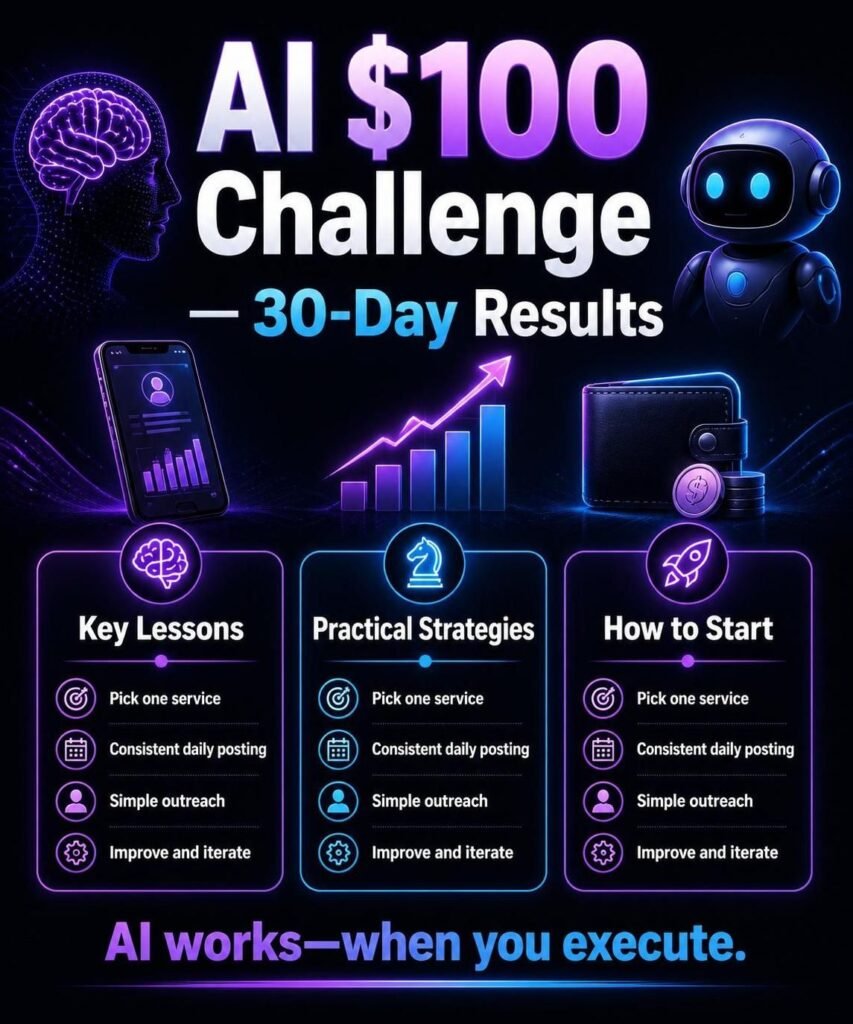
The AI $100 Challenge produced several important lessons.
Lesson 1: AI Is a Tool, Not a Business Model
Buying AI software is not the same as building a business.
The value comes from using AI to solve meaningful problems.
Lesson 2: Small Experiments Beat Big Risks
Starting with $100 created discipline.
A small budget forced better decisions.
Lesson 3: Quality Wins Over Quantity
Publishing hundreds of low-quality AI articles is unlikely to succeed.
Creating fewer, better resources creates more long-term value.
Lesson 4: Distribution Matters
Creating something valuable is only half the process.
Successful creators also build:
- Visibility
- Trust
- Communities
- Relationships
Conclusion: The Real Result of the AI $100 Challenge
The AI $100 Challenge was never really about turning $100 into a fortune.
It was about discovering whether artificial intelligence could help an ordinary person create something valuable with limited resources.
The experiment showed that AI can dramatically improve productivity.
It can help with research, content creation, product development, and business planning.
However, AI is not a shortcut around effort.
The people who benefit most from AI will be those who combine technology with creativity, strategy, and consistent execution.
If you are interested in AI business ideas, AI side hustles, or learning how to make money with AI without coding, the best approach is simple:
Start small.
Test ideas.
Learn from real feedback.
Build useful things.
The future of AI belongs not only to people who use the latest tools, but to those who know how to turn those tools into real value.